SEM images for Micro & Nano Scale experiments
Hello Everyone,
I have been trying to take SEM images in 3 different steps during my experiments with polystyrene beads over Track Etched membranes including before capturing, After capturing and releasing.
Micro Scale Experiments:
As you might remember, in Micro-scale experiments, we use 10 micron beads and 8 micron pores.
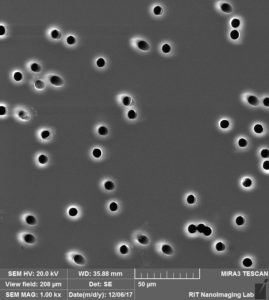
Before capturing:
This is only bare membrane SEM image.
After Capturing:
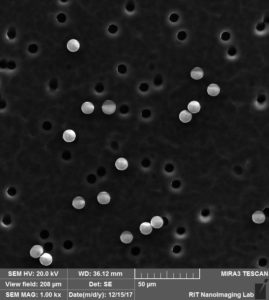
I’ve been having hard time fixing beads after capturing step. Micron pore size membranes have a thickness – pore size ratio of almost 1:1, they are highly permeable. Therefore, this device is so sensitive to any stress and shocking, for examples if we pause the pump, some captured beads get released. Because of these reasons, i am having problem fixing beads on the pores, and i usually lose like 50 % of the beads.
In one of my experiments, i was able to dry the membrane with captured beads using formaldehyde and BSA although i lost almost half of the beads even with this. As you can see in the SEM image, it is hard to tell if the beads are captured or non-specifically adsorbed since we can’t see the pores underneath of the beads. However, there is a color difference between beads, which might have happened due to charging effect and difference between beads that are stuck in the pores and those that are sitting on the surface of the membranes. So we are assuming that those that are captured look darker and those that are non-specifically adsorbed are brighter.
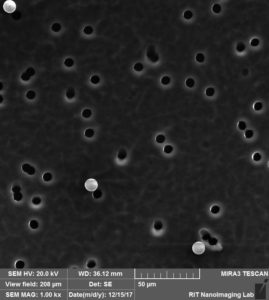
After Releasing:
In this step, the goal is to show that there are only couple of beads which are non-specifically absorbed and we are able to release almost all captured beads.
Nano Scale Experiments:
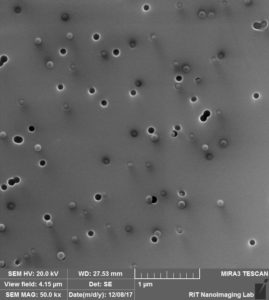
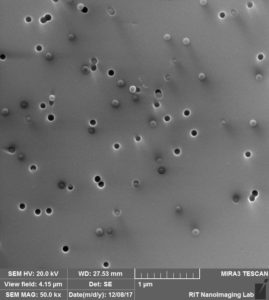
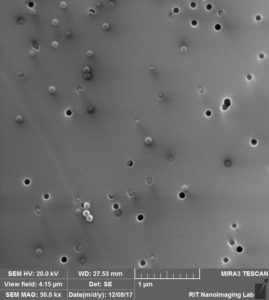
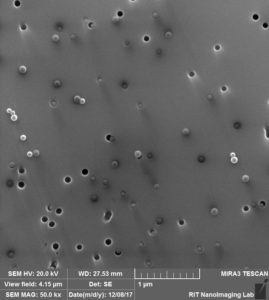
After Capturing:
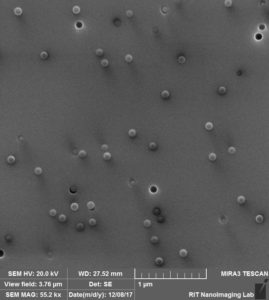
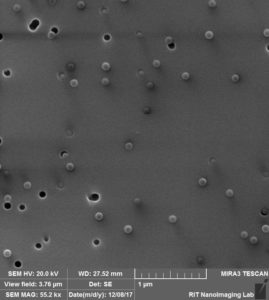
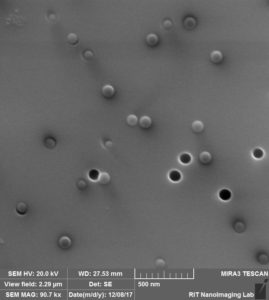
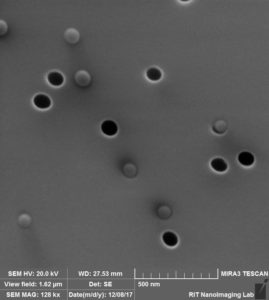
So i took images of one of my experiments, and as you can see from SEM images, we can see beads inside the pores(Like clogging), on the pores, and non-specifically adsorbed. Same observation was found about the beads color difference which is clearer and approves the assumption in Micro scale experiments.