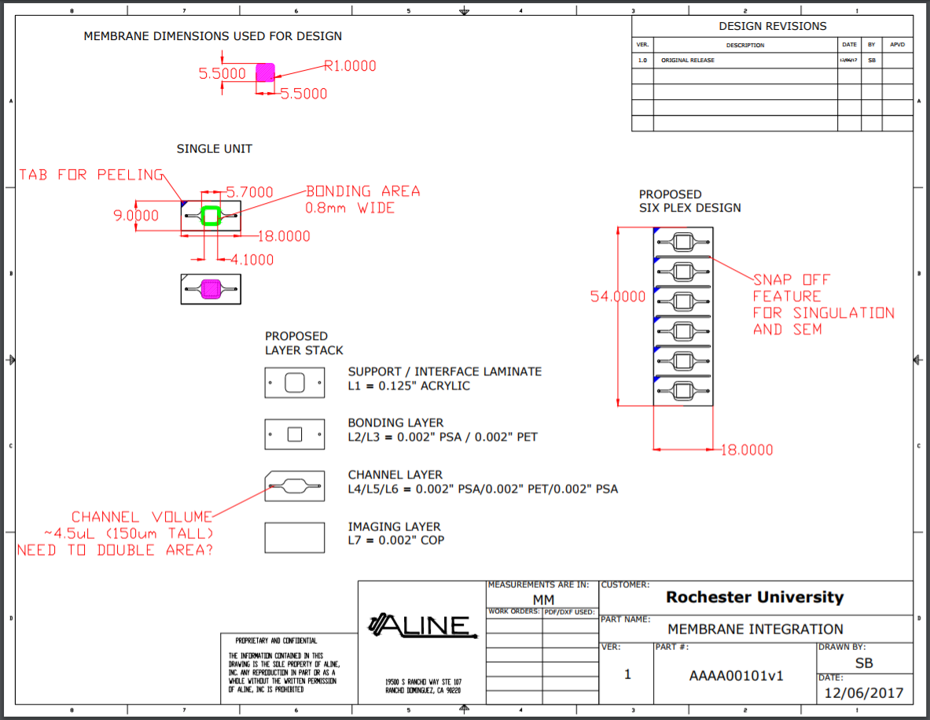
Over the past year, our lab has been working in close collaboration with the Schwarz lab to design, develop, and manufacture microfluidic transwells for their P50 project. The project was initiated after the discovery of S. aureus migration through sub-micron canaliculi in vivo. To further explore the genes involved in this newly proposed mechanism of immune system evasion, the Schwarz group collaborated with our lab to hand build transwell devices that would allow them to mimic the confined geometries of the canaliculi. After the initial experiments involving strictly wt staph, candidate mutants were developed and are now in the process of being tested. In order to facilitate faster biological experiments, we contracted out Aline Inc, a microfluidic company based out of southern California, to build these transwell devices in large batches.
Design Stages
Figure 1. First formal Aline design. Bonding area was suited for three slot 0.5 um SiO2 format chips. The six-plex design was implemented to facilitate multiplexed experiments in an easy to handle format.Figure 2. Membrane failure during production highlighted a potential problem with the high number multiplexed design: if one membrane fails, the whole ‘device’ is not suitable for delivery. It was also harder to handle the six-plex devices then expected at this stage. For these reasons the design was changed to fit a three-plex need.Figure 3. High fluid resistance through the bottom channel, coupled with tiny access ports, made it near impossible to load the bottom channel of these devices. The bottom channel and access ports were both increased in size to adjust for these issues.
Figure 4. The discovery of potential leaks in the system lead to the shrinking of the sealing layer. This final design was easier to load through the bottom channel and was leak tested to confirm nice bonding.Figure 5. Leak testing confirmed firm bonding of the sealing layer to the Si chip.
Membrane Design
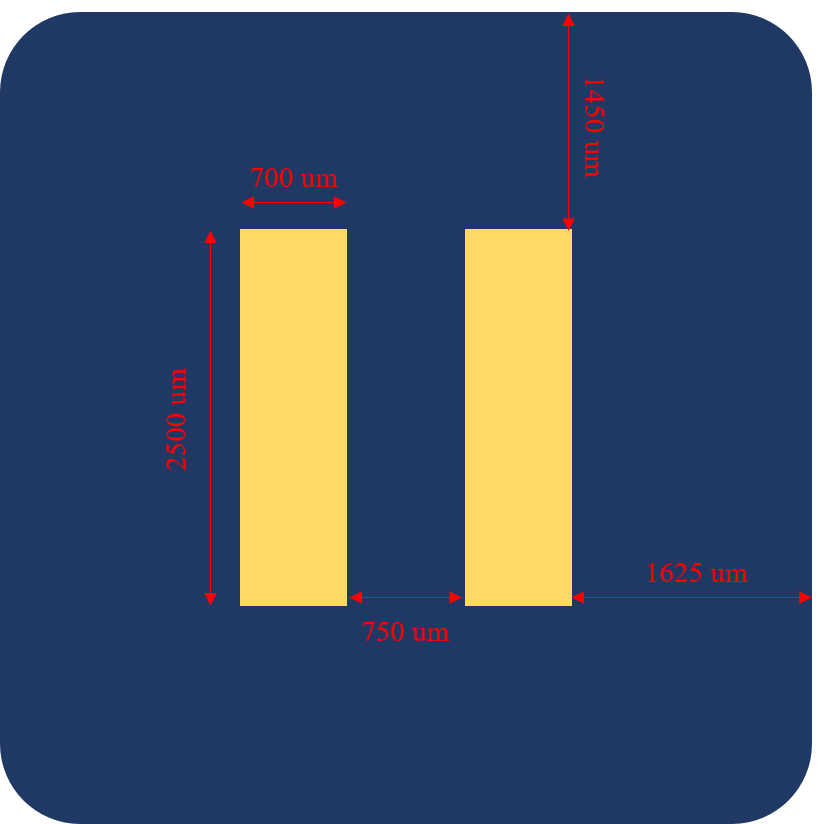
Due to concerns over the available three slot bonding area, two slot chips were designed. This design maintains high membrane area, while increasing bonding area.
Figure 6. 2-slot membrane format.Figure 7. Since completion of the design, we have been able to integrate a variety of membrane formats. The yields from these builds will help guide our future production runs.
Experiments were conducted to determine how effectively protein is bound by suspended graphene oxide (GO) particles. This is important for our application because we hope to use GO as a membrane to bind toxins present in blood. BSA (bovine serum albumin) was used as the test protein. Test samples consisted of a mixture of BSA…
Introduction This post will detail the work completed in the last chapter of my Thesis. The overarching goal of this chapter was to perform dialysis on whole blood utilizing a serial-separation system. This system would first: generate plasma from whole blood and second: remove uremic toxins from plasma employing microporous and nanoporous membranes, respectively. Conducting…
Just wanted to post an update on the creation of a counter flow system using the pncSi chips from wafer 619 (the wafer with the etched trenches for the insertion of capillary tubing). Over the past few weeks Henry and I have been able to produce a few functional counter flow systems using UV Ozone…
Last week, I deposited silicon nitride/ amorphous silicon/ silicon nitride stack and then annealed the free standing stack after etching the substrate. The nitride film was deposited with 25W bias and the silicon film with 5W bias. The thickness for the nitride film is 30nm where it is 25nm for silicon. One of the initial…
We’re submitting the following paper to Separations and Purifications within the next two weeks: model-paper model supplement Below are the (almost) final versions of the figures from the paper. Figure 1: Schematic of Particle Distribution for Particles Rejected by Membranes The distribution is a quasi-equilibrium between convection towards the membrane and back diffusion, which is…
In our previous post I relate how our first experience with the membranes encountered some difficulties. These were mostly of two kinds: clogging or braking of the membrane and somewhat arbitrary sizing of the particles. We think we have fixed both. In our latest experiments we have used manually-extruded particles. These are obtained after the…