Thickness and pore-size selectivity of neutrophil transmigration: Which membrane parameters matter and how would they affect transmigration?
Continuing the studies on neutrophil transmigration in devices with embedded parylene membranes of different pore sizes and thicknesses, three pore sizes (1.0 um, 1.4 um and 1.7 um) and two thicknesses (0.7 um and 1.2 um) were used for these sets of experiments. Thickness ratio of 1.2 um to 0.7 um roughly correlated with the pore size ratio of 1.7 um to 1.0 um. Instead of only observing and tracking neutrophils and in order to quantify their transmigration, the liquid from the bottom channel was collected and diluted ,and the number of neutrophils were counted using hemocytometer.
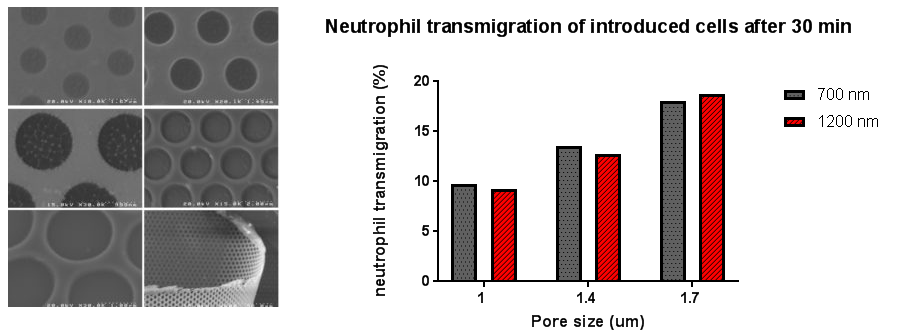
The results interestingly did not yield a significant difference in transmigration between different membrane thickness. However, only two thicknesses were tested and there is no proof that the same indifference/slight increase for thicker samples would be a linear/steady behavior. One other issue that may have contributed to this result is that since we only applied a very dilute collagen coating on the back of the membrane, fMLP most likely have found its way to the top chamber and it has created a gradient of fMLP instead of serving as a chemo-attractant in the bottom chamber and having a thinner membrane (0.7 um) may have resulted in lower fMLP concentration difference between the samples.
The difference between different pore sizes indicated a possibility for passage selectivity for different neutrophils based on their motility/invasion capability. This is a more pronounced result, when we consider the fact that 1 um pore size is at the lower end of pore sizes, which allow neutrophil transmigration, indicating that mostly “elite” neutrophils may have passed through lower pore sizes.
One other fact that may complicate the conclusion from this study is that due to the size of neutrophils (~10-12 um), they have multiple available pores to sense the fMLP, probably helping in hindering transmigration. In order to test this hypothesis, we have designed a mask with 8 um spacing and we will repeat the experiments.