Skip to content

Nanomembrane Research Group

  • Home
  • Publications
  • MembranesExpand
    • Common Chip Formats
    • Common Membranes
    • Microslit Membranes
  • DevicesExpand
    • µSiMExpand
      • Geometry
      • µSiM CAD Files
      • AssemblyExpand
        • Protocols.io (µSiM Assembly)
        • Instructions
        • Common Issues and Troubleshooting Tips
      • Cell Culture ProtocolsExpand
        • Top Well: hCMEC/D3
        • Top Well: HUVEC
        • Bottom Channel Culturing
        • Immunocytochemistry Protocol
        • Impact of Chip Orientation on Fluorescence Imaging
        • Permeability: In Situ Method
        • Permeability: Sampling Method
        • Cell Culture Common Issues and Troubleshooting Tips
    • SepCon®Expand
      • Sepcon Assembly
      • Sepcon Video Protocol: Assembly
      • SepCon Gasket Silhouette File
      • SepCon Video Protocol: Wetting the membrane
      • SepCon Video Protocol: Disassembly
    • µSiM-DXExpand
      • µSIM Video Protocol: Capture of Nanoparticles
  • ImpactExpand
    • TraCe-bMPS
    • HCIC
    • LOMP
    • SiMPore
Nanomembrane Research Group
  • NRG

    Bad to the Bone: Hydroxyapatite Coating Silicon Nanomembranes

    ByMichael Klaczko May 5, 2021

    In support of the bone infection studies done in the Schwarz lab at URMC, I have recently been tasked with coordinating a new collaboration with Dr. Yates lab in the Chemical Engineering department. The goal of this collaboration is to establish a method to coat our membranes with hydroxyapatite crystals. Two different methods were attempted,…
    Read More Bad to the Bone: Hydroxyapatite Coating Silicon NanomembranesContinue

  • NRG

    ALine for EV Capture

    BySam Walker May 4, 2021September 13, 2021

    ALine Capture Device In this post I will go over some of my recent work that is a continuation of Kilean’s research concerning extracellular vesicle (EV) capture and characterization. In the past, this was done using a tangential flow filtration (Figure 1) scheme and clamped devices featuring nanoporous membranes (Figure 2). These devices are straightforward…

    Read More ALine for EV CaptureContinue

  • memBrains

    New design of the flow platform with a functional lid (V2)

    ByMehran Mansouri April 28, 2021April 28, 2021

    Introduction In a previous post, an initial version of the flow module and its sealing components were described. In order to improve the initial version based on collaborators’ feedback, several modifications have been made to simplify the device assembly for the end-user (Fig. 1) and address concerns about: 1) Local regions of high shear stress…

    Read More New design of the flow platform with a functional lid (V2)Continue

  • hToC | memBrains | NRG | μSiM

    Flow Cell/µSiM Testing – Push versus Pull Flow Modes

    ByDan Ahmad April 27, 2021April 28, 2021

    Introduction Static endothelial cell cultures have been routinely performed and optimized on the µSiM platform for multiple membrane and cell types. In order to increase the physiological relevance of our device with tissue vasculature mimetics, we need to incorporate fluid flow to emulate shear stresses experienced by endothelium under physiological circulatory conditions. Recently Mehran has…

    Read More Flow Cell/µSiM Testing – Push versus Pull Flow ModesContinue

  • memBrains

    Multiplexed sequential brain endothelial cell cytokine secretion measurement from μSIM

    ByHoward Su March 30, 2021March 30, 2021

    Background Previously, we have demonstrated multiplexed digital sensing on MCP1, KC and TNFα secreted by RAW 264.7 cells stimulated in conventional cell culturing well plates. We observed decent TNFα and strong MCP1 response but no KC secretion from RAW cells upon 100ng/ml of LPS stimulation overnight. The work verified our platform’s capability of multiplex cytokine…

    Read More Multiplexed sequential brain endothelial cell cytokine secretion measurement from μSIMContinue

  • Human brain vascular pericyte viability in endothelial media
    memBrains | NRG

    Human brain vascular pericyte viability in endothelial media

    ByLouis Widom March 29, 2021April 29, 2021

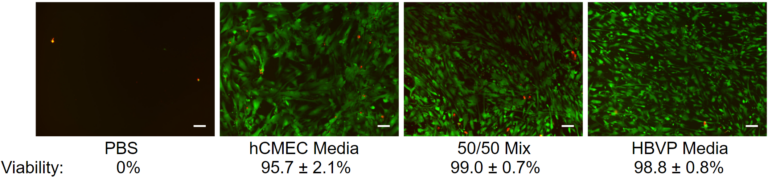
    Introduction Mural cells, including smooth muscle cells and pericytes, are important for supporting endothelial cells in the vasculature [1]. They play a role in angiogenesis, and contribute to the development of the vascular basement membrane that provides structure for blood vessels [1,2]. Numerous in vitro models of the blood-brain barrier (BBB) have incorporated pericytes alongside…

    Read More Human brain vascular pericyte viability in endothelial mediaContinue

  • hToC | memBrains | μSiM

    Monocyte Transmigration in μSiM Devices – Optimizing Microporosity for Future Studies

    ByDan Ahmad March 19, 2021April 28, 2021

    Introduction Infection or injury of tissue results in inflammatory signalling that motivates leukocyte recruitment to an inflamed location. Monocytes in particular are implicated in both pro inflammatory signalling through the M1 macrophage phenotype and regulation through the M2 macrophage phenotype. The μSiM devices developed in our lab have yet to assess/optimize monocyte transmigration from the…

    Read More Monocyte Transmigration in μSiM Devices – Optimizing Microporosity for Future StudiesContinue

  • hToC | memBrains | Protocols

    Monocyte Isolation via CD14+ Selection (Protocol)

    ByDan Ahmad March 17, 2021March 17, 2021

    Please see the attached .PDF file for a full monocyte isolation protocol. This is for isolating human monocytes from whole blood. Monocyte-Isolation-Protocol

    Read More Monocyte Isolation via CD14+ Selection (Protocol)Continue

  • memBrains | NRG

    hiPSC Differentiation to Endothelial Cell Culture Method, Brain Microvascular Endothelial Cells (EECM-BMEC-like cells), Round 1

    ByMolly McCloskey March 17, 2021March 19, 2021

    Introduction Breakdown of the blood-brain barrier (BBB) is one of the earliest signs of sepsis and is linked with long-term cognitive impairment. As animal models poorly recapitulate human sepsis, alternative approaches are direly needed to understand sepsis-associated brain injury and develop strategies that protect against cognitive decline. To fill this gap, we are developing a…

    Read More hiPSC Differentiation to Endothelial Cell Culture Method, Brain Microvascular Endothelial Cells (EECM-BMEC-like cells), Round 1Continue

  • NRG | μSiM

    Electron Beam Lithography Microchannel Fabrication

    ByGreg Madejski March 3, 2021March 10, 2021

    This post is a continuation of project found in Fabricating 0.5 um Channels in Microscope Slides for Staph Invasion Assays. Just to review, after the development of μSiM-CA (Canalicular Array; see Masters et al., Nanomedicine: Nanotechnology, Biology, and Medicine 2019), Jim wanted to develop a platform to answer some more biophysics focused questions. In order…

    Read More Electron Beam Lithography Microchannel FabricationContinue

Page navigation

Previous PagePrevious 1 … 23 24 25 26 27 … 231 Next PageNext

© 2026 Nanomembrane Research Group - WordPress Theme by Kadence WP

0
    0
    Your Cart
    Your cart is emptyReturn to Shop
    Continue Shopping
    • Home
    • Publications
    • Membranes
      • Common Chip Formats
      • Common Membranes
      • Microslit Membranes
    • Devices
      • µSiM
        • Geometry
        • µSiM CAD Files
        • Assembly
          • Protocols.io (µSiM Assembly)
          • Instructions
          • Common Issues and Troubleshooting Tips
        • Cell Culture Protocols
          • Top Well: hCMEC/D3
          • Top Well: HUVEC
          • Bottom Channel Culturing
          • Immunocytochemistry Protocol
          • Impact of Chip Orientation on Fluorescence Imaging
          • Permeability: In Situ Method
          • Permeability: Sampling Method
          • Cell Culture Common Issues and Troubleshooting Tips
      • SepCon®
        • Sepcon Assembly
        • Sepcon Video Protocol: Assembly
        • SepCon Gasket Silhouette File
        • SepCon Video Protocol: Wetting the membrane
        • SepCon Video Protocol: Disassembly
      • µSiM-DX
        • µSIM Video Protocol: Capture of Nanoparticles
    • Impact
      • TraCe-bMPS
      • HCIC
      • LOMP
      • SiMPore