Skip to content

Nanomembrane Research Group

  • Home
  • Publications
  • MembranesExpand
    • Common Chip Formats
    • Common Membranes
    • Microslit Membranes
  • DevicesExpand
    • µSiMExpand
      • Geometry
      • µSiM CAD Files
      • AssemblyExpand
        • Protocols.io (µSiM Assembly)
        • Instructions
        • Common Issues and Troubleshooting Tips
      • Cell Culture ProtocolsExpand
        • Top Well: hCMEC/D3
        • Top Well: HUVEC
        • Bottom Channel Culturing
        • Immunocytochemistry Protocol
        • Impact of Chip Orientation on Fluorescence Imaging
        • Permeability: In Situ Method
        • Permeability: Sampling Method
        • Cell Culture Common Issues and Troubleshooting Tips
    • SepCon®Expand
      • Sepcon Assembly
      • Sepcon Video Protocol: Assembly
      • SepCon Gasket Silhouette File
      • SepCon Video Protocol: Wetting the membrane
      • SepCon Video Protocol: Disassembly
    • µSiM-DXExpand
      • µSIM Video Protocol: Capture of Nanoparticles
  • ImpactExpand
    • TraCe-bMPS
    • HCIC
    • LOMP
    • SiMPore
Nanomembrane Research Group
  • hToC | memBrains | μSiM

    Assessing Neutrophil Activation inside a Flow Cell Device with Flow Cytometry

    ByDan Ahmad August 27, 2021

    Introduction As part of our continuing evaluation of the flow cell developed by our collaborators at RIT, our next goal is to demonstrate that neutrophils remain inactivated when flown through a first generation device (Figure 1). For this, we studied neutrophil activation as a function of fluid flow induced shear stress based on the physical…
    Read More Assessing Neutrophil Activation inside a Flow Cell Device with Flow CytometryContinue

  • NRG | μSiM-DX

    Beadazzled: Laying the Foundation of the μSiM-DX Fouling-based Sensor

    ByMichael Klaczko August 24, 2021September 9, 2021

    Starting in December of 2019, we began capturing fluorescent beads on microslit silicon nanomembranes as an illustrative representation of particle capture within our microfluidic devices. From then until now we have successfully used this method within gasket made TFAC devices and uSiM ALine devices using a range of micropore sizes/shapes and bead sizes. These experiments…

    Read More Beadazzled: Laying the Foundation of the μSiM-DX Fouling-based SensorContinue

  • memBrains | NRG

    Theoretical Underpinnings of Small Molecule Permeability Measurements in the µSiM (Part 4: Sampling)**

    ByJim August 10, 2021September 28, 2021

    Introduction In addition to in situ measurements of small molecule permeability (Parts 1, 2 and 3), we wish to enable an assessment of permeability by sampling from the abluminal chamber of the µSiM in a manner similar to what is done with Transwells®-style devices. To begin this, we need to review the methods used with…

    Read More Theoretical Underpinnings of Small Molecule Permeability Measurements in the µSiM (Part 4: Sampling)**Continue

  • NRG

    Affinity Based Capture of Streptavidin Conjugated EVs

    ByMarlyn Torres July 20, 2021

    Introduction Proliferation, invasion and metastasis of cancer cells require bidirectional cell-cell communication. Cell-cell communication involves the secretion of oncoproteins, mRNAs, RNAs and DNA fragments by cancer cells. The particles that get secreted by these cancer cells are encapsulated in extracellular vesicles (EVs), which include exosomes. Since evidence suggests that cancer cells secrete more EVs than…

    Read More Affinity Based Capture of Streptavidin Conjugated EVsContinue

  • memBrains | NRG | μSiM

    Theoretical Underpinnings of Small Molecule Permeability Measurements in the µSiM (Part 3: Application to Cell Barriers)*

    ByJim June 28, 2021November 1, 2021

    This is the third installment in a series of posts focused on the development of a method for measuring barrier permeability in the µSiM. In Part 1 we discussed the goal of making these measurements in situ at a position beneath the membrane. In Part 2 we validated this approach experimentally on the Andor Dragonfly…

    Read More Theoretical Underpinnings of Small Molecule Permeability Measurements in the µSiM (Part 3: Application to Cell Barriers)*Continue

  • memBrains | NRG | μSiM

    10dynes/cm^2 Aline bottom channel

    ByJulie Kuebel June 22, 2021

    AlineFlowBottomChannel

    Read More 10dynes/cm^2 Aline bottom channelContinue

  • NRG

    hiPSC Differentiation to Endothelial Cell Culture Method, Brain Microvascular Endothelial Cells (EECM-BMEC-like cells), Round 2

    ByMolly McCloskey June 5, 2021October 21, 2021

    Introduction This post highlights results from my second attempt to differentiate hiPSCs into endothelial progenitor cells  EECM-BMEC-like cells in our lab. For details on methodology, see Nishihara et al., FASEB, 2020 and my previous post. Methods Cells were seeded at 70,000 and 100,000 cells/well on D-3. Only the 100,000 cell/well plate was sorted. Due to media being backordered,…

    Read More hiPSC Differentiation to Endothelial Cell Culture Method, Brain Microvascular Endothelial Cells (EECM-BMEC-like cells), Round 2Continue

  • memBrains | NRG | μSiM

    10 dynes/cm^2 bottom channel Aline

    ByJulie Kuebel May 26, 2021June 1, 2021

    AlineFlowBottomChannelSup AlineFlowBottomChannel

    Read More 10 dynes/cm^2 bottom channel AlineContinue

  • Basement Membrane Disruption by Tumor Necrosis Factor-α in the μSiM-hNVU
    memBrains | NRG | μSiM

    Basement Membrane Disruption by Tumor Necrosis Factor-α in the μSiM-hNVU

    ByLouis Widom May 25, 2021June 14, 2021

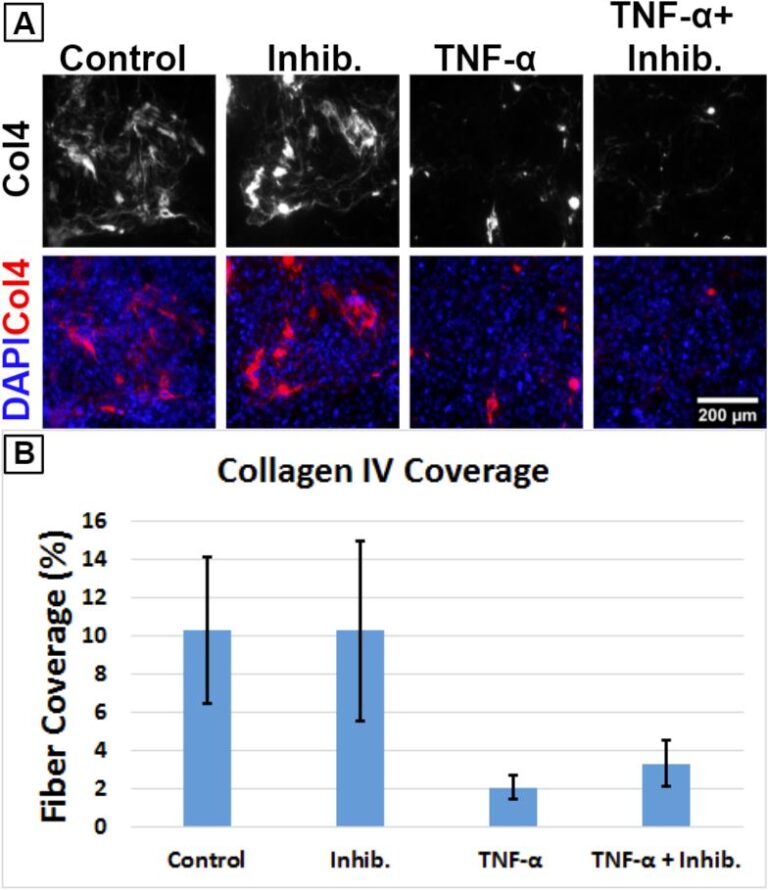
    Note: a postscript regarding an assay to determine the activity of our MMP-2/MMP-9 inhibitor was added to this post on June 14, 2021. Introduction The blood-brain barrier (BBB) plays an important role in maintaining brain chemistry by restricting the permeability of small molecules and cells. Inflammatory diseases may disrupt the BBB and promote the development…

    Read More Basement Membrane Disruption by Tumor Necrosis Factor-α in the μSiM-hNVUContinue

  • NRG

    Electrospinning aligned polymeric fibers on parylene stencils: cell culture and pll-g-PEG coating update

    ByShayan Gholizadeh May 5, 2021

    A quick recap of the goals and initial experiments: https://trace-bmps.org/electrospinning-aligned-polymeric-fibers-on-parylene-stensils/ After obtaining a reproducible optimized fiber deposition settings and an improved device design, we moved on to growing HUVECs on these devices as the next step. As previously stated, given that there is a parallel project with membrane masking of ECM with parylene stencils, we…

    Read More Electrospinning aligned polymeric fibers on parylene stencils: cell culture and pll-g-PEG coating updateContinue

Page navigation

Previous PagePrevious 1 … 22 23 24 25 26 … 231 Next PageNext

© 2026 Nanomembrane Research Group - WordPress Theme by Kadence WP

0
    0
    Your Cart
    Your cart is emptyReturn to Shop
    Continue Shopping
    • Home
    • Publications
    • Membranes
      • Common Chip Formats
      • Common Membranes
      • Microslit Membranes
    • Devices
      • µSiM
        • Geometry
        • µSiM CAD Files
        • Assembly
          • Protocols.io (µSiM Assembly)
          • Instructions
          • Common Issues and Troubleshooting Tips
        • Cell Culture Protocols
          • Top Well: hCMEC/D3
          • Top Well: HUVEC
          • Bottom Channel Culturing
          • Immunocytochemistry Protocol
          • Impact of Chip Orientation on Fluorescence Imaging
          • Permeability: In Situ Method
          • Permeability: Sampling Method
          • Cell Culture Common Issues and Troubleshooting Tips
      • SepCon®
        • Sepcon Assembly
        • Sepcon Video Protocol: Assembly
        • SepCon Gasket Silhouette File
        • SepCon Video Protocol: Wetting the membrane
        • SepCon Video Protocol: Disassembly
      • µSiM-DX
        • µSIM Video Protocol: Capture of Nanoparticles
    • Impact
      • TraCe-bMPS
      • HCIC
      • LOMP
      • SiMPore