Skip to content

Nanomembrane Research Group

  • Home
  • Publications
  • MembranesExpand
    • Common Chip Formats
    • Common Membranes
    • Microslit Membranes
  • DevicesExpand
    • µSiMExpand
      • Geometry
      • µSiM CAD Files
      • AssemblyExpand
        • Protocols.io (µSiM Assembly)
        • Instructions
        • Common Issues and Troubleshooting Tips
      • Cell Culture ProtocolsExpand
        • Top Well: hCMEC/D3
        • Top Well: HUVEC
        • Bottom Channel Culturing
        • Immunocytochemistry Protocol
        • Impact of Chip Orientation on Fluorescence Imaging
        • Permeability: In Situ Method
        • Permeability: Sampling Method
        • Cell Culture Common Issues and Troubleshooting Tips
    • SepCon®Expand
      • Sepcon Assembly
      • Sepcon Video Protocol: Assembly
      • SepCon Gasket Silhouette File
      • SepCon Video Protocol: Wetting the membrane
      • SepCon Video Protocol: Disassembly
    • µSiM-DXExpand
      • µSIM Video Protocol: Capture of Nanoparticles
  • ImpactExpand
    • TraCe-bMPS
    • HCIC
    • LOMP
    • SiMPore
Nanomembrane Research Group
  • NRG

    SPIE Photonics West BiOS Conference Presentation: Rapid detection of intact SARS-CoV-2 viral particles using silicon nanomembranes

    ByMichael Klaczko March 3, 2021

    This year we were invited to submit a manuscript and presentation to the SPIE Photonics West BiOS Conference. We submitted both on the work we have done on the uSIM-DX virus sensor platform. Below I have attached the presentation which I presented. It summarizes the motivation behind our work, current testing capabilities, introduces our membranes…
    Read More SPIE Photonics West BiOS Conference Presentation: Rapid detection of intact SARS-CoV-2 viral particles using silicon nanomembranesContinue

  • NRG

    Electrospinning aligned polymeric fibers on parylene stencils

    ByShayan Gholizadeh March 3, 2021March 3, 2021

    The aim of this work was to electrospin aligned polymeric fibers on parylene stencils as means to characterize the critical necessary total area and necessary opening sizes to elicit endothelial cell response in the form of cell alignment among other characteristics typically found in human cells that are adjacent to highly aligned ECM. For this…

    Read More Electrospinning aligned polymeric fibers on parylene stencilsContinue

  • NRG

    Modification of parylene C/N membranes for altered cell-substrate interactions

    ByShayan Gholizadeh March 3, 2021March 3, 2021

    The motivation of this work by Daniela Lincoln (master’s student) was to investigate the feasibility of using different variants of parylene (C and N) for barrier studies and to look deeper into the implications of plasma surface modification for cell-substrate interactions. For this purpose, we used and tested a variety of device designs, which led…

    Read More Modification of parylene C/N membranes for altered cell-substrate interactionsContinue

  • memBrains

    R61: Slide Decks for 6 Month Progress Report

    ByJim February 24, 2021February 27, 2021

    PDF with all slides: R61 HL154249-01(6 Month Progress)

    Read More R61: Slide Decks for 6 Month Progress ReportContinue

  • NRG

    Cell-substrate interaction modeling

    ByZahra Allahyari February 24, 2021

    The idea of this project started when we were writing a mini-review about cell-substrate interaction. Although most of studies of cellular responses to porous membranes have pointed towards a multiphasic response with the same trend of changes with respect to the pore sizes, we also found some variation in the results. We suggested that some…

    Read More Cell-substrate interaction modelingContinue

  • Collagen IV deposition by hCMEC/D3 (endothelial cell) and HBVP (pericyte) co-cultures in the μSiM-hNVU
    memBrains | NRG | μSiM

    Collagen IV deposition by hCMEC/D3 (endothelial cell) and HBVP (pericyte) co-cultures in the μSiM-hNVU

    ByLouis Widom February 24, 2021February 25, 2021

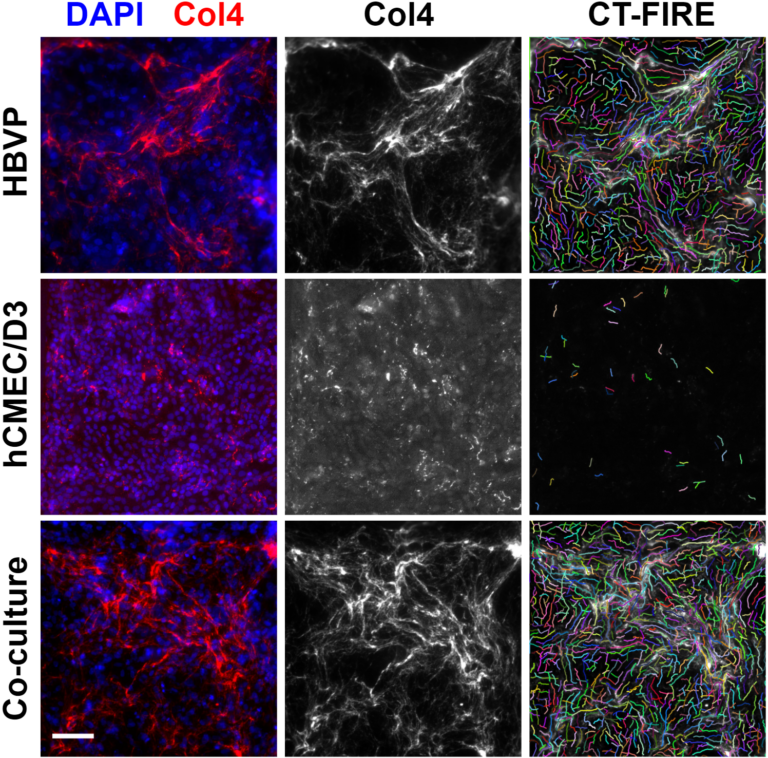
    Note: A postscript regarding a gelatin assay to determine MMP-9 activity was added to this post on Feb 25, 2021. Introduction The blood-brain barrier (BBB) plays an important role in maintaining brain chemistry by restricting the permeability of undesirable small molecules and cells. Inflammatory diseases may disrupt the BBB and promote the development of neurological…

    Read More Collagen IV deposition by hCMEC/D3 (endothelial cell) and HBVP (pericyte) co-cultures in the μSiM-hNVUContinue

  • memBrains

    Introduction of beads into the flow module

    ByMehran Mansouri February 24, 2021March 5, 2021

    1. Introduction Fluid flow is one of the key elements of vascular models for delivering nutrients and growth factors to cells as well as introducing other components like neutrophils. In post 1, we described our modular design for incorporating a flow module into the uSiM device. Then, we presented fluid flow simulation and its experimental…

    Read More Introduction of beads into the flow moduleContinue

  • NRG

    Fibroblast Wound Healing with EVs and EV Depleted Media

    BySarah Henretta February 23, 2021February 24, 2021

    Introduction Previous experiments completed by Hayley Miller investigated the effect of small extracellular vesicles (EVs) collected from Adipose Derived Stem Cells (ADSCs) on wound closure velocity and cell speed. Her previous related post can be found here.  It was initially hypothesized that EVs play an important role in wound healing and affect the wound closure…

    Read More Fibroblast Wound Healing with EVs and EV Depleted MediaContinue

  • memBrains | NRG | μSiM

    Monolayer Culture of mouse CMECs on μSIM A-Line Devices

    ByFeyone La February 23, 2021

    Introduction In the Glading Lab we study a rare disease called Cerebral Cavernous Malformations (CCMs). In this disease, brain capillaries develop greatly enlarged lumens and a disrupted blood-brain barrier. A genetic cause of the disease is the presence of a mutation in KRIT1 that causes loss of KRIT1 protein function in the cells. KRIT1 binds…

    Read More Monolayer Culture of mouse CMECs on μSIM A-Line DevicesContinue

  • memBrains | NRG | μSiM

    Theoretical Underpinnings of Small Molecule Permeability Measurements in the µSiM (Part 2: Experimental Validation)

    ByJim February 23, 2021October 18, 2021

    This is the second installment in a series of posts focused on the development of a method for measuring barrier permeability in the µSiM. In Part 1 we discussed the goal of making these measurements in situ at a position beneath the membrane. Because our preference is to use the trench down configuration in the…

    Read More Theoretical Underpinnings of Small Molecule Permeability Measurements in the µSiM (Part 2: Experimental Validation)Continue

Page navigation

Previous PagePrevious 1 … 24 25 26 27 28 … 231 Next PageNext

© 2026 Nanomembrane Research Group - WordPress Theme by Kadence WP

0
    0
    Your Cart
    Your cart is emptyReturn to Shop
    Continue Shopping
    • Home
    • Publications
    • Membranes
      • Common Chip Formats
      • Common Membranes
      • Microslit Membranes
    • Devices
      • µSiM
        • Geometry
        • µSiM CAD Files
        • Assembly
          • Protocols.io (µSiM Assembly)
          • Instructions
          • Common Issues and Troubleshooting Tips
        • Cell Culture Protocols
          • Top Well: hCMEC/D3
          • Top Well: HUVEC
          • Bottom Channel Culturing
          • Immunocytochemistry Protocol
          • Impact of Chip Orientation on Fluorescence Imaging
          • Permeability: In Situ Method
          • Permeability: Sampling Method
          • Cell Culture Common Issues and Troubleshooting Tips
      • SepCon®
        • Sepcon Assembly
        • Sepcon Video Protocol: Assembly
        • SepCon Gasket Silhouette File
        • SepCon Video Protocol: Wetting the membrane
        • SepCon Video Protocol: Disassembly
      • µSiM-DX
        • µSIM Video Protocol: Capture of Nanoparticles
    • Impact
      • TraCe-bMPS
      • HCIC
      • LOMP
      • SiMPore