Proposed Electroosmosis Device
The goal of my rotation was to create a small, self-contained electroosmosis device that operates on a microliter scale using TEM membranes. Development of this device went through several phases, picking up where Mark Lifson left off. One important aspect of my design is that it is put together in stages. This allows for observation of the membrane integrity throughout the assembly.
The previous design took about 90 minutes to assemble because of the large amounts of UV glue involved. This also meant that the membrane was inaccessible for this entire time and the state of the membrane (intact or broken) could not be assessed during this period. My design, however, involves only about 20 minutes of gluing in 10 minute intervals. As a result, there is more transparency during the assembly which allows for continuous monitoring of the membrane.
Membrane integrity has been a real issue throughout this project. I have yet to fully test this as an electroosmotic device but the major components for it have been tested on their own and should work. Hopefully I can test this device fully when my TEM wafer is ready.
The current design is very similar to Mark’s design with some changes. A PDMS mold is created using the open end of a Falcon conical tube:
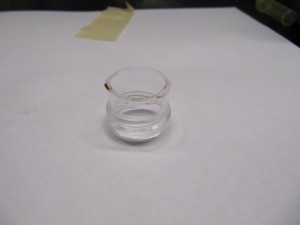
The device is assembled in the vertical pipette puller. This capillary/PDMS combination is put on the bottom part of the puller and will act as a cushion for the membrane:
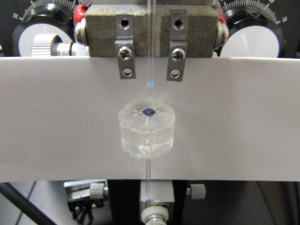
- The setup prior to gluing of the capillary. The white paper is just to help for contrast.
After lining up the window with the top capillary, the pipette is lowered onto the chip (membrane side up to make sure the exposed side was protected) and secured on with some pressure. The UV glue is applied with the UV light on. This is to increase the viscosity of the glue so it does not leak under the capillary tube. The precure time for the glue is 45 seconds but I didn’t wait that long.
After the piece is glued on, the device is checked to make sure that glue is not covering the membrane. To do this, the device is filled ~90% of the way. If there is glue on the membrane, the pressure from the filling would pop the glue and the membrane. After it is confirmed that there was no glue on the membrane (and assuming that the membrane was still intact), about 3uL of PVP (0.5mg/mL in ethanol) would be applied to the chip.
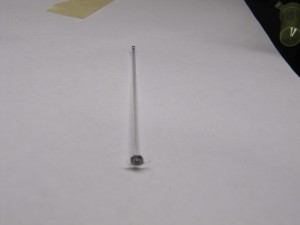
- Device after PVP assembly
After the PVP layer dried, the device would be completely filled until some water was pulled through the membrane by the PVP. At this point, the device would go back in the pipette puller to attach a capillary tube at the other end. Afterward, both capillary tubes would be cut in half to decrease the overall volume of the device. The final device would look like this:
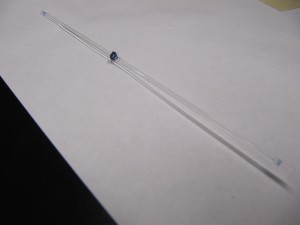
- Fully Assembled EO device with TEM (uncut capillary tubes)
So far I have been able to get to the point of PVP application. For a few instances, water is able to be pushed through an intact membrane after application. For the most part, however, the membrane breaks either during PVP application or right after the drying phase. I hope that using newer, cleaner membranes will help this process along. A more detailed device assembly process is attached because I thought it would be too cumbersome to include in the post.
Assembling a TEM Electroosmosis Device
UPDATE: On Friday I was able to work with the membranes from a new wafer. They did, in fact, prove to be more robust than the membranes I had been working with. Unfortunately, I was still unable to achieve electroosmosis. I was having no trouble filling my capillary device. Also, the membrane stayed intact during PVP application and drying. Unfortunately, after the PVP dried on the exposed side of the membrane, filling of the device essentially stopped. It seemed that after drying the PVP on the surface, it formed a layer that was either air-tight or very close to it. I am still unsure of the mechanism involved.
In the future, someone should experiment with PVP treatment of the membranes. Perhaps the concentration (0.5mg/mL) is too great for this type of experiment. Possibly one needs to force water through the membrane while the PVP layer is still wet. If PVP turns out to be unusable for this process, maybe an alternative chemical needs to be used. Although the other aspects of this design seem to work very well, the necessity of PVP application for its functionality means that we need to find a way to make the PVP work or find a suitable substitute.