14 Days of TEER on PET and pnc-Si transwells
In my previous post, I showed images of bEnd (P8) cells on PET and pnc-Si transwells. These were seeded at 105 cells/cm2 and grown for 14 days. This post contains the TEER data. I simply normalized all values to the Day 0 (no cells) resistance, so everything starts at 100%.
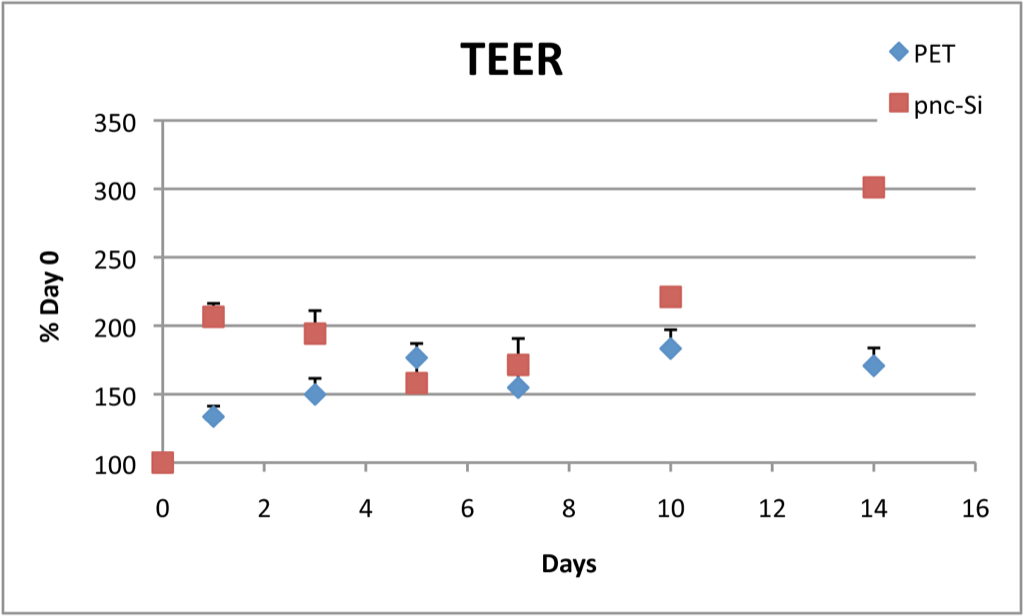
This data for PET matches my previous post investigating TEER and bEnd on PET transwells (up to day 7). The TEER reaches a plateau after about 5-7 days (when the cells are a couple days past confluence). The monolayer doesn’t get any tighter even after letting the cells grow for 2 weeks. This may be due to the open edges around the transwells. The error bars are from averaging 3 different PET transwells, so the data is pretty consistent.
TEER for pnc-Si jumped up immediately after seeding, probably due to the high seeding density. Then it fell back down to PET levels by about a week. Interestingly, the 7-day time point corresponds to the significant cell clumping/dead cells in clumps that I posted here. But then the TEER increased at the 10 and 14 day time points. The 14-day pictures I posted yesterday seem to show a bit less clumping than at 7 days – could this explain the higher 14-day TEER value? The TEER values for pnc-Si were from 4 samples (up to and including day 10) and 1 sample at day 14, so this data is really consistent, as well.
Could the high TEER value on day 14 be associated with cells forming a multilayer over the free standing membrane? (TEER is measured across the membrane windows, right?)
Could be but there tend to be dead cells in those multi-layers. The dead cells wouldn’t help increase the TEER.