Track-Etched Membrane Update
This morning I did a little work with the track etched membranes (0.05um 13mm). I talked with Paul over in Hopeman and he is currently working on making a small coring tool to cut out the membranes (it should be done by the end of the day). In the mean time I figured out that using a hole punch with paper on both side allows circles to be cut out of the membrane that can be assembled in the microcon systems.
After talking with Tom this morning I tried using larger o-rings (not the standard ones that come with the microcons) to compensate for the thinner track-etched membranes. I assembled three of these systems and tested them at low pressure (4.33psi : 1000RPM in the clinical centrifuge).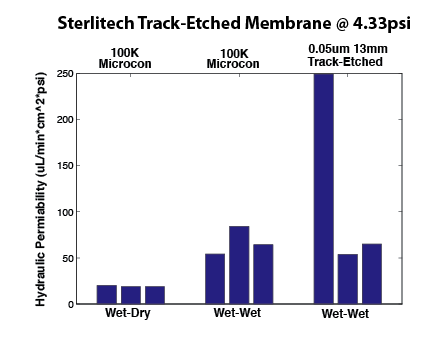
The first bar in the track-etched data is extremely large because I am near positive that that membrane did not have a good enough seal and it leaked.
How do these flow rates compare to theory, based on the pore densities and sizes on the manufacturer’s website? I think for this pore size, Maryna was able to get reasonable correlation with air flow theory, and may be able to help with the calculation for water flow, if you need it. I think Jim also has a Matlab file that might work.
Has any progress been made in imaging these pores with SEM or TEM to get our own pore sizes for comparison with the manufacturer numbers?
Is there any easy way that we could screen for leaks in these experiments? Maybe some 100nm colored bead or colloid could be added to the retentate in low concentration. Then we could screen for it in the filtrate? This would also give us a feeling for how “leaky” the Nanoseps are, relative to our membranes, as they are likely to let many 100 nm objects through their matrix, even though their “cutoff” is closer to 10 nm. Flow rate measurements without any controls for leaks/cutoff could have hidden problems….