Endothelial cell attachment to porous substrates via focal adhesions is initially affected by pore spacing and not absolute porosity. Maturation of endothelial monolayers via cell-cell interactions occurred over the same time course regardless of substrate porosity, pore size and contact area. Cell-matrix interactions at maturity were dictated by substrate stiffness.
Data
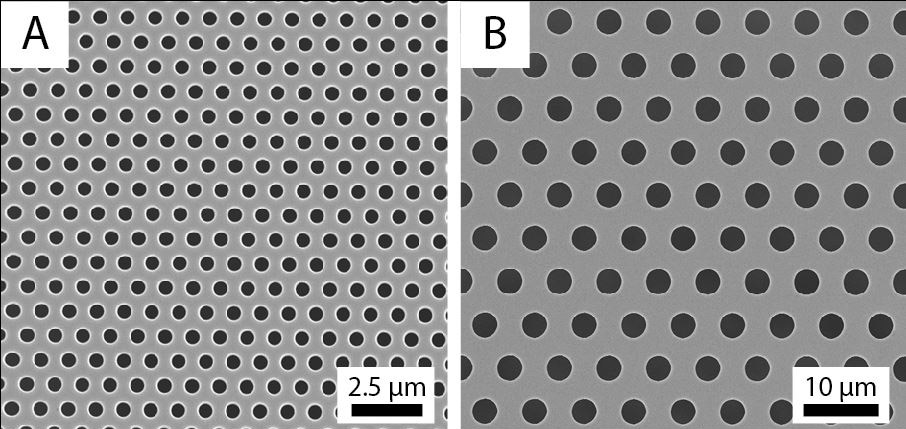
Fig. 1 SEM images of 0.5 mm and 3.0 mm pore size membranes. Spacing between pores is one pore diameter. Porosity for both membranes is 22.7%.
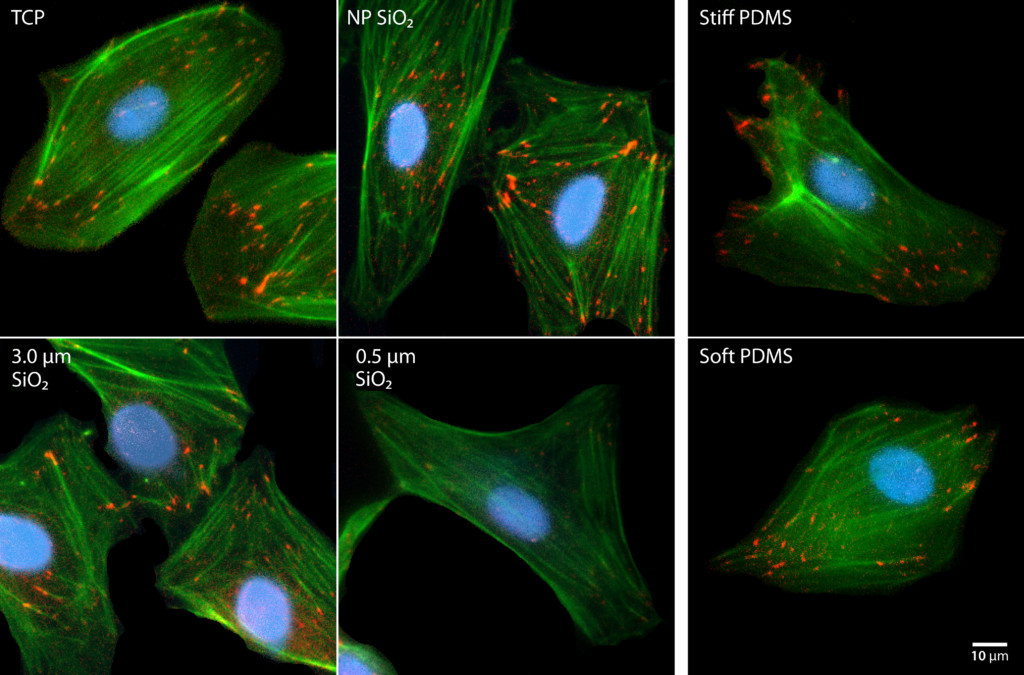
Fig. 2 Cell attachment to substrates through focal adhesions at 24 hours. HUVEC were cultured on tissue culture plastic (TCP), non-porous, 3.0 µm high porosity, 0.5 µm high porosity SiO2 membranes, and stiff (E = 2 MPa), and soft PDMS (E = 5kPa). Cells were stained with DAPI (nuclei, blue), phalloidin (actin filaments, green), and anti-vinculin (focal adhesion vinculin, red).
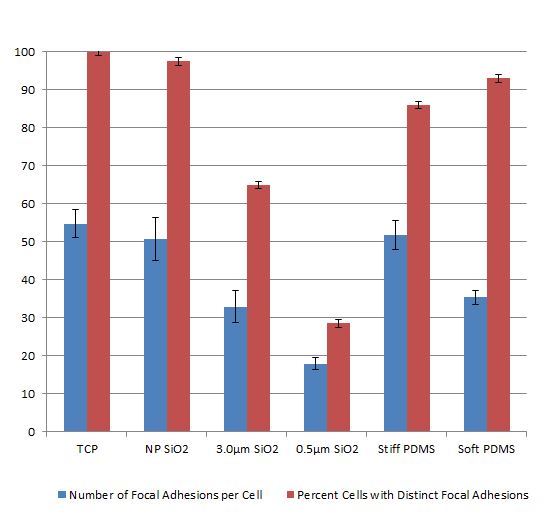
Fig. 3 Quantification of focal adhesion formation. Formation of distinct focal adhesions was quantified for all substrates – number of focal adhesions per cell and percent of cells with distinct focal adhesions. Error bars are +/- SD. Sample size >50 for each substrate.
[missing figure]
Fig. 4 Endothelial Barrier Maturity. HUVEC were cultured to form a monolayer on tissue culture plastic (TCP), non-porous, 3.0 µm high porosity, 0.5 µm high porosity SiO2 membranes, and stiff (E = 2 MPa), and soft PDMS (E = 5kPa). Cells were stained with DAPI (nuclei, blue), anti-VE-cadherin (cell-cell junctions, green), and anti-vinculin (focal adhesions, red) to visualize formation of endothelial barriers.
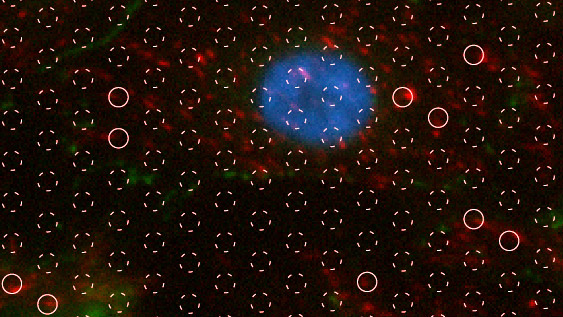
Fig. 5 High-resolution fluorescence image of focal adhesion formation on 3.0 µm pore size SiO2 membranes upon reaching confluence. White circles are locations of pores. Solid circles are locations where focal adhesions (vinculin, red) are present over the pore or at the pore edge.
Supplemental Data
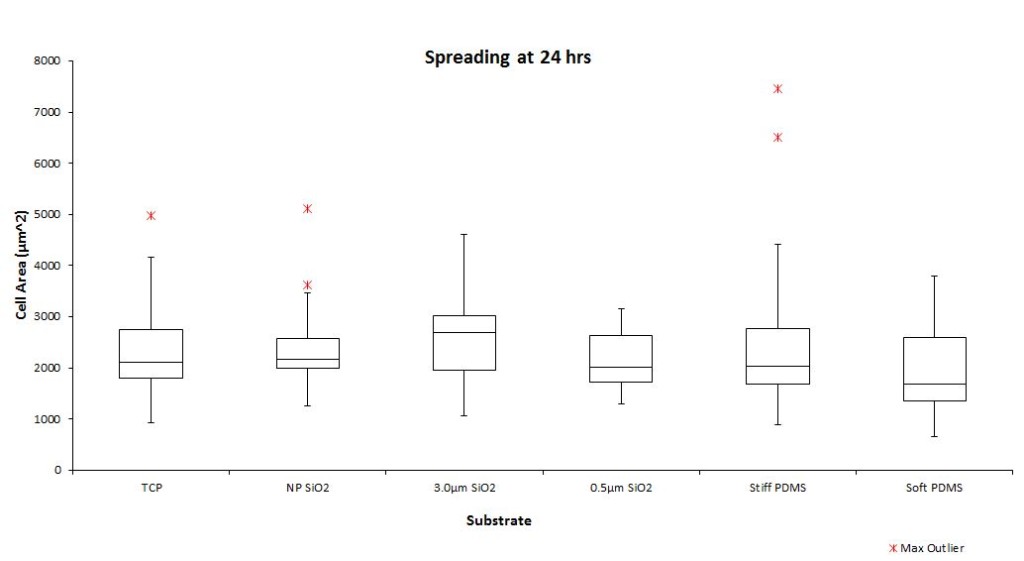
Fig. S1 Cell Spread Area at 24 hrs. HUVEC spread area was quantified 24 hrs post-seeding on TCP, non-porous SiO2 membranes, 3.0 µm pore size SiO2, 0.5 µm pore size SiO2, stiff PDMS (E = 2 MPa), and soft PDMS (E = 5kPa). The box plots represent median and IQR of spread area. Whiskers are +/- 1.5IQR.
Transferred from other blog… Wafers 398 and 418 were recently tested for burst pressure. Wafer 398 had a burst pressure range of 4.28-8.24 psi, with the great majority of intact membranes on the wafer having no or one tiny pinhole. When removing samples from this wafer more shards than usual were created, with some fragments…
Hi all, this report will serve both as an update and a template for my upcoming BMES 2012 poster on the shear-free chemotaxis system. Introduction: Because of its capability in hosting reactions and transporting materials in small volumes, microfluidics enables the efficient processing of precious reagents. However, the shear stress inherent in the use of…
Here is an interesting discovery of nanopores in the SiO2 layer after the laser annealing. Basically I was doing laser annealing on free-standing OS membrane the other day. It’s an excimer laser with 248nm wavelength, 25ns FWHM and spot size of 2.6 mm diameter. Same setup we used before in ORNL. The sample we test…
In continuation of the desalting work, I ran three additional controls: a SepCon with no slits (negative control) and direct addition of 4M NaCl producing final dilutions of 1:400 and 1:600 (these are the experimental final dilutions I have been working with). The results are shown below. I also calculated the flux for each condition….
In the previous posts, I have shown that nanopores can be formed in silicon film sandwiched by two silicon nitride films. This discovery shows silicon nitride as an alternative barrier layer in the stack geometry. In this post, I’ll discuss a hypothesis about the pore forming conditions. The hypothesis is that either silicon dioxide or…
At some point, when things settle down, I’ll create a page dedicated to the TECAN machine and document all of the troubleshooting and tricks I’ve learned so far. Before that happens I have another mystery to solve. Take a look at the following three scans: This first are some scans of BSA filtrates from…
Anticipating the eventual introduction of nanoporous SiO2 can we call non-porous SiO2 something other than np-SiO2?