STTR: Silicon Nanomembranes for Ab-labeled NP clean-up
Submitted on April 7, 2014. Posted to NRG Cloud under NRG/Funding.
 Figure 2. Dead End Filtration with SEPCONTM (A) SiMPore’s SEPCONTM spin cup with a silicon nanomembrane chip. B) Dead end filtration in a centrifuge. The direction of the centrifugal force is indicated with the gravity vector g.
 Figure 3. Nanoporous Silicon Nitride (A) pnc-Si is formed atop silicon nitride and serves as a template. (B) Pores are transferred through SN by reactive ion etching (RIE). (C) The resulting membrane has pore and filter characteristics similar to pnc-Si. From (5).
 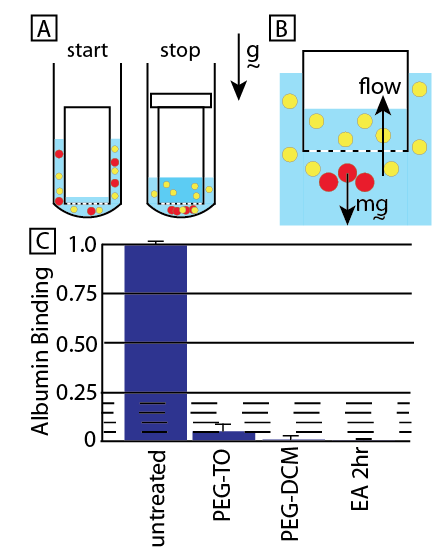 Figure 4. Methods to overcome clogging (A) ‘Reverse’ centrifugation scheme. (B) Agglomerates of NPs are pulled away from membrane despite flow through membranes. (C) Membrane functionalization with small PEG molecules minimizes protein adhesion (8).
 Figure 5. Unique ability of SiMPore Nanomembranes to Separate IgG and 20 nm NPs (A) Protein absorbance for retentate and filtrate fractions as measured in a Tecan nanoquant plate (IgG start = 1 mg/ml). Note that IgG passes through silicon nanomembrane filters with little hindrance. (B) Fluorescence NPs (20 nm at 10^15 parts/ml) in retentate and filtrate fractions. Spectra and inset images show complete retention of NPs (C) Literature from Millipore and Pall indicates that only the Pall 300 kD filter should pass IgG. (D) Study with 300kD Pall Nanosep demonstrates passage of 20 nm NPs.