Long Term Urea Clearance in Serum
I made 50 mL of 30% fetal bovine serum (FBS), 70% PBS, 0.5 mM urea. Pumped with syringe pump at 5.6 µL/min through an untreated and EA treated single slot dialysis chips in a stirred beaker of PBS (two separate experiments). We expect (without Serum) a 30% extraction so from 0.5 mM urea to 0.35 mM. The data below shows that for the shorter (13 hour) experiment, we are getting about 0.45 mM out, or a 10% extraction. But for the longer experiment, EA treated, it actually reaches the target extraction. It is problematic that the data seems a bit unsettled. I do like that there is some agreement (aside from the fluctuations) with both experiments. The untreated experiment was terminated early due to technical difficulties.
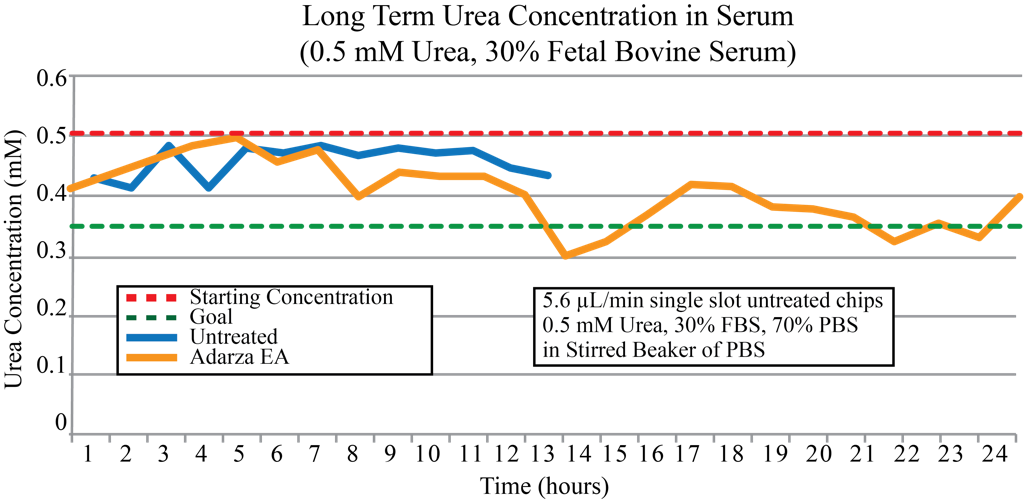
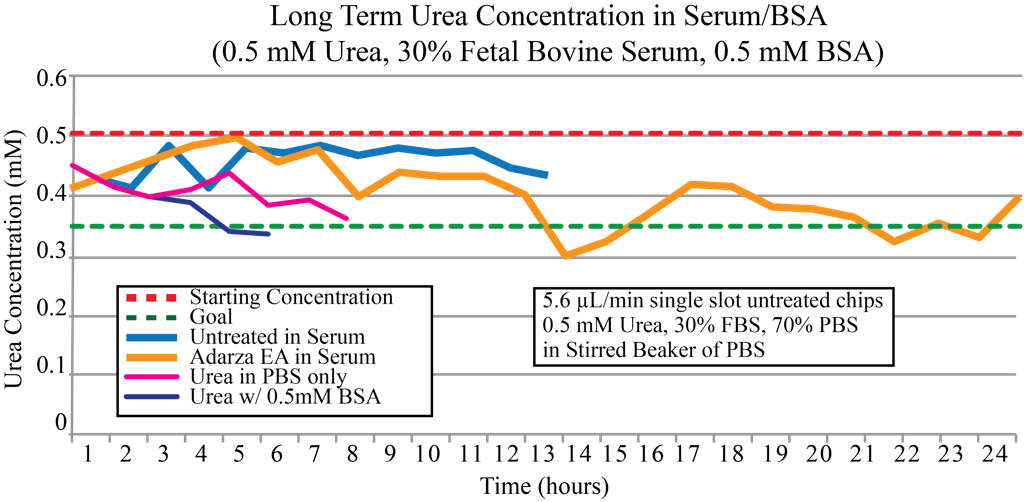
Next Steps: Run this with 100% Serum running PBS for at least 10 hours prior to the introduction of proteins to the membrane. I’ll use a three way valve to connect two syringes, one with PBS and one with serum/urea. We will see if running PBS first will take care of the fluctuations. I would like to run higher concentrations of urea, but to keep the data consistent I will continue to run 0.5 mM Urea, (Koncki 2007) reports that the physiological level of urea in blood is between 2.5 mM and 8.6 mM, though he does not provide a reference for this number.
Koncki, R. (2007) ‘Recent developments in potentiometric biosensors for biomedical analysis’ in Anal Chim Acta, Netherlands: 7-15.
Odd but consistent transients and its hard to say EA is any better. But I love the long term clearance in 30%FBS!
Can you plot your results without serum on this graph for comparison? I thought I remembered seeing this older clearance data, but I cannot find it on the blog.
The delay in getting to the expected clearance may be wetting related. Shigeru at Pitt found that he had to do an O2 plasma clean immediately prior to applying solution to the membranes in order to wet the pores. Otherwise the permeability was poor for many hours and never became ideal. I don’t think the PEG that you have been working with will help much here, since the density is low and contact angle is no where near zero. Do you ozone clean now prior to wetting? What is your current wetting procedure?
The long term clearance does look generally good but I’m not sure this type of experiment will be useful in comparing surface treatments. It would take a boatload of protein binding to have any effect on urea permeability in this system, since the protein will be a low-density network and with the low efficiency of stirring, you are unlikely limited by membrane permeability. However, my impression is that reasonable clearance data like this in combination with the BSA binding data will go a long way with Coulter, which is certainly the short-term objective.
Thanks!