Long Term Urea Clearance in 100% Serum
I ran a 30 hour urea clearance with 100% serum through the single slot dialysis device. The now standard protocol was run.
The single slot chip was annealed in the RTP for robustness then clamped into the acrylic/PDMS flow fixture.
Ethanol was pumped through the chip for 1 hour, then degassed PBS was pumped for 18 hours (this time is not standard and should be reducible). All pumping at 5.6 µL/min with the device submerged in 250 mL of PBS in a stirred beaker.
(Because I am daring I used 1 mM urea in the 100% serum instead of the 0.5 mM I had been using for the 30% serum.)
The serum/urea was also degassed and pumped for over 30 hours at 5.6 µL/min and collected in 1 hour samples.
I did have measurement issues with the first assay I performed, but a second assay, with limited test times provided much more consistent results. The red line is the initial concentration, the green line is the 30% extraction predicted for 0.5 mM urea. I expected to have better clearance for higher concentrations, due to a higher concentration gradient across the membrane. I have yet to re-do the COMSOL model to arrive at an expectation for 1 mM urea. I now have to decide if I should go right to whole blood or if I should continue with serum increasing the urea concentration to biological levels. I’m leaning towards whole blood, but have yet to use my own blood for ex vivo experiments.
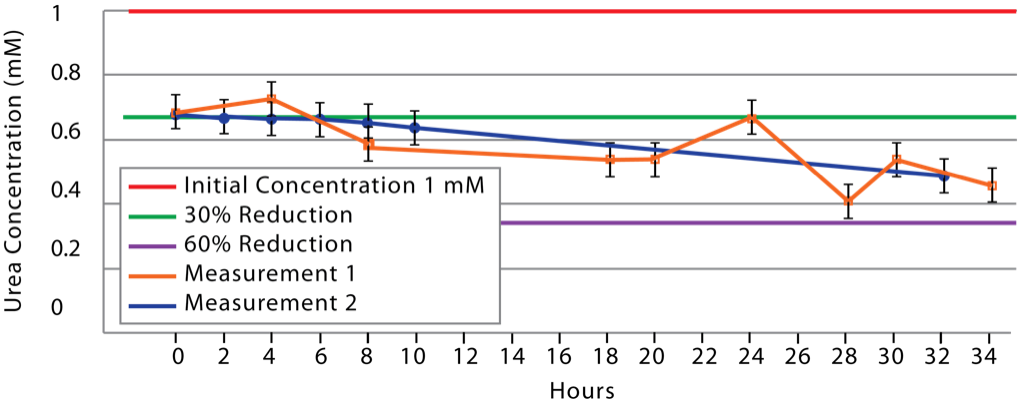
In a linear system, the starting concentration should not effect the % removal of urea, right? The gradient is steeper, but there is more to remove, so it seems like it should cancel out.
Also, I was curious if you know how much fluid passes through the membrane, relative to how much passes into the collection vial that you measure? There must be some convective flow through the membranes, although most is probably tangential.
Data looks promising! Thanks!
Data does look promising. Can you add a theoretical prediction to the figure to check the 60% drop?
A non-porous membrane as a control would be helpful. This would ensure that we are not losing urea to adsoprtion on the walls, etc.
I’m anxious to see if the functionalized membranes settle down quickly.
Jim