I have tinkered with the etch recipe some more, adding Argon to help prevent polymer formation (adding 5% O2 was not enough). The current recipe is 200 mTorr (100 mTorr Ar, 5 mTorr O2, 95 mTorr CHF3) at 120-125 W (6-12 W reflected). The plasma color is initially rosy (Argon), settling into a light purple after a few seconds (Light blue from CHF3 and O2 mix). After 140 seconds of etch using this recipe, the coated (250C, 1-3 A/s, 50nm) MgF2 films remain, while the backside is fragmented and discontinuous.
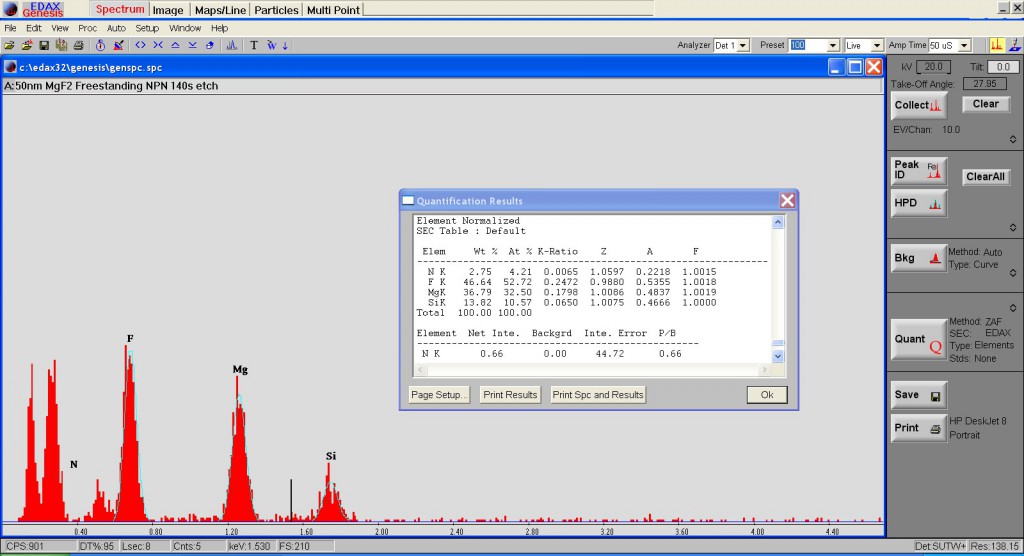
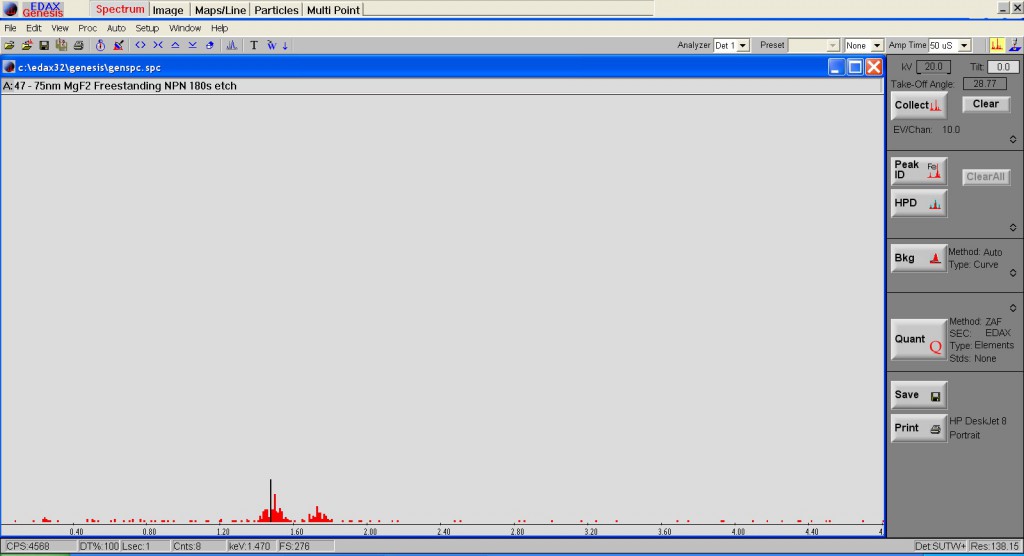
The true composition of these films has yet to be confirmed. Using EDAX on our SEM, I was able to find a decrease in the relative Silicon composition of the etched film, though some signal remains. I hope to get an XPS reading soon to confirm this result.
In the discontinuous film state, the etched free-standing membranes have survived for 48+ hours. The burst pressure for these films (SEPCON format) were 1.5 and 1 psi, much weaker than what we are used to having from nitride alone (thermal processing after deposition to densify the films may help in the future).
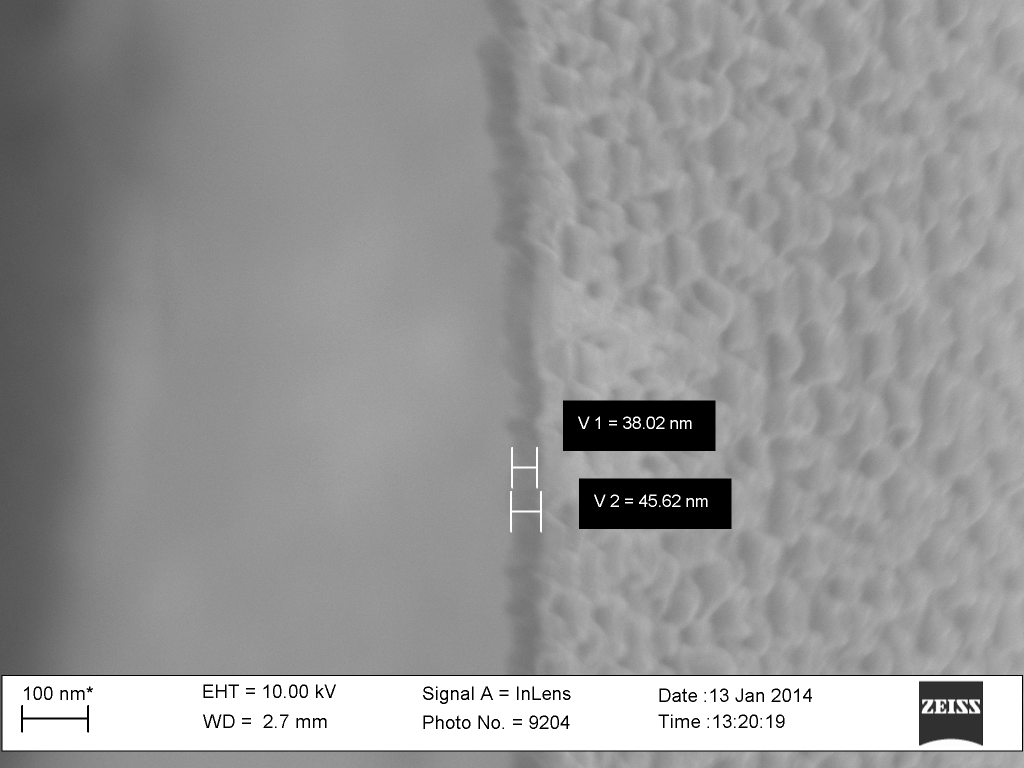
Step height on 50nm MgF2 film (kapton tape occludes deposition surface)
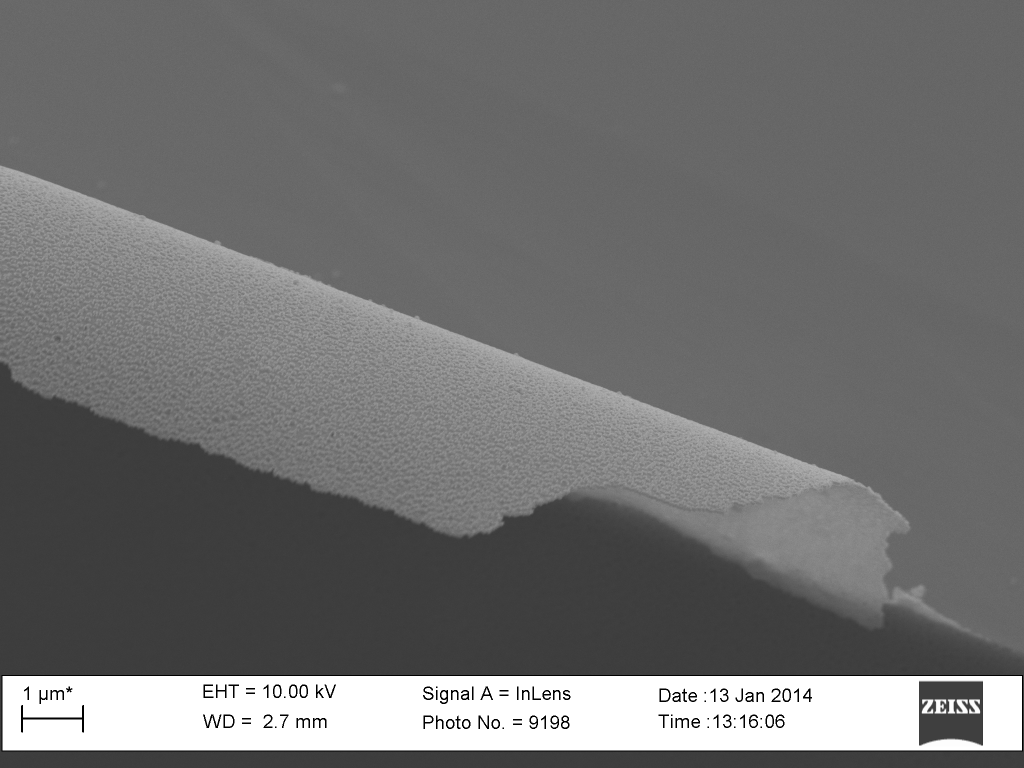
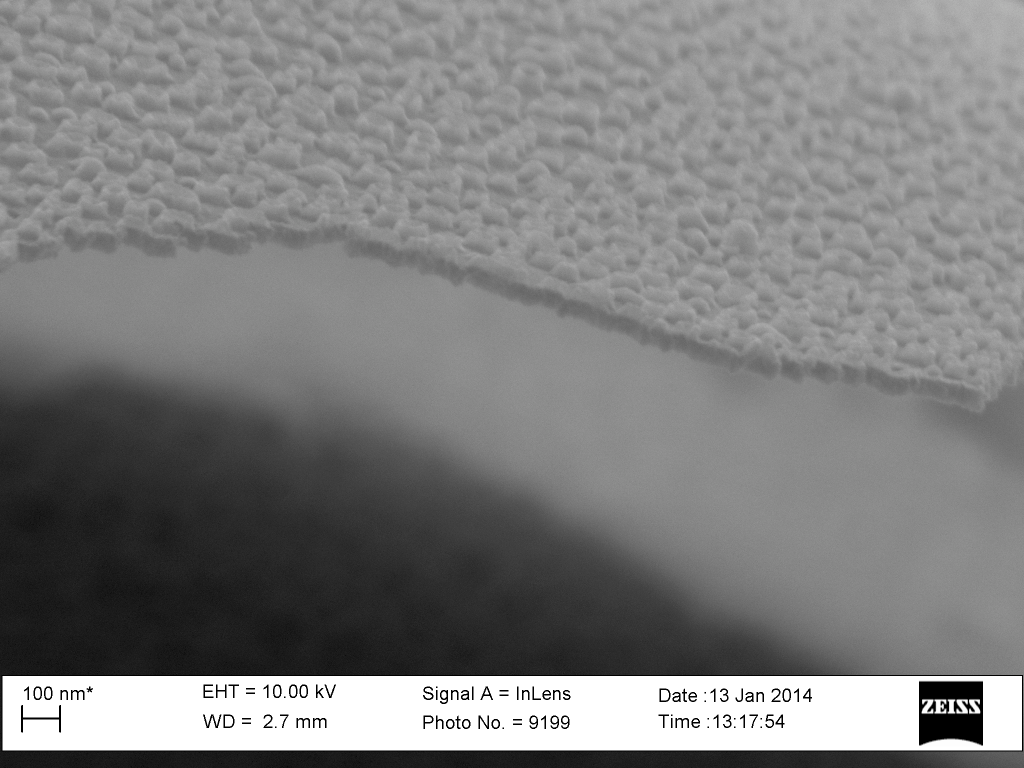
Sample 40, 50nm MgF2, 140s Ar+CHF3+O2 etch, curling up from freestanding region. The dark region is the bulk. The top face would be where the silicon nitride has been etched (backside)Sample 40, 50nm MgF2, 140s Ar+CHF3+O2 etch, curling up from freestanding region. The dark region is the bulk. The top face would be where the silicon nitride has been etched (backside). The film appears discontinuous, with little volcano structures remaining. Ideally, we would have none of these structures remaining with a more complete etch.Is the etched Film Pure MgF2?Or is the remaining film scummed up with Si3N4 volcano structures around the pore?
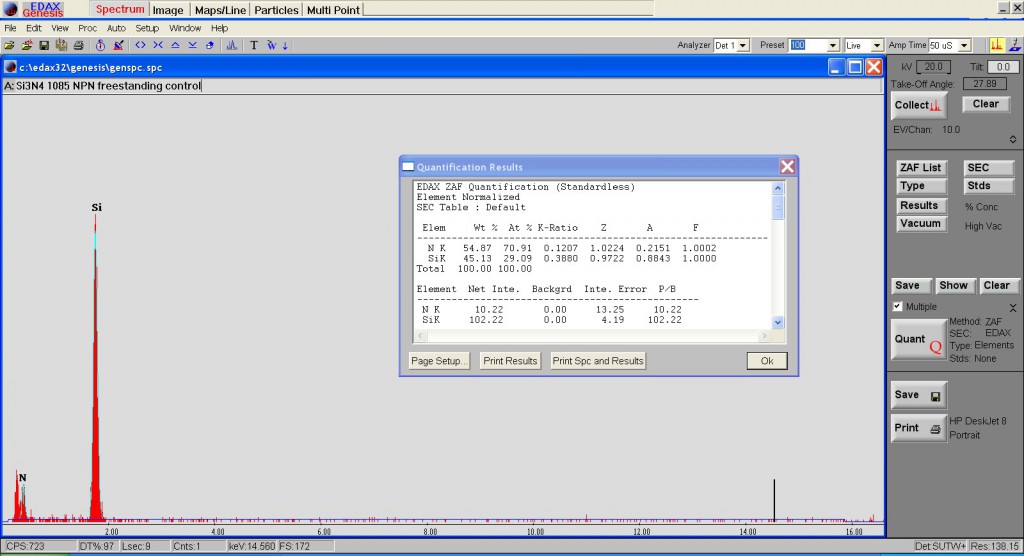
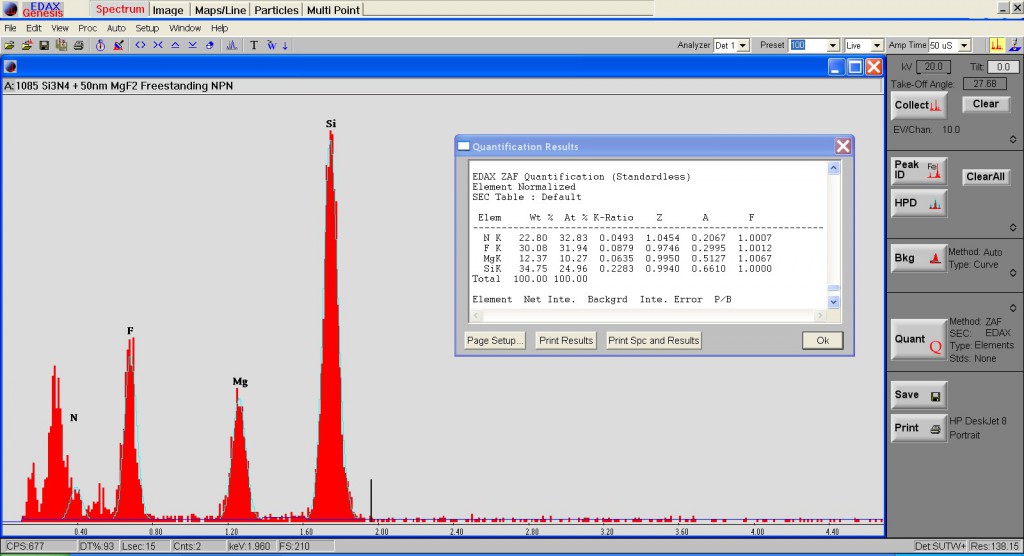
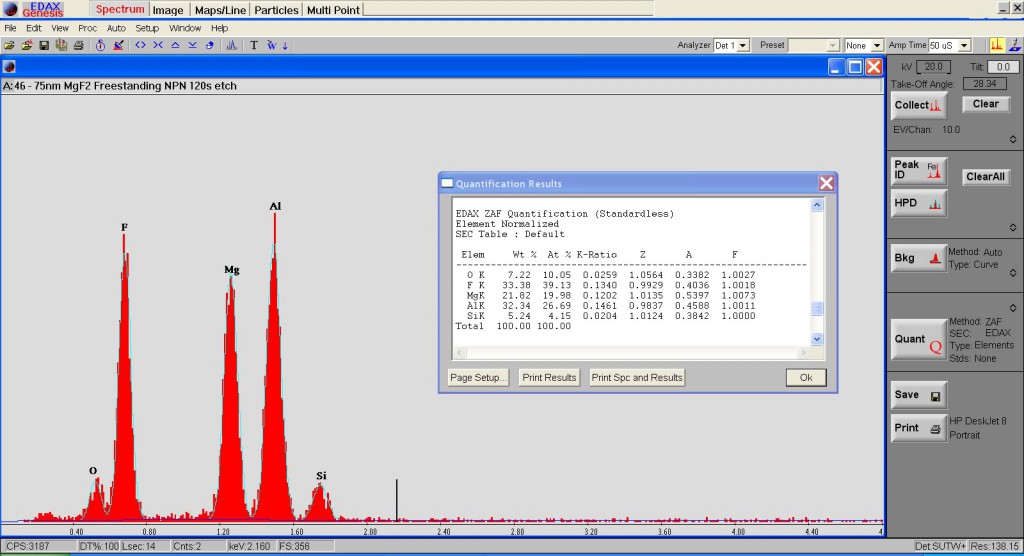
Control 50nm NPN EDAX measurement. Pure Si3N4 is expected.50nm NPN with 50nm of MgF2. This film has not been etched.140s Etched MgF2 membrane. Little silicon remains in the signal (85% MgF2). The larger peaks on the left are the Carbon background.I tried measuring another etched film with a different holder (Al). Again, the silicon signal remains. This sample had 120s etch (compared to 140s).This sample had 180s of etch, but no signal is coming out of the membrane? Clearly a freestanding region under SEM, and a measurement on the sidewalls of the chip confirm the EDAX detector’s functioning.
Sample 40, 50nm MgF2, 140s Ar+CHF3+O2 etch, curling up from freestanding region. Film thickness of MgF2 film is preserved.
Sample 40, 50nm MgF2, 140s Ar+CHF3+O2 etch, curling up from freestanding region. Crossection shows the thickness of the MgF2 film remains the same.Sample 40, 50nm MgF2, 140s Ar+CHF3+O2 etch, curling down in freestanding region. MgF2 surface appears much smoother, with through pores apparent.
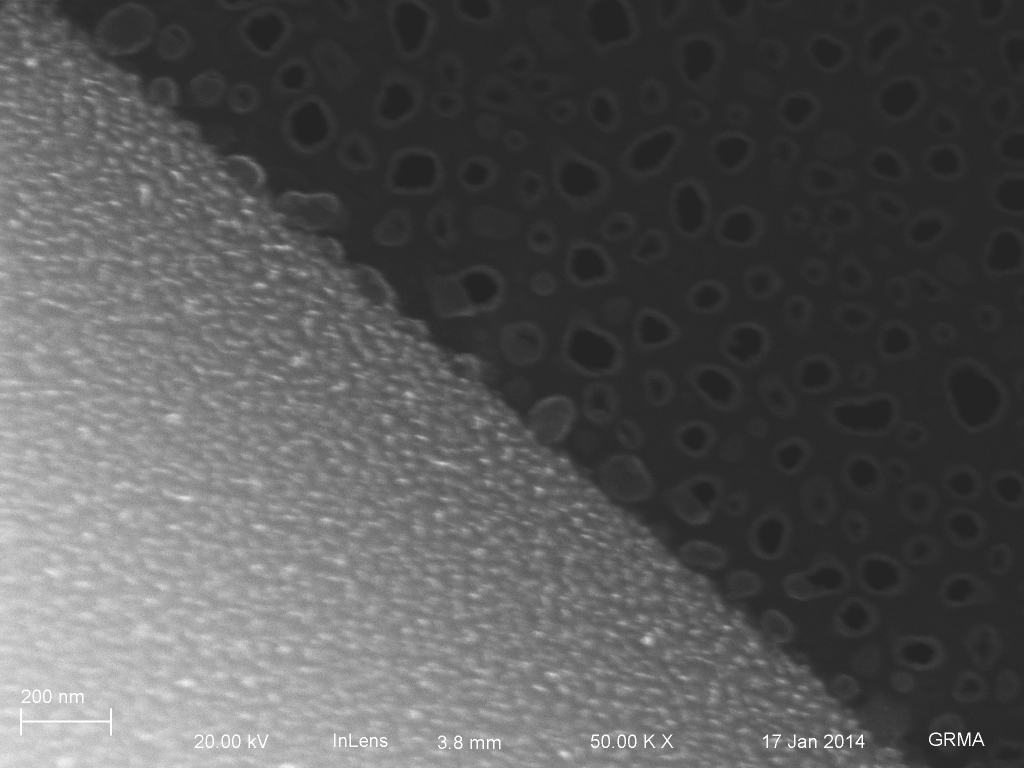
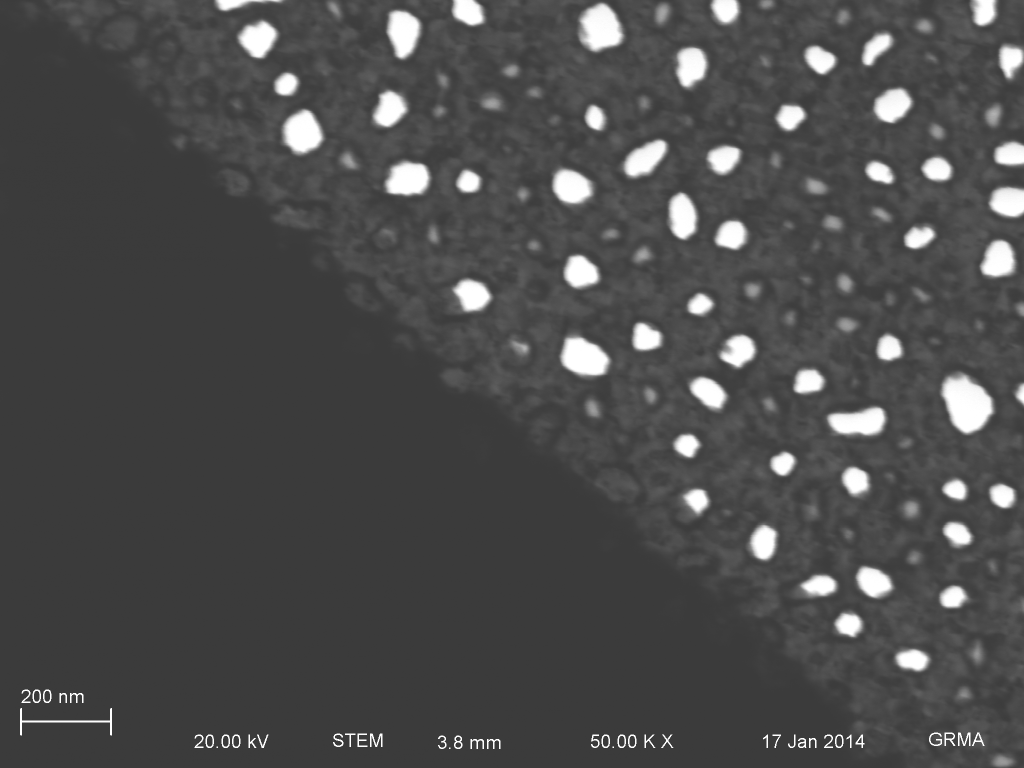
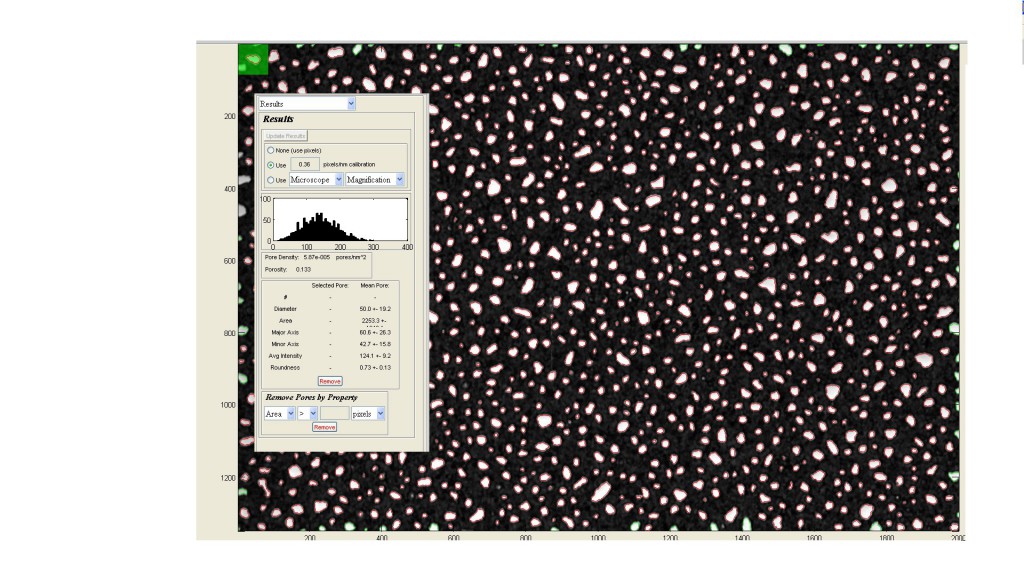
Sample 47, 180s etch SEM mode.Sample 47, 180s etch, TEM mode.
47 – Pore Histogram
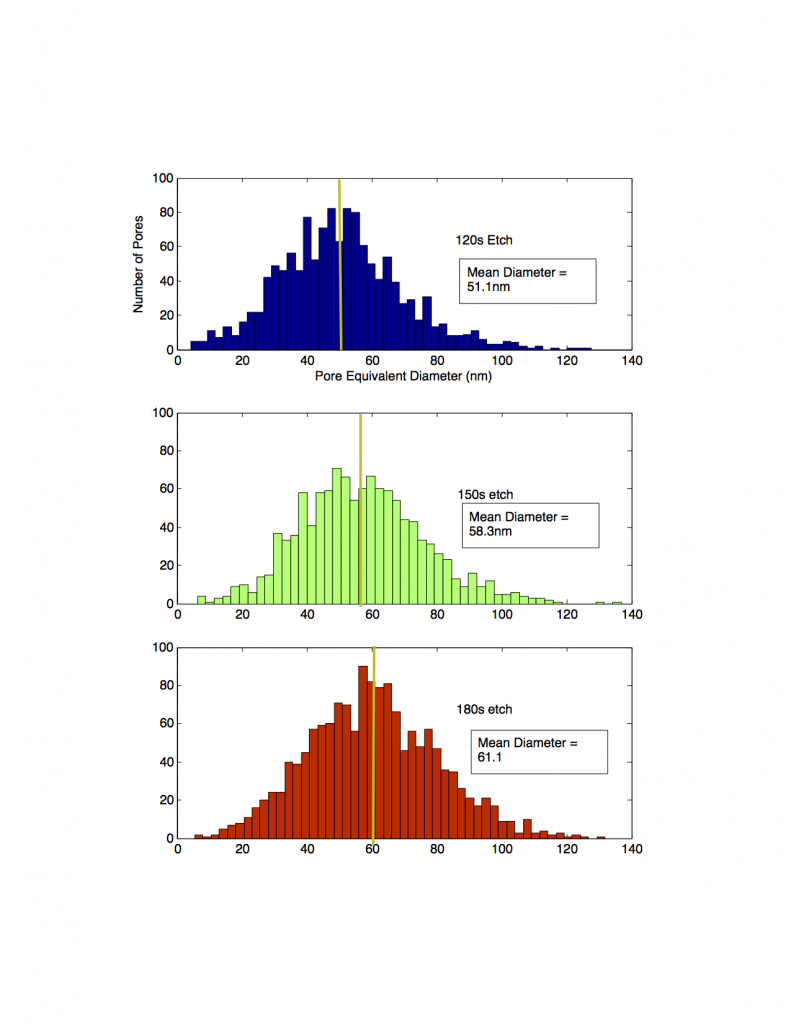
Pore Histograms from samples 45, 46, and 47. Sample 45= 150s, 46=120s, 47=180s. Etching longer appears to blow out the pores somewhat, though the resistance is fairly high for 60s of additional etch time.
After years of on again/ off again work – dating all the way back to the earliest days of the NRG – we have finally submitted a manuscript on membrane mechanics. The story of this manuscript is a remarkable one: it was willed into existence by a UR Mechanical Engineering PhD student who developed a…
Samples are from wafers #316 and 318. This is the first time for wafer scale deposition. Processing conditions:1) chamber base pressure @ 6×10⁻⁷ Torr (previously @ 5×10⁻⁶ Torr)2) 15nm Ti + 15nm Au, no vacuum break Estimated “cell resistance”: about 20-25 ohm, much lower than previous measurement. Possible reasons why lower resistance is observed:1) “Au…
One of the things that I’ve been working on recently is trying to explain the extreme elasticity of the pnc-Si material which is connected to its nanocrystalline structure. There are two parts in this question. First, how are amorphous or crystalline phases involved during stretching? Second, does the crystalline phase change under application of mechanical…
Hello everyone! this post describes how we are going about determining the size cut-off of the membranes we make through nanosphere lithography. These are 120 nm thick silicon nitride membranes with controlled pore size between 320 and 80 nm. A polymeric scaffold is placed on them to increase robustness. The scaffold is a square grid…
As a continuation of the substrate bias series, I deposited a 15 nm film with 05 W substrate bias and annealed at 1000 C. TEM shows that this condition generates a 13.4% porosity and a max pore size of ~40 nm! Here is a comparison of all the bias conditions tested thus far: I believe…
The plot below shows a calibration curve to calculate the etching time needed during the RIE step (used to reduce the size of the nanospheres) to obtain a desired pore size. The membranes were patterned from nanospheres with a nominal diameter of 300 nm., we know from SEM images that their actual size is 340…