Transferred membranes under shear
Pertaining to the tenting work that Greg and I have been doing, some of the experiments discussed on my last post have given us reason to believe that the transferred membranes may not adhere well to silicon oxide, floating just above it rather than sticking to it. As a test for the stability of the attachment of the membranes to our oxide patterning, I’ve performed a simple experiment designed to expose nanoporous membranes to varying shear forces, with the goal of quantifying stability according to the shear necessary to detach them from their substrate.
For these experiments, I designed a simple flow cell which is schematized here. The channel which contains the membrane is 300 um tall and 4 mm wide.
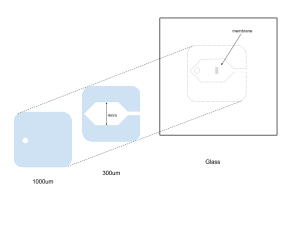
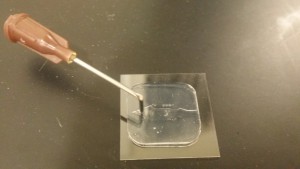
The cell was constructed by transferring the membrane to the glass (I’ll discuss this in more detail shortly,) UV/Ozone treating the glass and silicone post-transfer, and permanently bonding them together as shown.
The transfer process itself was variable. In two of the four experiments (numbered 1 and 2, respectively,) the membrane was transferred using the traditional method: it was broken manually with a small tip and then exposed to water vapor for 5 seconds to seal it to the glass. For the third (3,) no manual breaking was used: water vapor alone was sufficient to transfer the membrane. Finally, in the fourth experiment (4,) the donor chip and glass were both UV/Ozone treated before transfer, and manual breaking was again used after simple surface-to-surface contact and water vapor alone were found to be insufficient.
While I had initially intended to measure the shear required to break the membranes away from the surfaces, I discovered quickly that the most interesting behavior actually occurs during the initial wetting process. In the remainder of this post, I’ll share the photos and videos taken during the experiments sequentially and provide whatever commentary I can. While I’ve developed a hypothesis to explain the behavior I’ve observed in these experiments, the exact mechanisms at work here remain an open question.
Experiment 1
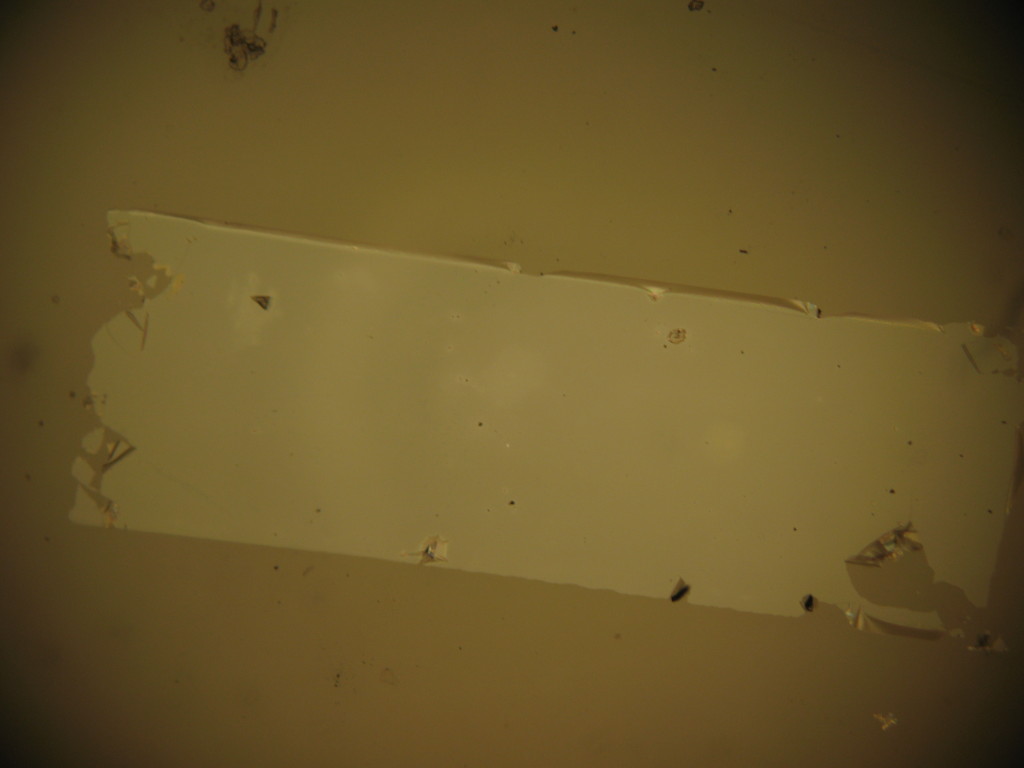
This membrane was transferred rather well, with minimal wrinkles except around the corners, where it was broken away from the donor chip manually with a glass micropipette.
The membrane was assembled into the shear cell and exposed to oncoming water flowing at 50 uL/min:
The membrane was dragged along the glass by the wet-dry interface in a manner resembling a wet paper towel dragged across a countertop. However, the shear forces due to the continued flow past where the membrane was left behind by the interface did not disturb it, indicating that at least some degree of attachment remained between the membrane and glass.
Experiment 2
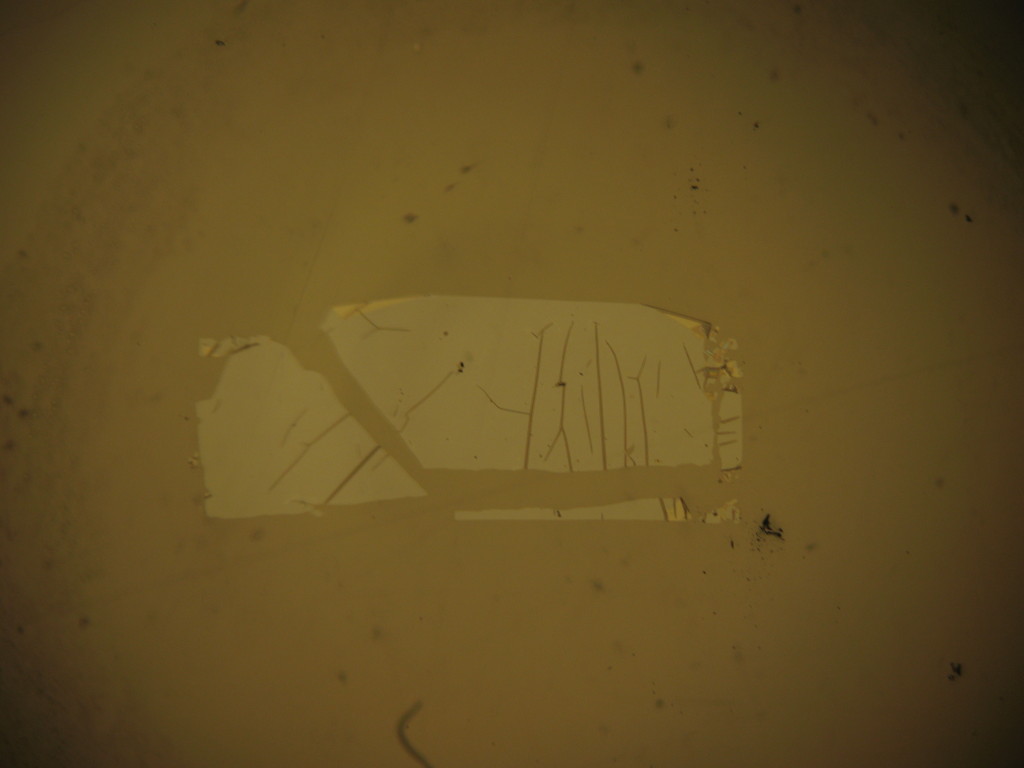
This time the membrane did not transfer so beautifully, with obvious wrinkles penetrating in normal to the edge. The initial flow rate was dropped by an order of magnitude, to 5 uL/min.
The most interesting part of this video in my opinion is that just after the contact between the interface and the membrane occurs, the water can be seen flowing into the wrinkles, presumably by capillary action. The interesting part is that in order to access the wrinkles from the side it came from, the water flowed underneath the unwrinkled edge of the membrane. This indicates that pre-wetting, the membrane was not firmly adhered to the glass, and also possibly that some water was already trapped under the membrane pre-wetting due to the water vapor applied during transfer.
Experiment 3
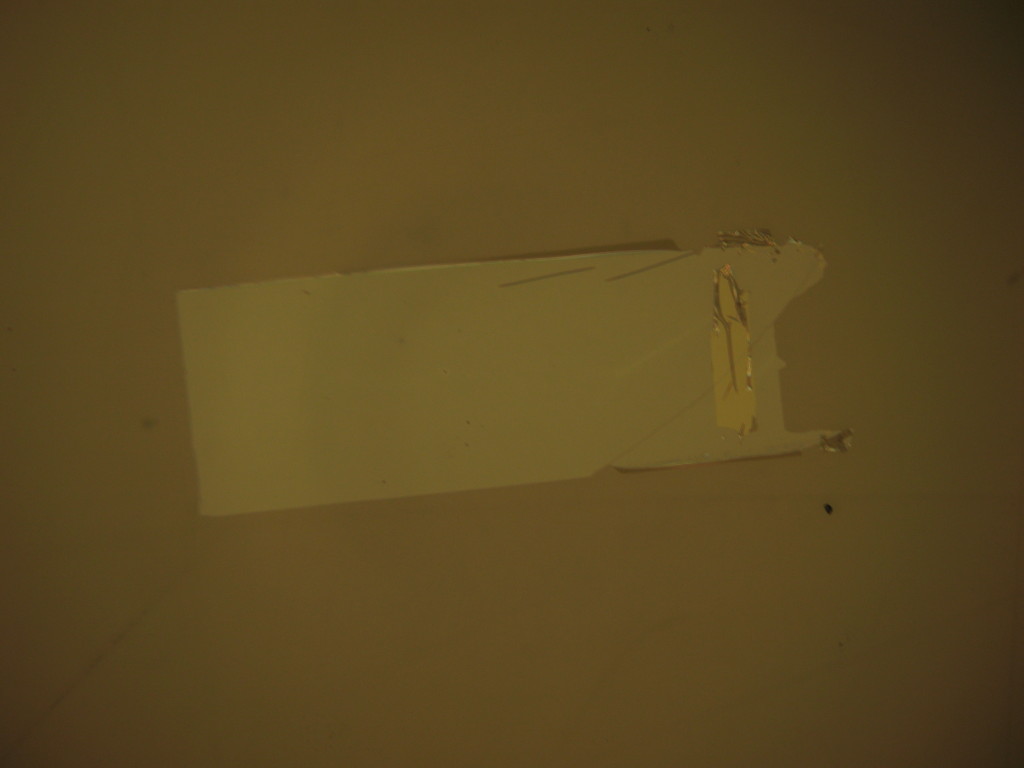
The membrane in experiment 3 was not manually broken away from its donor chip: water vapor and the compression from the burst pressure clamp alone were sufficient to create a clean transfer with minimal wrinkling across much of the membrane surface.
Because 50 and 5 uL/min disturbed the membranes in experiments 1 and 2, respectively, the flow was again slowed to 1 uL/min, the slowest available flow rate from the syringe pump I was using.
As before, the wrinkled part of the membrane was picked up and washed away (not shown due to upload size restrictions: the removed section is later dropped off downstream by the interface, and stays there.) The bulk of the membrane, however, remains where it was placed. I then ramped up the flow rate considerably, reaching the maximum rate of the syringe pump at 0.8 mL/min (8000 times faster than the initial flow) without further disturbance to the membrane.
As a happy accident, an air bubble found its way into my syringe and passed over the membrane at very high speed:
Shockingly, reintroduction of the water did not dislodge the membrane, even though the flow rate was thousands of times larger than those which had been observed to drag membranes previously. All this leads me to believe that something occurs between the membrane and the glass during the initial wetting which seals the membrane to the surface, and that prior to this step the connection between the two is extremely weak.
We can be rather sure that the connection is between the membrane and the glass surfaces themselves, with no water in between — at least in some places. If there was a layer of water between the two surfaces, we would expect that the high shear forces experienced by the membrane under the action of large flow rates would drag the membrane along in the direction of flow. Instead, we observe no such motion: the membrane must be directly against the glass and thus remains motionless due to the no-slip condition.
My current hypothesis, therefore, is that small volumes of water become trapped between the membrane and the glass during the exposure to water vapor used during the transfer process. When the water-air interface arrives at the membrane, the water molecules under and above the membrane meet through the pores, a process which we know to be favorable when both sides are already wetted (and notice how in the video for Experiment 3, the membrane appears to break the surface tension at the interface.) As the water flows over the membrane, the molecules under it are pulled out through the pores into the bulk due to the reduction in surface tension which this process allows, sealing the membrane to the glass due to the vacuum left behind. In the time before the water has been entirely sucked out of the pores, however, the flow of the bulk applies viscous drag on the water inside of them in the direction of flow, and this force is transferred to the membrane, which is pulled along until all the water beneath and within it has been voided.
This mechanism would predict that the membrane dragging would be transient (limited to the time it takes for the water under the membrane to be pulled out) and that slower flow rates would drag the membrane less due to reduced shear, both of which are consistent with observations. What’s less clear is whether a direct connection between the membrane and glass would really provide sufficient adhesion to withstand the shear forces at higher flow rates, and by what mechanism this adhesion would act, whether it be simple friction or a real chemical attachment (e.g., ozone bonding-style hydroxyl crosslinking.)
Experiment 4
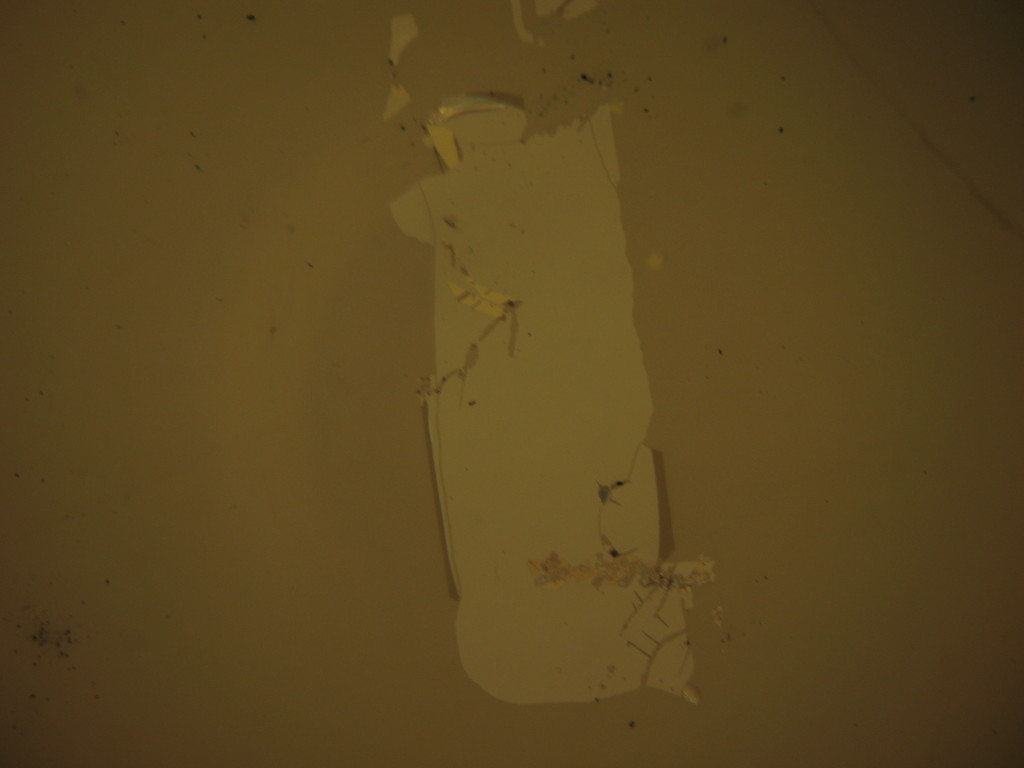
Experiment 4 was performed with a pre-transfer UV/Ozone treatment in an attempt to improve the bond between the tent and the glass. I initially attempted the transfer without manually breaking the membrane or applying water vapor, simply using the burst pressure clamp to press the donor chip and glass together in the hopes that they would ozone bond and stick. This failed, as did my next attempt to transfer by use of water vapor only, still without breaking the membrane manually. Eventually, I simply broke it and applied vapor, and the membrane finally stuck.
Despite the difference in treatment, this membrane behaved very much like the three before it when exposed to water, which was introduced at 5 uL/min.
It’s definitely arguable that this membrane remained more firmly in place than would be expected of an untreated membrane given the flow rate, which may lend support to the hypothesis that hydroxyl crosslinking is the mechanism of adherence between the membrane and glass. Like the membrane in experiment 3 before it, this one remained stationary even under very high flow rates once it had already been wetted.
If my hypothesis is correct, we would expect that wetting without shear (i.e., simply placing a droplet on top of the membrane) would have the same sealing effect without the dragging, and that this water could then be evaporated off and reintroduction of water with shear would not disturb the membrane. This is simple enough to test, so I’ll do that tomorrow and I may update this post with the results.
Either way, I’ve shown definitively that post-wetting, there is a strong adhesion formed between our nanoporous membranes and glass. I’d like to perform a similar experiment with non-porous membranes, but so far I’ve been unable to do so simply for lack of appropriate material.
The flow situation at the membrane is really interesting. At the surface, the shear forces are high but the velocity is zero because of the ‘no slip’ condition. So far we have not seen the membrane slip in a video and so you conclude it must be attached to the wall. But I can imagine that it has water beneath it and since this water cannot slip, the membrane too does not slip.
My reasoning was that if there’s water under the membrane, then we would expect the membrane to be sandwiched between two layers of water. Even if the lower layer is the only layer between the membrane and the glass (and thus, as you say, immobilized,) the membrane on top of it would not be subject to the no-slip condition.
After thinking about it more, I have to revise that. If there’s only ONE layer of water between the membrane and glass, the no-slip condition has to hold between the glass and the water and between the water and the membrane, so in that case the membrane would remain immobile. However, I’m not sure how a single layer of water could form underneath the membrane without more water than that being able to enter as well and nixing the transfer of the no-slip condition because of the addition of further layers. That’s not to say it couldn’t happen…
Neither case is going to surprise me and I’m sure it will all make sense in retrospect. But for now, it is a puzzler.
Can you hang a membrane upside down and see if it falls from the surface under its own weight?
Sure, I’ll do that when I come in tomorrow. I can’t answer definitively since I haven’t done the test, but I feel very strongly that the membrane won’t fall off.
Have you tried long term experiments (leaving it in liquid over >24 hours?). So far I have not seen any delamination on short timescale, just on chips that sat overnight in liquid.
Kyle – You mentioned partial drying of the chamber overnight because of a leak. Based on Tucker’s results here, perhaps a bubble passed over the membrane in your case.
Could well be