Matlab Generated Endothelial Cell Alignment Distribution
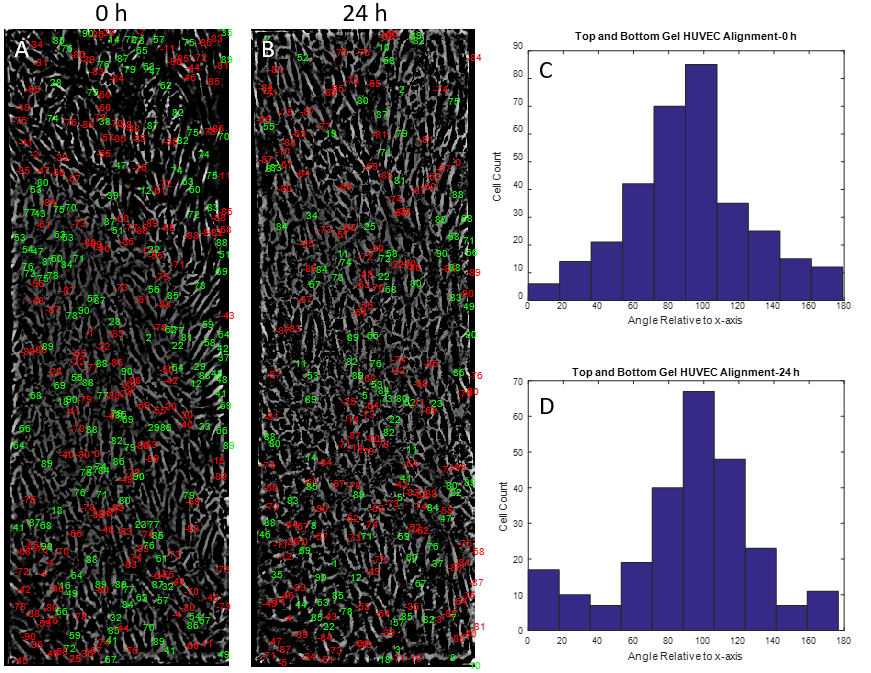
Top and Bottom Gel
Figure 1. Matlab based alignment semi-quantification of HUVECs seeded on top of a collagen I gel. (A) Matlab output of major axis angle (relative to the x-axis) of HUVECs before flow set on top of cell image. (B) HUVEC angle of alignment relative to x-axis after 24 h flow. (C) Histogram plot of A, angles changed to reflect y-axis alignment. (D) Histogram plot of B.
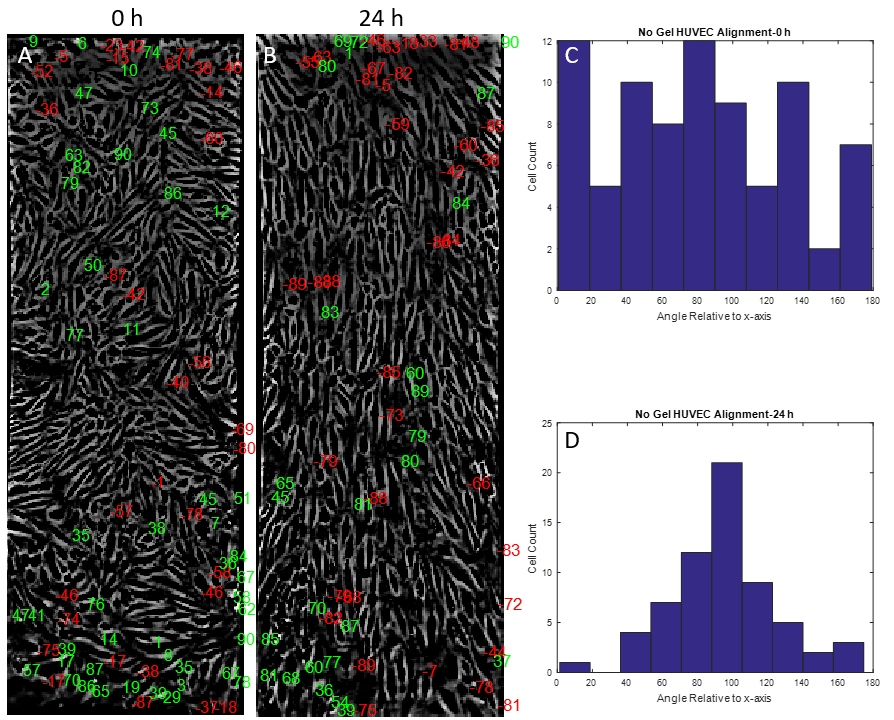
No Gel
Figure 2. Matlab based alignment semi-quantification of HUVECs seeded directly on the NPN chip. (A) Matlab output of major axis angle (relative to the x-axis) of HUVECs before flow set on top of cell image. (B) HUVEC angle of alignment relative to x-axis after 24 h flow. (C) Histogram plot of A, angles changed to reflect y-axis alignment. (D) Histogram plot of B.
Bottom Gel
Run 1
Figure 3. Matlab based alignment semi-quantification of HUVECs seeded directly on the NPN chip with collagen I gel on the reverse side. (A) Matlab output of major axis angle (relative to the x-axis) of HUVECs before flow set on top of cell image. (B) HUVEC angle of alignment relative to x-axis after 24 h flow. (C) Histogram plot of A, angles changed to reflect y-axis alignment. (D) Histogram plot of B.
Run 2
Figure 4. Matlab based alignment semi-quantification of HUVECs seeded directly on the NPN chip with collagen I gel on the reverse side (RUN 2). (A) Matlab output of major axis angle (relative to the x-axis) of HUVECs before flow set on top of cell image. (B) HUVEC angle of alignment relative to x-axis after 24 h flow. (C) Histogram plot of A, angles changed to reflect y-axis alignment. (D) Histogram plot of B.
Statistical Analysis
The next step in this data analysis is to perform some form of statistical analysis. Comparing real alignment data to a set of randomly generated alignments may be a good place to start. Also, comparing the frequency distributions of the before flow and after flow alignment histograms may provide some level of significance.
Example Shear Calculations with 1um Polystyrene Beads
Matlab Video Processing
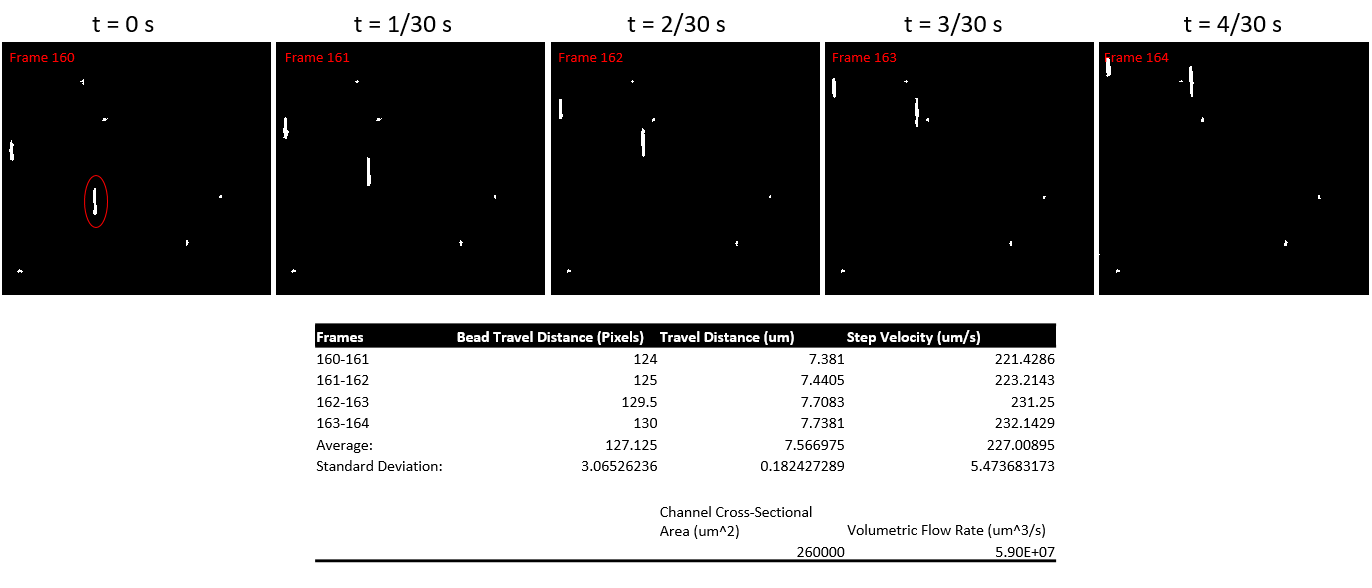
Using matlab, the video seen above was converted to gray scale frames, which were then converted to binary images (Figure 5). Matlab then tracks the center of the particle over 5 frames and calculates a distance traveled in pixels, distance traveled in um, and velocity in um/s.
Figure 5. (Top) Images showing particle trajectory over 4/30 s. Each picture represents a frame of a video shot at 30 fps. The particle circled in red was used to obtain velocity. (Bottom) Data from matlab analysis on particle velocity.
Using the formula for shear flow through a slit:
τ=6Qμ/(wh^2 )
I calculated a shear at the surface of the gel of about 0.093 dyn/cm^2. The expected shear at this level is around 6.5 dyn/cm^2.
Hello Everyone, I have been working with Track Etched membranes since last year and we always had problems with leaking and also not being able to push the flow through the membrane. At the end of the summer, i decided to test my new idea for my devices and finally i have a system which…
I did some imaging on the URinc TEM today and took the nice image below from wafer SC021. I wanted to see the correlation between highly diffracting (dark) crystals in our standard lower resolution TEM and the lattice fringes observed at high-res. In the image, the very strong <111> lattice fringe area to the upper…
Electron Beam Evaporator Protocol (V_1.0) – Lingyun Here is the first version protocol of the electron beam evaporator at RIT clean room. There is not too much to put down here – the best way to learn this is to attend the training facing the real machine tool. I will try to provide some photos…
After a few more revisions of the micro pump, I performed a significantly more thorough characterization. Flow rate was determined as before using a horizontal capillary of known volume and a stop watch. A extremely small thermocouple was inserted into the PDMS substrate directly adjacent to the fluid outlet channel emptying the…
I’ve been trying for a year now to make a nanofluidic transistor – a nanomembrane with a thin layer of metal coated in dielectric that allows for the dynamic modulation of the sieving characteristics of the chip. Beginning with the last 14 chips from wafer #1081, I coated them in ~3 nm of Ti and…
Henry and I just got back from our meeting with Dean over at RIT to talk with him about the production process for making our proposed flow dialysis system. While we were there Dean described in detail the entire production process including the anodic bonding and the parylene deposition. We also returned with membrane samples…