To normalize or not to normalize
Hello everyone! this post describes how we are going about determining the size cut-off of the membranes we make through nanosphere lithography.
These are 120 nm thick silicon nitride membranes with controlled pore size between 320 and 80 nm. A polymeric scaffold is placed on them to increase robustness. The scaffold is a square grid with 100×100 um openings and is made from SU-8 (negative photoresist) and it is another story all by itself.
The membranes are lifted off their supporting substrate (a silicon wafer) through the dissolution of a sacrificial layer (ZnO which dissolves in HCl). The free standing membrane is picked up and gently placed on a silicone gasket to be made into a fluidic device.
Here is a schematic of the cross-section of a finished device. In reality the top chamber is much taller.
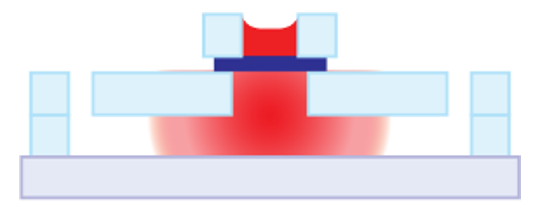
To evaluate the size cut-off, testing solutions containing fluorescent beads are placed in the top chamber while the fluorescent intensity change is recorded on the bottom channel over time. Under diffusion only this process takes a long time, long enough for the device to dry. Tom suggested creating a siphon-like device as a way to gently move the fluid from the top to the bottom chamber. Here is a picture of what that device looks like:
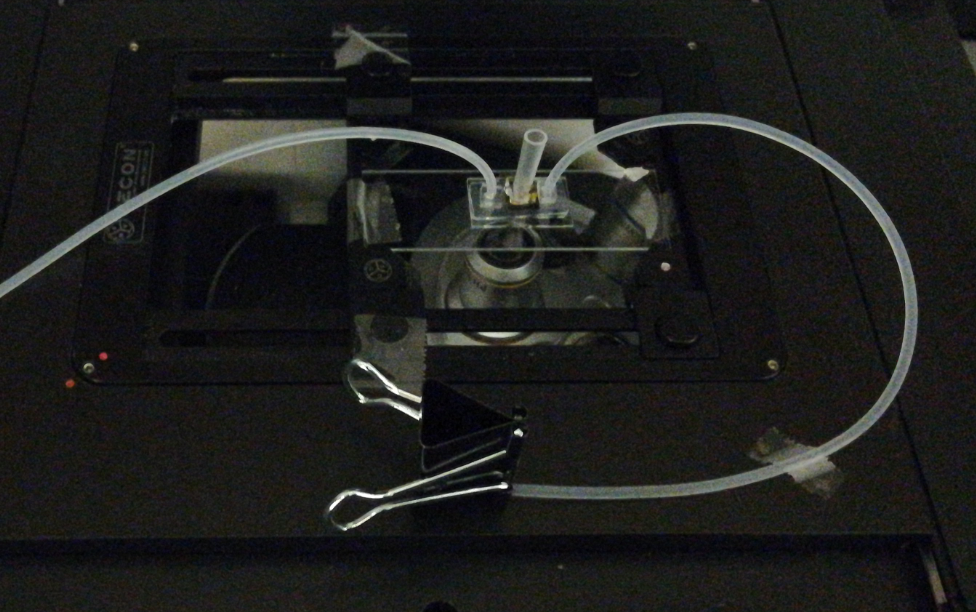
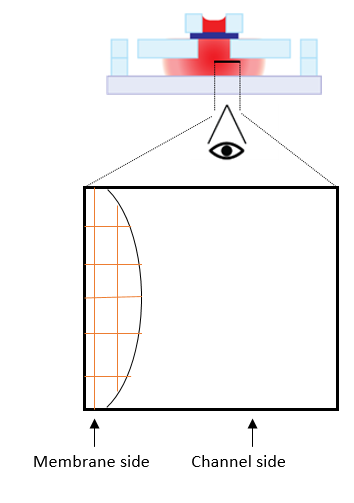
….and it works. Here is a schematic of the field of view we image:
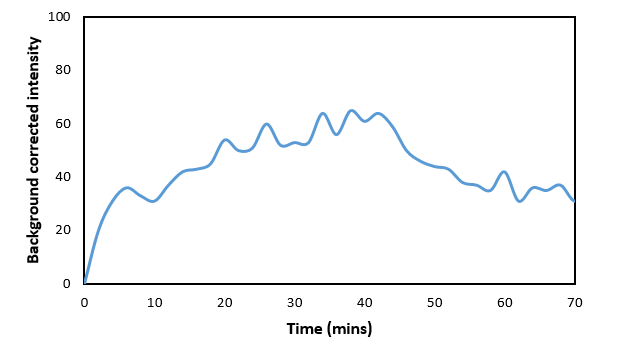
Here is some background corrected data from the intensity on the channel side for a testing solution containing 300 nm beads passing through a membrane with 330 nm pores and lots of merged pores:
The fluid exiting the bottom channel (through the tubing) was being collected in 10 min fractions. Here is what that looks like:
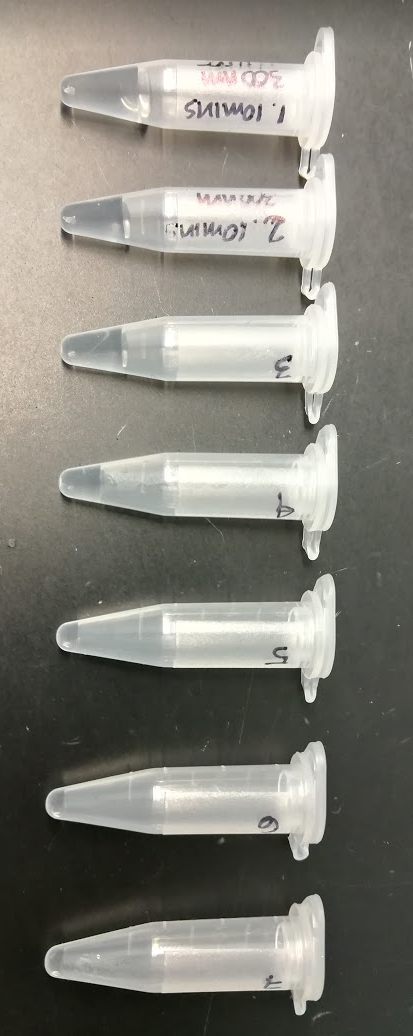
You can see the flux was decreasing over time most likely because of clogging of the membrane which may also explain why the intensity drops after 40 mins.
Now, we would like to normalize these results so that we can compare to different membranes. There are several approaches to go about this: normalize to the value obtained on the membrane side at the beginning, at each time point, or to the maximum; or normalize to the value obtained when filling up the bottom chamber with the testing solution before or after the experiment or on a second device.
What do you think?