UV-Ozone was broken, now fixed?
Nakul and I noted last week that the UV-ozone system was not performing. We took pictures of control and treated samples (2x) to measure contact angles on Amorphous, pnc-Si, Oxide and Nitride TEM grids. Our results were pathetic – most samples had less than a 10 degree decrease in contact angle, staying near 60 degrees. Below is an image of two pairs of control and treated samples. Each pair is from the same wafer. The contact angle is approximately the same for the control and treated sample.
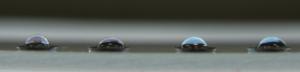
After some discussion with Jim and Barrett – we hypothesized that PDMS or other polymers present during some ozone treatments were somehow contaminating samples in future runs.
Today I tried an experiment to “clean” the system by running the vacuum line while the system was running.
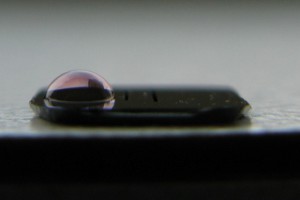
First – before treatment image (2 uL deionized water on a square SepCon):
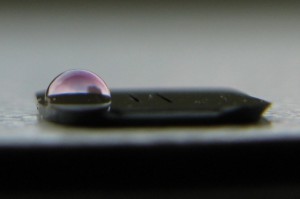
After a routine 10 minute UV-ozone treatment with supplemental ozone generation (no noticeable change):
While I don’t fully understand what might be occurring – my theory is that somehow the PDMS from prior experiments is becoming mobile/vapor-state while the system is on and then coats surfaces when the bulb and ozone are turned off. When a fresh sample is placed in days or weeks later and the bulb and ozone are turned back on, the PDMS or PDMS-remnants become mobile. When the new user turns off the bulb and ozone, all surfaces including their chips become coated with PDMS or a PDMS remnant.
Last week Nakul and I ran the UV-ozone system four or more times within an afternoon without much of a difference between the first and last runs. This suggested to me that if something was becoming mobile, it was only when the bulb and or ozone were running since opening the chamber four times did not seem help, nor did just running the system.
In my attempt to “fix” the problem, I ran the system for 15 minutes while at the same time running the vacuum line. The goal here was to remove any mobile/vapor-state PDMS remnants through the vacuum line.
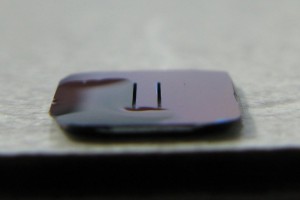
I then placed the same square SepCon in for 10 minutes like before. A similar 2 uL deionized water drop completely spread this time with a nearly 0 contact angle:
Anecdotally – I noticed last week that the tweezers no longer made that horrible screeching sound on the glass slides inside of the chamber. Today after “purging” the system, that horrible screech returned 🙂
I’m worried that this contamination has affected previous silane chemistry experiments or anything that we sent through the ozone treatment for cleaning. Potential solutions include requiring anyone who places any polymer in the chamber to run a 15 minute post-purge in an empty chamber with the vacuum running. Additionally, it’s probably a good idea to run a purge before any important experiments.
Anant and I should definitely keep this in mind as a possible explanation for the difference between his and my results for long-term stability in cell culture media.