Separations with inner membranes
This week I set up some diffusion experiments with the inner membranes of wafers 187 and 310. From the TEM images posted previously, we see that these inner membranes have what appear to be either very small pores or small divots that do not pass entirely through the membrane.
I allowed the protein standards to diffuse for 24 hours, and then I collected both retentates and filtrates and ran an SDS-PAGE (10%, silver stained). We see that proteins did indeed pass through these pores, and the separations are remarkably similar to those I performed previously (link) with much larger pores. Do we think that the small pores are the ones controlling the separations?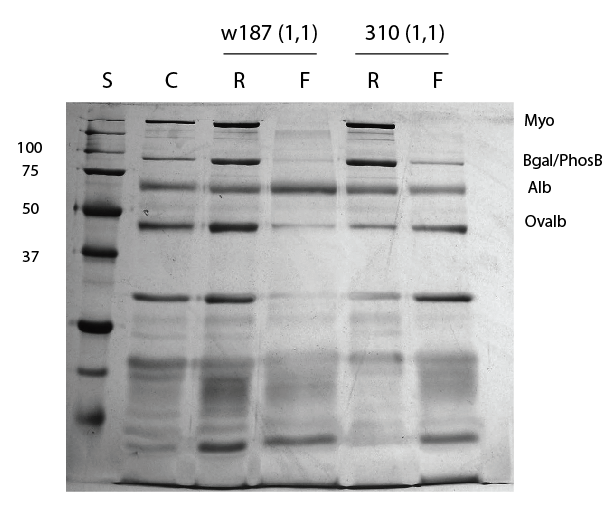 Pore histograms to follow.
Interesting. We should note that center membranes from wafer 310 did have a few larger pores (image). As for wafer 187, it is possible that there are areas with larger pores, but we’re just not seeing them in the 2um x 2um tem imaging field.
It is hard to believe that if there were only small pores in the 187 sample, that it would allow the larger proteins through…
I can also see a slight difference in intensity at the Bgal/PhosB weight for the two membranes. Did more go through 310? This would seem to correspond to the higher comparative density of larger pores in that membrane.
I think in the next imaging session, I’ll try scanning the inner membrane samples at low res. to try and pick up any larger pores.
Dave,
I think it is unlikely that these results can be explained by rare large pores. Jess is not only seeing the same cut-offs as before but roughly the same transfer rate. The membranes used here must have had open pores in reasonable numbers.
Jim
Given the low permeability numbers by Mike and Maryna in later posts, I’ve gotta change my interpretation of what is happening with 187 here. 310 shows more material transfer at the lower molecular weights and so there is some slowing by 187, but overall the protein transfer is comparable to 310 and similar to older diffusion experiments. This must be more evidence that our transport rate is not a strong function of porosity in Jess’ diffusion experiments. We’ve said it many times but seeing it still surprises me.
So I’m retracting my prior comment. This gel comes from a membrane with a very low porosity. Wow. Wish we had numbers to go with these results (porosity, pore size, etc).