Chemical Stability of 30nm Samples with RTP Treatment
Previously I ran a chemical stability study of samples from W613, which has a 30 nm thick pnc-Si layer. In that study complete failure of untreated samples was observed by 18 hours in cell culture, which was not a significant improvement from sample lifetime of 15nm thick pnc-Si. To see if RTP treatment helped the 30 nm thick samples survive we RTPed them in Ar at 800C for 5 minutes. Discoloration in DMEM +10% FBS was well as membrane stability with cells (fibroblasts, P27).

Within 19 hours discoloration of non-treated samples has progressed, with complete discoloration by 43 hours. No discoloration has been seen for the RTPed samples, though it is hard to tell this from the above image (this is a very reflective wafer). The failure with cells image is a RTPed sample; failure occurred due to cracking of the membrane. It should also be noted that these samples showed odd discoloration patterns on the membrane itself, with regions becoming brown (compared to a yellow-ish hue of the membrane in general in culture). This can be seen after 67 hours in the above image. At 167 hours, discoloration has started to occur in one of the RTPed samples.
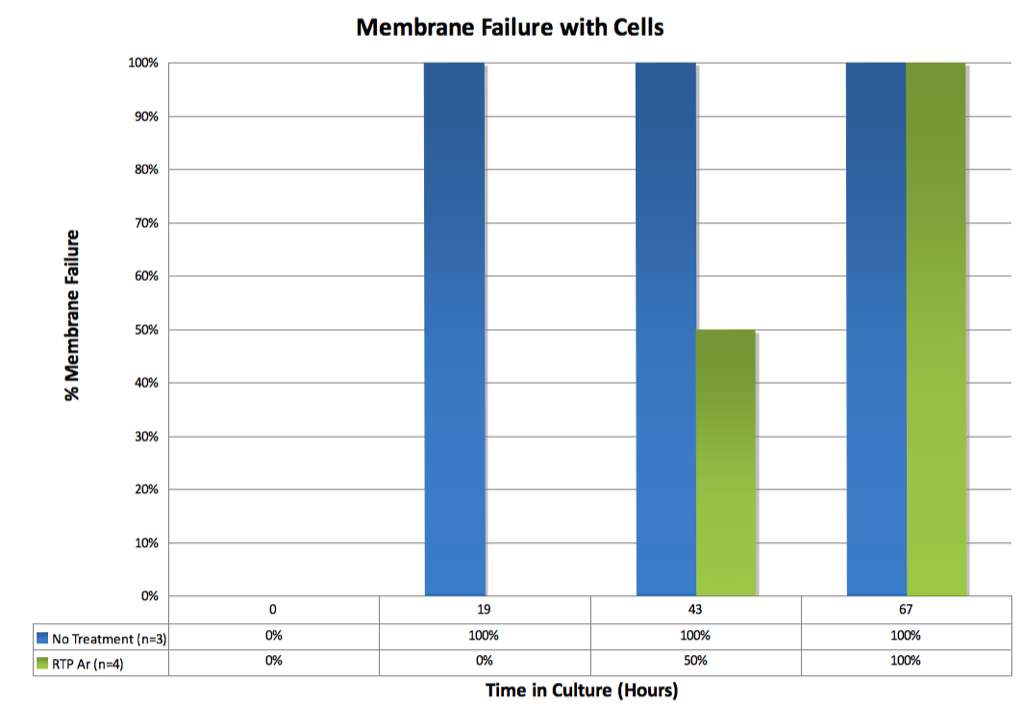
After 19 hours all non-RTPed samples have failed. Initial failure of RTPed samples started between 19 and 43 hours, with complete failure by 67 hours.
In conclusion, 30 nm thick pnc-Si samples do not seem to perform any better than 15 nm samples in culture. It may be the case that the odd etching pattern makes these samples even weaker, so “normally etched” 30 nm samples may perform better than analogous 15 nm samples.
Is the discoloration study continuing on the RTP treated samples, as the membrane breakage is likely just due to geometry? Discoloration is the more important metric, given the crazy geometry of the membranes.
Also, any luck with the silane-treated samples, regarding discoloration? Thanks!!
Yes, the discoloration study is ongoing. After 139 hours in DMEM +10% FBS the RTPed samples still show no obvious discoloration.
In regards to the silanization discoloration study, I will post the results today. Silanization did not seem to delay discoloration… we should probably repeat it to be sure.
It will be interesting to see how 30nm thick membranes with the 2 slit geometry come out. Its good to see that the discoloration takes place after 7 days. The membrane failure might have occurred due to the geometry.