Pnc-Si zeta potential
This is kind of a shot in the dark, but I wanted to see if I could get a zeta potential for pnc-Si that was as high as predicted by the electroosmosis results.
- First I tried to get the membranes to break in 1mL of PBS so that the windows were floating on top of the solution.
- Next I sonicated the solution in a bath sonicator for 3 minutes.
- Finally I ran both size and zeta potential measurements using the Malvern Zetasizer.
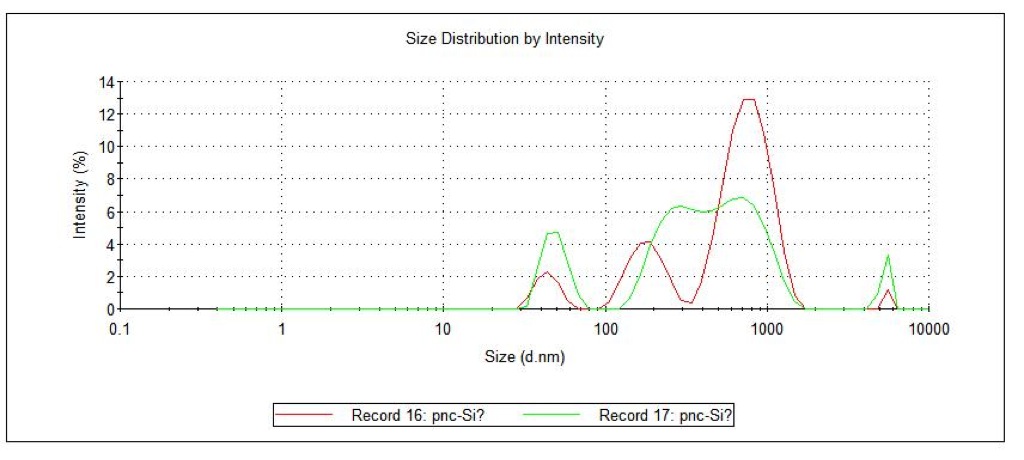
Now the idea here is that I made particles of pnc-Si by sonication. They’re probably not very similar in size or shape. Even if I actually measured the zeta potential of pnc-Si particles (which I’m not sure I believe quite yet), the zeta potential for particles is not necessarily the same as the zeta for the pores of intact membrane. Here are the results:
Size Intensity
Size Number

Zeta
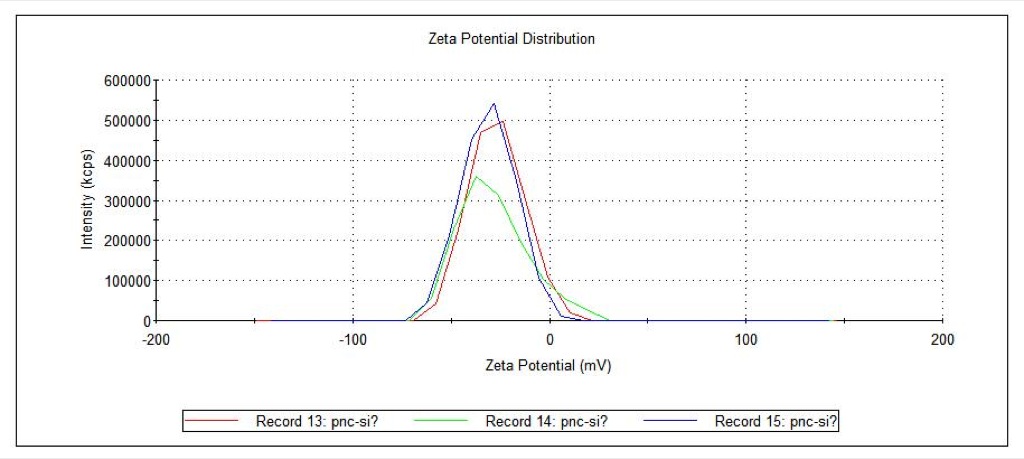
So there’s a lot of different sizes of particles, but most are around 40nm. The zeta potentials are all coming out around -30mV which is in the reasonable range for zeta potentials. So this leaves us to reconsider the electroosmosis – zeta potential arguement which predict that the zeta potential would be 3000mV (edit 15000mV for an oxidized membrane, these samples in this study were non oxidized). That being said, this method for collecting zeta potential is still rough.
15000 mV is different enough that this measurement probably means something. Still, we should figure out the maximum density of negative charge that pnc-Si could carry on its surface and what this would mean for a zeta potential. This is an advanced modeling question, but there is a calculation to be done I’m sure.