Carbonization – contact angle and discoloration
Last week, Dave carbonized some w501 samples for me so that I could look into discoloration with this new type of silicon stabilization. The carbonization recipe was:
– 1 min 50:1 HF strip to form Si:H
– Purge RTP with 100% Ar for 5 minutes
– 10 min 95% Ar 5% C2H2 flush @ 200 C in susceptor
– 10 min 95% Ar 5% C2H2 @ 500 C
– Cool down to 200 C
As controls, I had untreated and RTP’ed (800C, 5 minutes, Ar) samples. I also had Dave RTP the carbonized samples. To measure the contact angle, I dropped 4uL DIH2O onto the samples after I had rinsed them in isopropanol and dried them with compressed air. I dropped the H2O off center b/c the membrane were not intact.

The approximate contact angles (calculated in ImageJ) were:
Untreated = 26.003
RTP only = 51.754
Carbonized = 48.196
RTP+Carbonized = 48.19
I also looked at discoloration in the 2D and 3D format. I performed this experiment in “harsh” conditions – DMEM+10%FBS, oven at 37C.
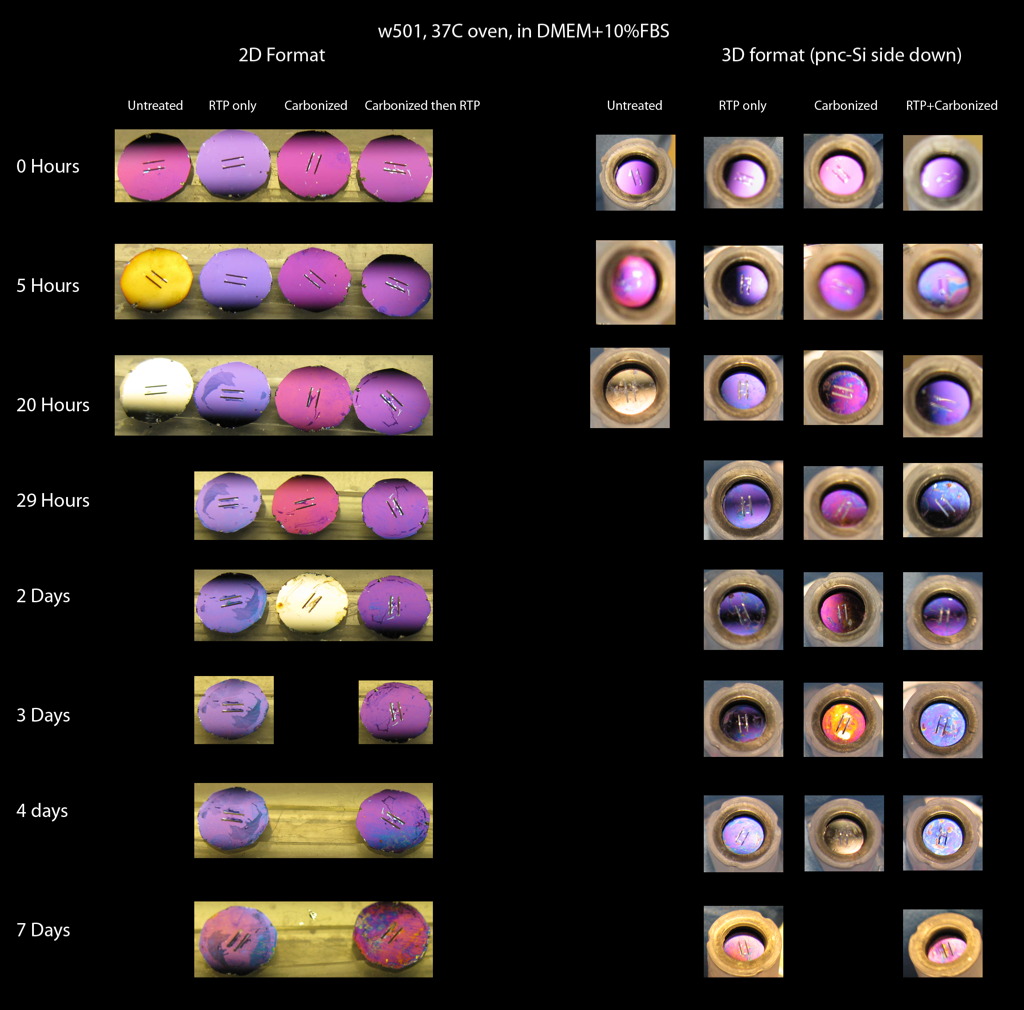
The trends in 2D and 3D are pretty close to each other – the Sepcon format delays discoloration by ~ 1 day. The untreated controls discolored within a day. Unfortunately, the carbonized sample discolored after ~ 2 days. The RTP and carbonized+RTP samples only started to discolor after ~ 7 days. There is something unusual about this wafer since RTP samples last more than a week in the oven. Also, I can’t think of why RTP’ing the carbonized sample would delay discoloration since the carbonized sample should have little to any native oxide. This was the 1st carbonization experiment, so it seems like we need to optimize for pnc-Si.
We should also note that carbonization was done inside the susceptor, which could be preventing the acetylene from hitting the membrane. The susceptor is a hollowed out disk with a cover.
There are a few slits cut into the sides so that some gas exchange is possible (but obviously much less than in an open geometry). Also, I did not tilt the chips on one side so that it’s likely that only one side of the membrane was exposed to gas.
I am also concerned with the density of Si:H at the surface of the membrane before carbonization. The process relies on the displacement of hydrogen to form Si:C. Currently, we use a HF treatment before to form the hydrogen bonds, but maybe there just isn’t enough at the surface?
Moving forward, I think we can try a few things:
1. Carbonization without the susceptor. I would put the chips on a dummy wafer.
2. Tilting the chip on one side to expose both membrane sides to gas
3. Increasing the carbonization temperature from 500 C
4. A longer HF exposure prior to treatment