Gold Update
A long running side story to my research has been attempted separations of nanogold. The basic idea is that we want to separate EM quality gold nanoparticles with the membrane, but I have had problems detecting gold in the filtrate with the zetasizer. We think this might be a result of the negatively charged gold being repelled by the membrane. This is further supported by the fact that albumin coated gold can be detected in the filtrate by the zetasizer, however albumin coating makes the separation rougher than the originally imagined hard spheres. Gold is unstable in salt solutions that shield the membrane charge and isn’t very receptive to small molecule modification.
Indee from the Turner lab is working on gold-DNA reactions, and told me that her gold was stable in 10mM salts, which is about 1 order of magnitude lower than what I’ve previously tried. Indeed my gold was stable in 10mM KCl also. I set up a diffusion experiment in the stir cell to see if I could see gold passing across the membrane, but again the zetasizer is not detecting 5nm gold in the filtrates. The stir cell also still has some larger sized contaminants (see pinhole trial post here), and these contaminants could potentially swamp out the signal from a low concentration of 5nm gold if it makes it through.
I thought I’d try an absorbance scan as well with the Tecan. The results show no gold signal in the filtrate.
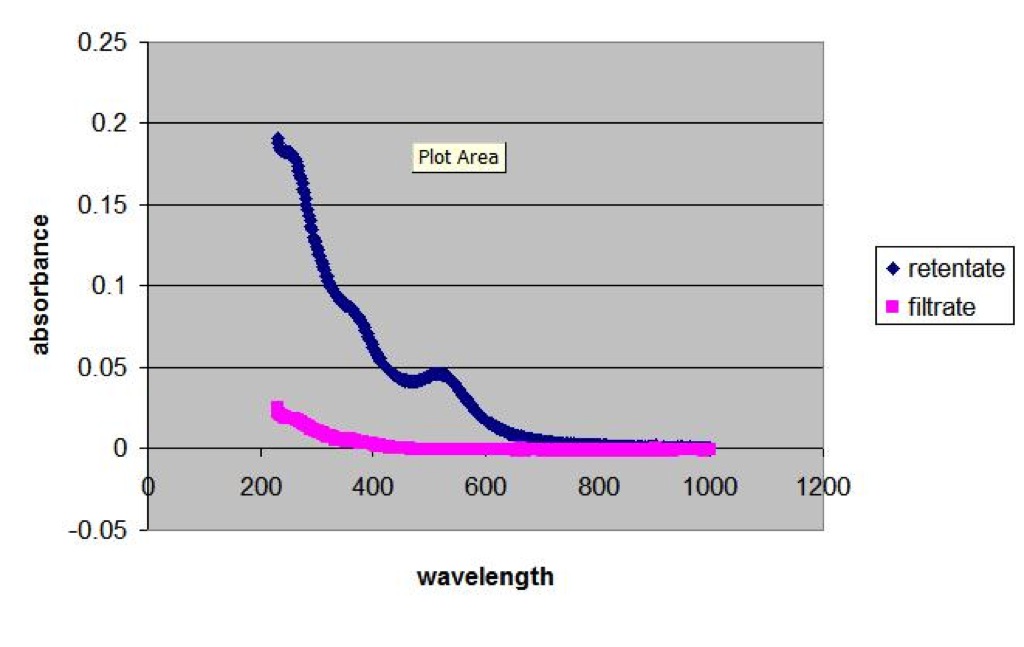
In this second scan I multiplied the filtrate by 5 (arbitrary) and it looks similar to the scan of the stock. Maybe this means some of the gold does go through.
From the literature (Zhou, Beattle, J. Colloid Interf. Sci. 2008.):
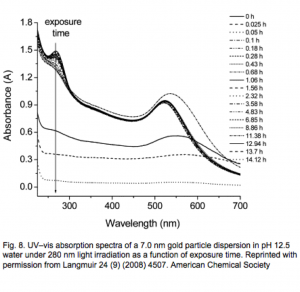
This shows light induced aggregation of gold in organics, but the intial spectrum is similar to the one I’m getting.