RTP affects short-term cell adhesion/morphology – Trial 1
Before Anant left for India, we were doing cell adhesion studies with pnc-Si transwells and getting some weird morphologies. Check it out here, here, here, here, here.
This is in contrast with the 2D studies that Anant did for the cell culture paper in which cell adhesion looked good. The main difference is the transwell format vs. 2D format. However, I’ve been customarily autoclaving the transwells instead of sterilizing with EtOH. Could the autoclave be leaching plasticizers/metal contaminants? Also, we’ve been RTPing samples before cell culture recently (and not previously).
As a first study, I compared the adhesion (after 5 hours) of b.End3 cells to 2D samples, one of which was untreated but autoclaved, one of which was RTP’ed and then sterilized with EtOH. Keep in mind that I can’t really do a -EtOH control since the samples muct be sterile for cell culture. Both samples were from TEM023, and cells were stained with CMFDA and then fixed. The first 3 images are 3 different areas from the same sample. The last images are 40X.
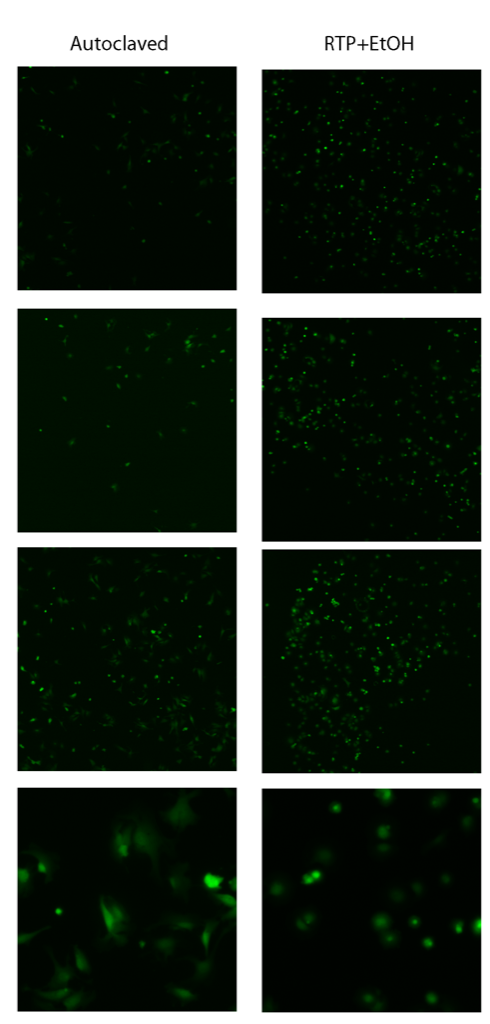 The cells on the autoclaved samples were spread out quite a bit and you can start to tell that they’re endothelial cells. By contrast, cells on the RTP’d sample were largely rounded. There is faintly stained cytoplasm surrounding the bright nucleus on some cells, which indicates that the cells are spreading, but their morphoogy is not as “mature” as on the autoclaved samples. This shows that the autoclave isn’t necessarily altering the surface and rendering unfavorable for cell adhesion. HOWEVER, this sample was autoclaved “by itself” – in a glass beaker only with another pnc-Si sample. It’s possible that adhesion would be different in samples that were autoclaved with Sepcon plastic and O-rings in the beaker. Also, it’s possible that I did a poor job of rinsing the EtOH from the RTP’ed sample and the cells reacted to that. I’m going to do another study with a couple extra controls to look into these possibilities.
Let me know if you notice any other unusual trends with the RTPed samples. I’ve been doing some carbonization work and there’s a chance that the surface of RTPed samples has changed due to residual acetylene that might be outgassing off the chamber wall during other processes…