Track-etched membrane permeability in transwell format
I finally got some MATLAB code working which calculates permeability coefficients (P, in cm/s) from a non-sink, generalized equation. This data is from (n=5) fluorescein (MW~370 Da) transport experiments in the Tecan (time vs. receiver well concentration (Cr) values). In this first set of data, I used polycarbonate and polyester transwells, at room temperature, without spinning. These track-etched membranes both have 0.4um pores, but different pore densities. To calculate the porosity, I assumed that all of the pores were single through-pores.
| Polycarbonate (PC) | Polyester (PET) | |
| Pores/cm2 | 1*108 | 4*106 |
| Porosity (%) | 12.57 | 0.50 |
| P (cm/s) | 12.6*10-5 | 5.23*10-5 |
| Std. Dev. | 2.24*10-5 | .97*10-5 |
20X images of transwell membranes:
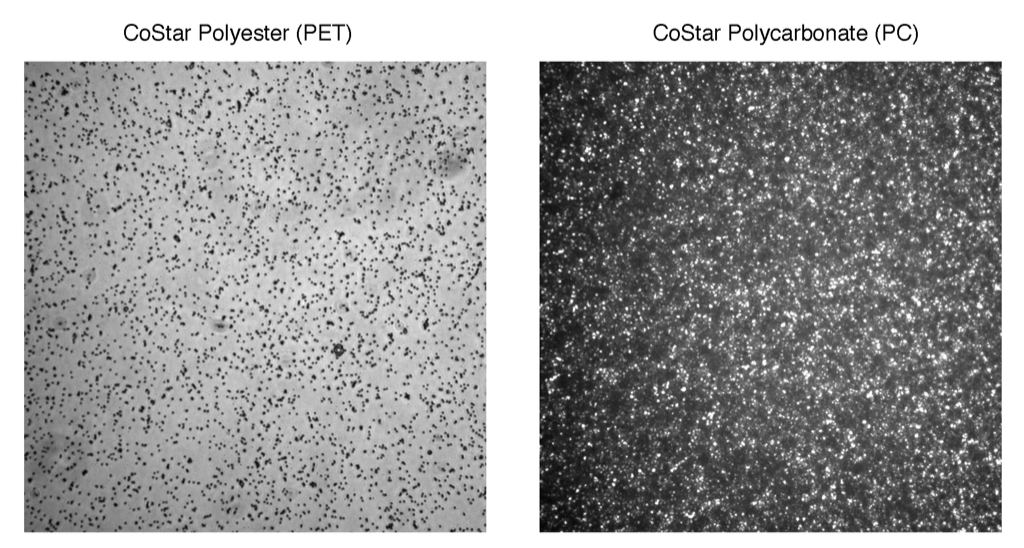
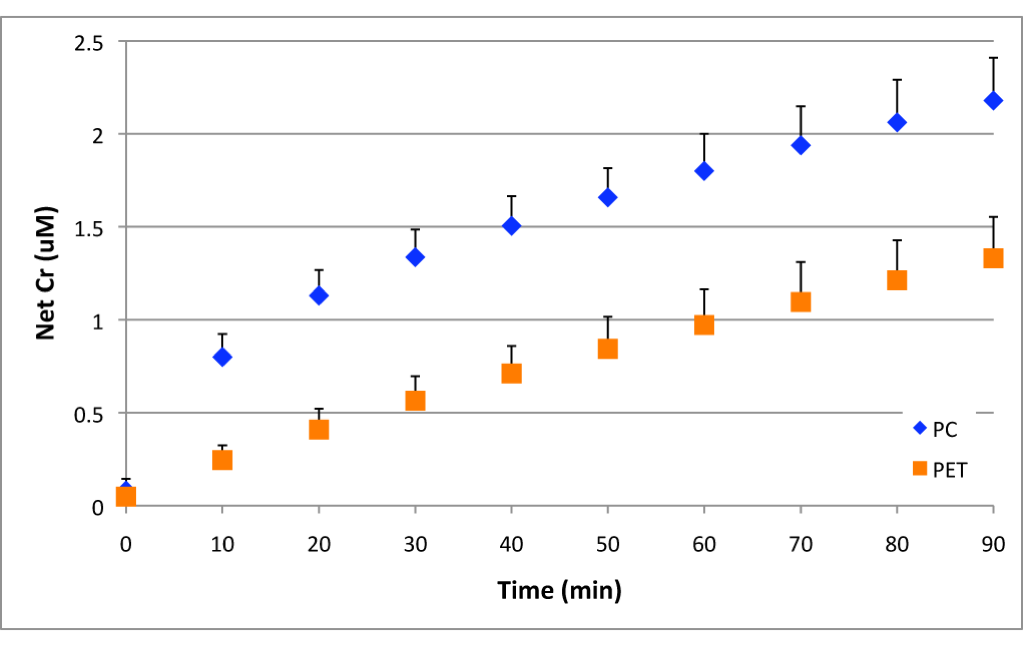
These permeability coefficients are ~1-2 orders of magnitude greater than values reported for highly permeable drugs through cell monolayers, so that makes sense. Even though PET membranes have ~ 25x less porosoty than PC membranes, they are only ~2x less permeable. This could mean 2 things: these P represet the permeability of the unstirred water layer since large changes in porosity do not affect the apparent permeability. Alternatively, could changes in porosity be less dominant than other filter/diffusion characteristics? Many studies do not report the intrinsic permeability of membranes without cells, but one I found (Gaillard and de Boer. Eur J Pharm Sci 12(2000) 95–102) that reported 13.1*10-5 cm/s for collagen-coated PC transwells – basically the same as what I calculated. So I think my protocol and analyses are legit.
Here is the averaged receiver concentration (Cr) and time data for the 5 trials:
Experimental data (blue *) and non-linear fit (red curve) for PC and PET transwells (average from 5 trials):
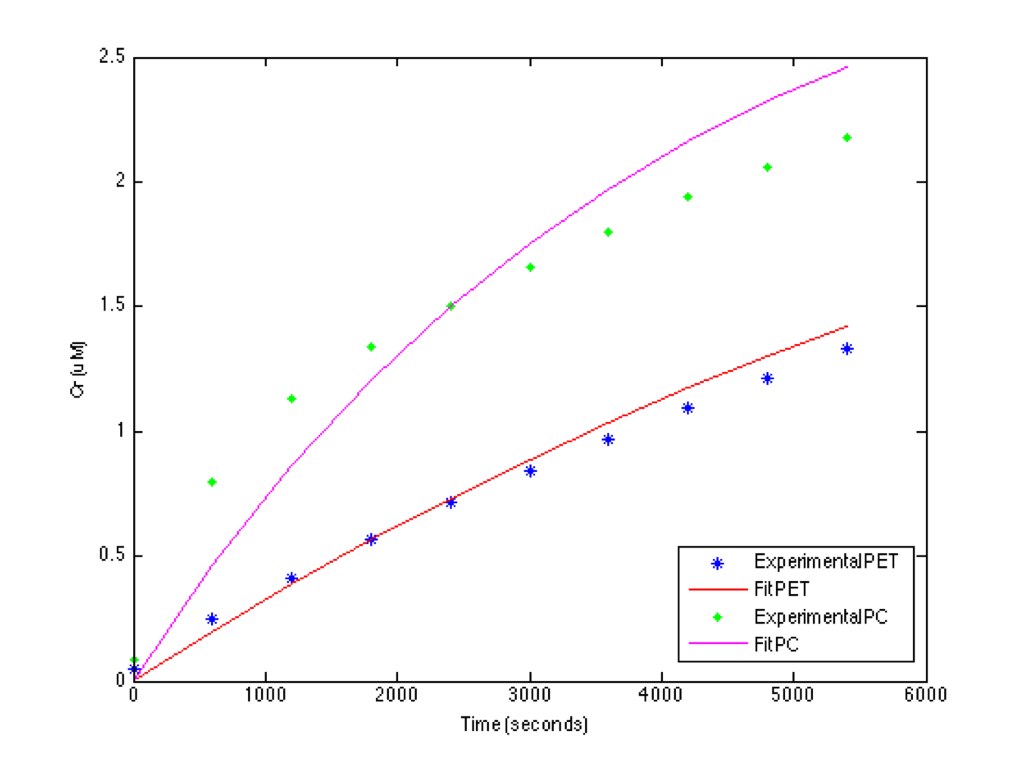
I used lsqcurvefit in matlab to minimize the sum of squared residuals based on changing P in a generalized equation for Cr(t) in non-sink conditions. Although the solutions didn’t converge in the optimization procedure, the changes in the differences were smaller than the default tolerance in the MATLAB options structure. Plus, the solutions matched those I calculated in Excel using Solver (before Solver stopped working for me).
Which membrane has the worse imaging characteristics. If it is PC, then I can understand why both are available commercially. They serve slightly different purposes: PC is more permeable but PET is better for imaging. What is the difference in the cost of the two?
These different membranes are the same price – ~$4 per insert.
The PET is more transparent – the PC is totally opaque and useless for imaging.