Closed System Device
One aspect of the blood brain barrier device is that it be a closed flow system. This would not only better mimic an in vivo environment, but also maintain Sema4D activity, negatively affecting endothelial cell junctions and providing a target for the antibody.
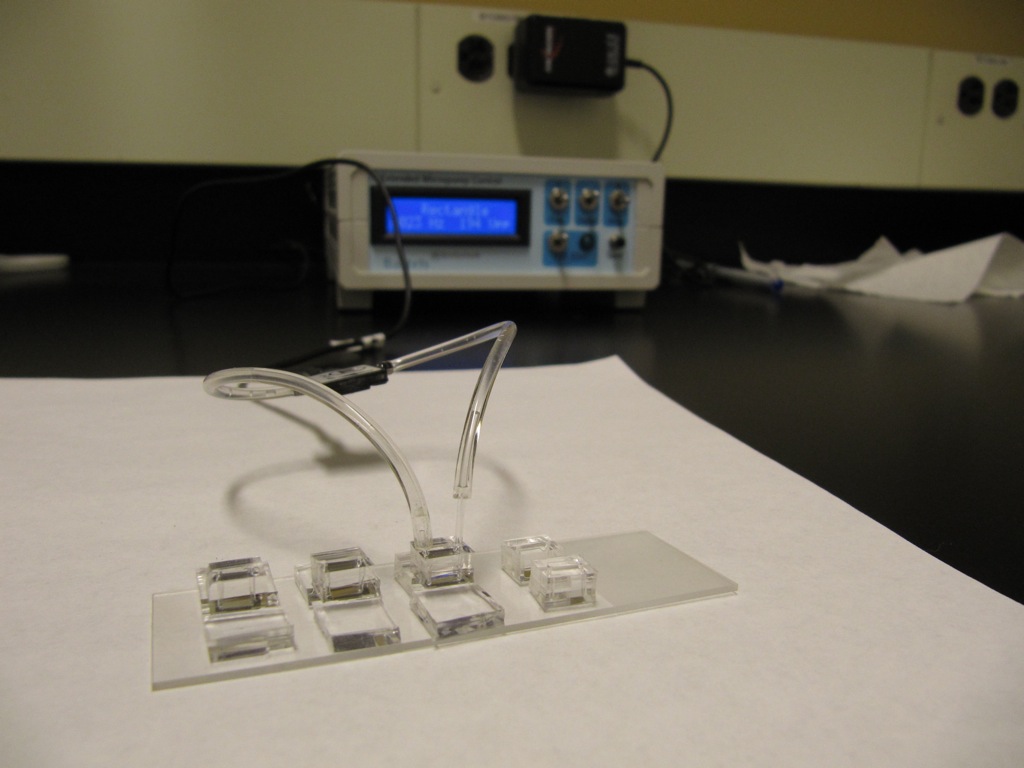
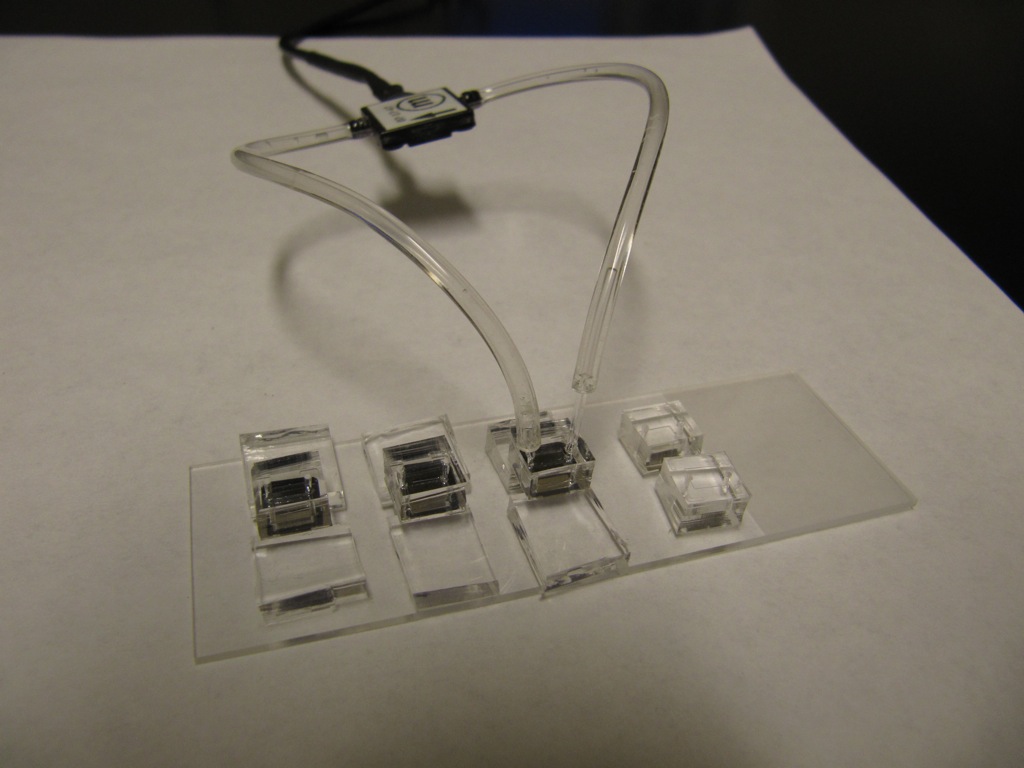
The microporous membranes were not yet available, so a closed flow system was made using one of the remaining Barrett chambers connected to a piezoelectric pump. Because the membrane is very delicate, the flow rate was kept extremely low, otherwise the membrane would rupture (this happened on 2 out of 3 chambers). The fact that one side of the membrane was exposed to air could have also made it more delicate, so in a closed system with both wells containing some sort of fluid, the membrane may be less likely to break. Regardless, I’d recommend starting below 5 Hz and 180 V, as movement can be seen at these parameters, increasing slowly if necessary. At the bottom of this post are pictures of the closed system, along with a video showing movement of 15 um beads (diluted 1:50 in water) on the membrane.
The trickiest part of this set-up is actually obtaining a closed system with no air bubbles. Even when the rubber tubing was loaded with water and water had been introduced into the chamber, upon insertion of the rubber tubing onto the glass capillary tubes, air bubbles formed. The bubbles would then be caught in the corners of the PDMS mold, where water enters the chamber, and affect the flow. This is why, in the video, the membrane is vibrating and the beads are bouncing around rather than flowing across the membrane (flow was briefly achieved, but not captured on video). It wasn’t possible to push the bubbles out by increasing flow as the membranes are delicate, so in future iterations of the device, two modifications could be made. The first would be to eliminate the corners, either by rounding the corners or having the capillary tubes inserted parallel to the membrane. The second would be to have two three-way valves added, one before water enters the device, and the second after. The three-way valve before the device would provide an additional source of water and the valve afterwards would remove the air bubbles. Once the system is air bubble-free, both valves could be closed and the water would circulate in the system. This would be a great way to introduce other solutions into the chambers, but the downfall of this set-up would be the added bulkiness.
Pictures:
 |
 |
 |
 |
 |
Video: mem4_reformatted