More details on INT cartridge's "desalting" column
First things first, the desalting column is not intended to desalt. Apparently that’s just an old name that has carried over. The current purpose is to separate viruses from large debris after sonication.
The sample in a buffer solution will be placed in the center of the cartridge and sonicated in the “glass bead pod”. Next, the syringe will pull the sonicated material in buffer solution out of the center column and push it into the base of the column formally known as “desalting”. I’ll call it separating column from now on. The debris should be stopped at the base of the separating column by a membrane with ~1 µm pores. The rest will pass through the column and get stopped at the top of the separating column by a membrane with ~80 nm pores. The process should concentrate viruses at the top of the column.
Next, a solution of guanadine and possibly SDS will be passed through the separating column to denature the viruses and allow denatured proteins and nucleic acids to pass through the membrane at the top of the column and get collected for further processing.
INT is considering adding glass beads to the separation column to reduce the total volumen of fluid necessary.
Here’s a schematic illustrating what I typed above:
Mike Connolly reiterated that we can use INT’s laser to fabricate some prototype devices if we think it helpful. Here’s a photo of a placard they have showing how they’ve made their own protoypes in the past:
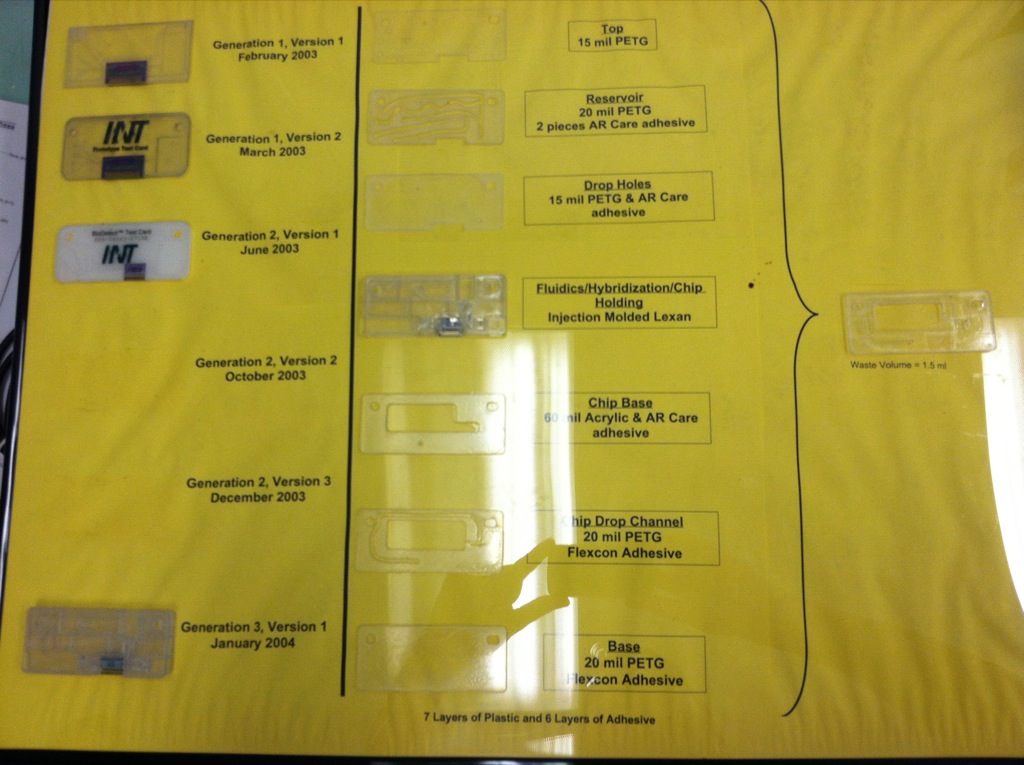
The have a variety of rolls of laminates and plastics as well as a laminator. Mike offered its use for this or any other project. Nate did not seem as enthusiastic about our chances of success because they had problems breaking their own silicon chips in the past during assembly.