SEPCON 0.1% SDS pretreatment
After discussions with the gentleman in charge of surface functionalization at INT last week, Jim suggested that I attempt to pretreat our membranes with 0.1% SDS before a filtration. The hope being that some surfactant left on the surface of the membrane would be enough to facilitate water passage through the membrane without wetting the backside. (A separate backside wetting step will be impossible once the membrane is placed in INT’s cartridge)
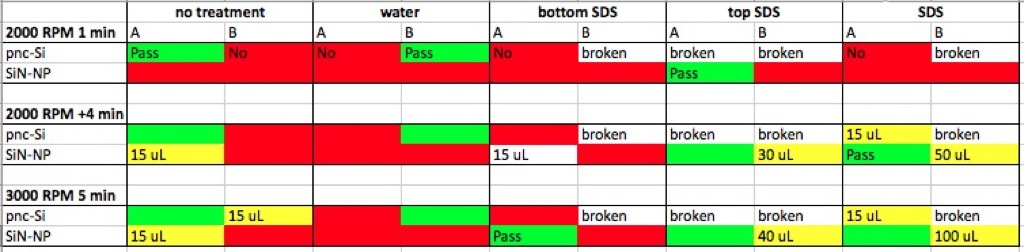
To that end I used 40 nm pnc-Si and 40/50 nm SiN-NP (wafer # 1019) to test the following pretreatments: no treatment, a dip in water only, SDS on the “bottom” side of the assembled SEPCON (initially dry), SDS on the “top” side (the side facing up and receiving the initial sample), and SDS on both sides of membrane. I started with 2 chips for each condition, A and B. The SDS is 0.1%. To treat both sides, the chips were submerged in SDS. To treat either the front or back only, 5 µL of SDS was pipetted on the respective side. All samples were dried directly on the benchtop, exposed to ambient air for several hours. The chips were then assembled into the plastic SEPCONs and spun for increasingly longer duration and higher RPM, as seen in the chart below. Green means passed entirely, yellow indicates partial passage, and red means no passage.
Generally speaking, the SDS did improve the chances of getting water to flow through the membranes for the SiN-NP samples. Unfortunately, the drying process seems to have broken the majority of pnc-Si chips, so it’s hard to measure the effect of SDS. (I imagine this would be avoided if we treated an entire wafer using normal wet processes.)
I can’t explain why some samples pass all of the water easily, such as the untreated pnc-Si, but I’ve had similar, seemingly random, results such as this before. I don’t believe the membranes are broken. Going out on a limb, it could be that during assembly my breath is hydrating the membrane?
The dried 5 µL of SDS left a very visible spot of material on the chip. It’s probably not worth repeating that experiment, since the submerged sample performed as well or better and was easier to prepare.
The SiN results do seem promising. Although coating the sample facing side is not supposed to help if the wet/dry problem is as we described it for pnc-Si. You might want to check out Tom/Nakul’s work using Ally Alcohol as a membrane pretreatment .