Etched vs. Unetched Non-Porous SiO2 Membrane Spreading
Overview:
Bob etched 4 non-porous membranes, on the backside of the membrane. HUVECs were to be grown on these etched non-porous SiO2 membranes and compared to unetched non-porous membranes. Below Bob describes how the membranes were etched:
“Four of the non-porous SiO2 membranes were placed on a ø6” carrier wafer with the membrane facing up in the Drytek Quad reactive ion etcher (RIE) tool. RIE was run for 15 sec. at following conditions: 100 mTorr, 125 W power, 50 SCCM SF6, 100 SCCM Ar.” -Bob
The process removed approximately 20nm of thickness.
Methods:
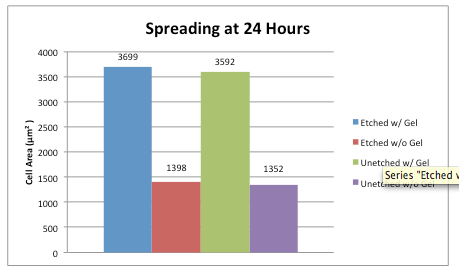
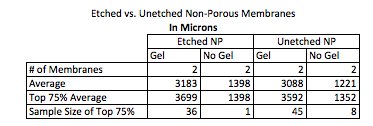
An experiment was set up where 2 of the ethced membranes received 1% Geltrex and 2 of them did not. In addition to the 4 etched non-porous membranes, there were also 4 unetched non-porous membranes, 2 of them received 1% geltrex and 2 of them did not. HUVECs were seeded onto the membranes at 250 cells/well. Media was added to each of the wells after 1 hr. At 24 hours, the wells were fixed with 3.7% formaldahyde, and permeablized with 0.1% Triton-100X. The cells were stained with DAPI/Phallodin (1:400,1:200) for 15 minutes and then washed and imaged. ImageJ processing was done to determine the average cell area for each of the membrane conditions.The ImageJ processing was the same as shown in the previous post HUVEC Spreading on Different SiO2 Membranes. The results are as follows:
Conclusion:
It was hypothesized that the etching of the membranes would created a roughened surface allowing for the cells to better adhere and spread on the membranes. The data concludes that the etching to the non-porous SiO2 membranes does not make a difference in HUVEC adhesion. Both with and without the addition of 1% Geltrex, the etched membranes had the same spreading area as the unetched membranes.