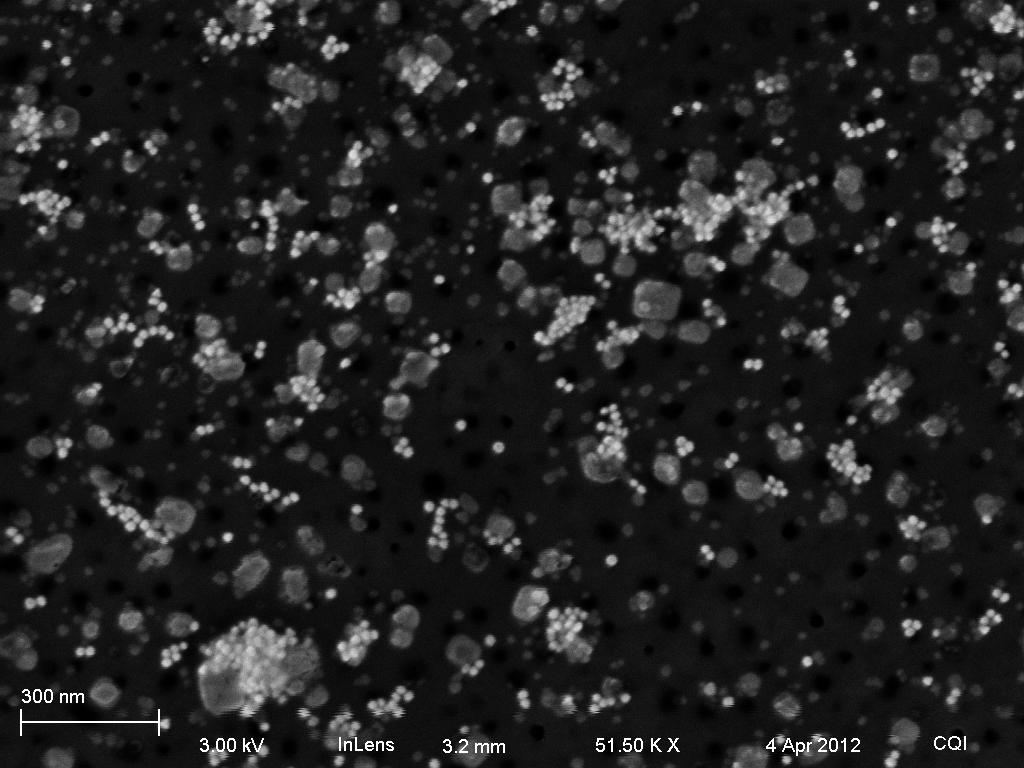
Over the last week or so I’ve taken some lovely SEM pictures with Joe, used the light scatter, and ran some separations on filters I assembled myself. Someone from the Barcikowski lab, Dr. Rehbock, got in touch with me and sent me an updated description of the four samples they’re sending and what they want done with them:
1) 7-10 nm bioconjugated gold colloid with peptide ligands in the supernatant (pH=9); retentate free of ligands
2) Bimodal gold colloids with fractions 7-10 nm and about 20 nm (pH=9); permeate with fraction < 10 nm
I plan to use next week to do some similar separations, ie separating out 5nm gold out of a mix of 5 and 10nm stock, so that when the samples come I can just troubleshoot instead of starting protocols from scratch. The Samples are due to arrive by the end of April.
After assembling some 20nm filters from scratch I used them to separate 5nm, 10nm, 15nm, and 20nm gold. I used the standard curves from my previous experiment to get the percentages.
For the 5nm gold particles, the average dilution was 33% (where 100% was the 1:1 dilution of the stock solution in your drawer)
for 10nm – 41%
15nm – 4%
20nm – 3%
Note that 10% is the cutoff for the machine, so that both the 15nm and 20nm results are noise.
I used the light scatterer on the filtrate of my separations. The results were as follows:
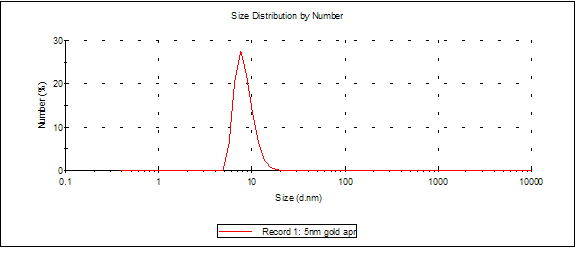
5nm gold had its largest number PSD peak (averaged over three samples) at 9.09nm:
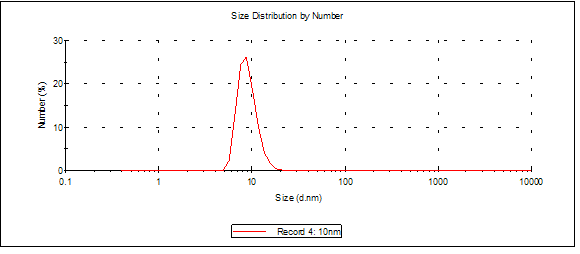
10nm at 8.86nm:
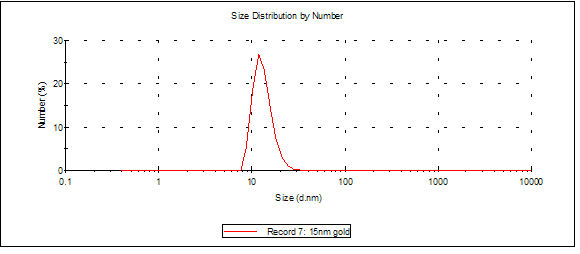
15nm at 13.2nm:
20nm at 22.6nm:
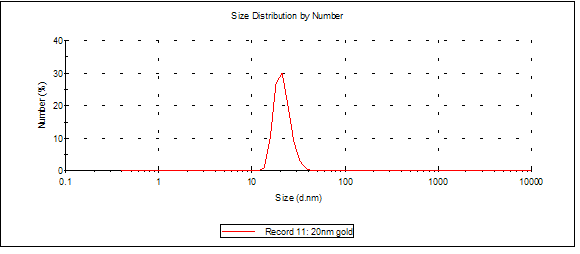
I think this means that the 5nm samples are clumping up preferentially in pairs, but everything else looks fair.
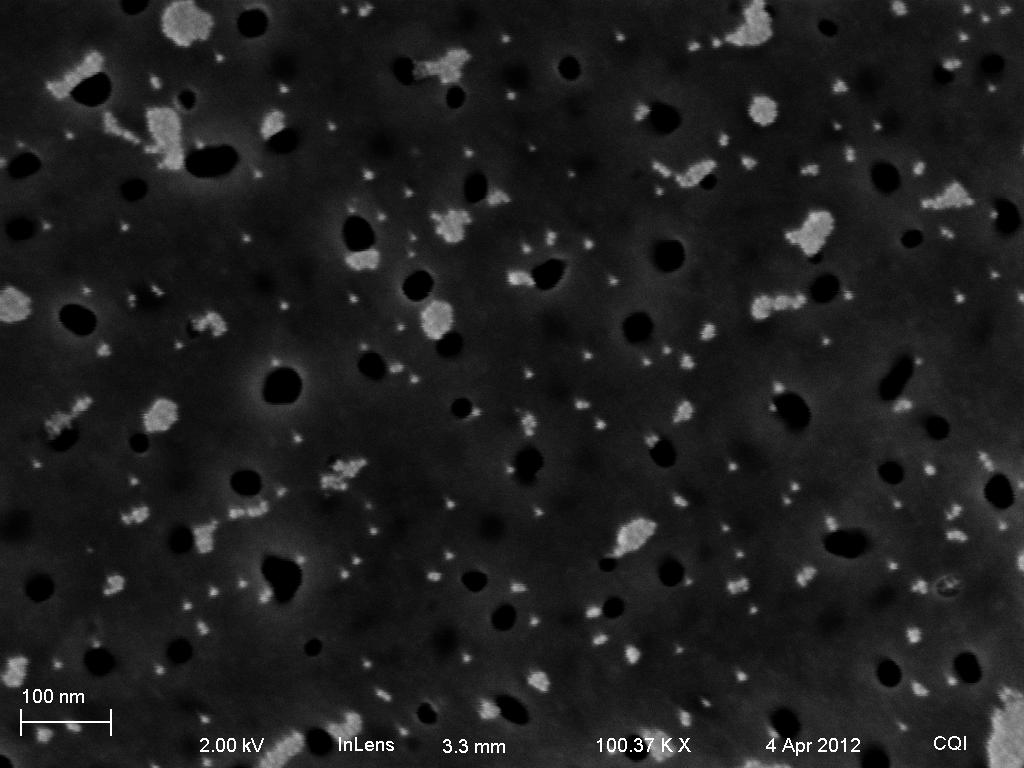
Four representative pictures of my SEM session with Joe are below:
Within the past few weeks we have been working on finalizing an architecture for PETL dialysis that can be cut out, assembled, and disassembled repetitively with precision. Within the past week we were able to replicate the results Kilean achieved back in March with capturing gold particles in the membrane using tangential two-pump flow. 80…
Initial studies into the mechanical properties of pnc-Si were carried out using the “bulge test”. With JP’s help, we’ve collected a large amount of pressure-displacement measurements. This technique has been used to investigate thin film membranes suspended over windows of different geometries e.g. Vlassak. In this study, we measure the deflection of a pressurized membrane…
Just to double check the numbers I calculated on Tuesday I ran some wet-wet trials with 100K and 300K Nanoseps. Based on the wet-dry results we would expect that the permeability for the 100K Nanosep would be higher than that of the 100K Microcon. It goes without saying that the 300K Nanosep would also be…
A bit of background: In order to quantify how permeable a tissue barrier is, we use a method known as trans epithelial electrical resistance (TEER). Cells are grown on a permeable growth substrate in a transwell format. When the cells are not confluent, there is a continuous diffusion of ions across the two sides of…
PLEASE read this journal article for NRG on Tuesday March 18th @ RIT (PDF links are at the bottom) Surface Chemical Modification of Poly(dimethylsiloxane) for the Enhanced Adhesion and Proliferation of Mesenchymal Stem Cells Shreyas Kuddannaya,†,§ Yon Jin Chuah,‡,§ Min Hui Adeline Lee,‡ Nishanth V. Menon,‡ Yuejun Kang,*,‡and Yilei Zhang*,† I’d like to discuss this paper…
The paper that came out from Shigeru’s laboratory earlier this year in Analyitical Chemistry (Ishimatsu et al. 2010 downloadable here) demonstrated that the permeability of pnc-Si membranes to small monovalent ions in 0.1 M salt is predictable from membrane geometry alone. The paper also shows that multivalent and/or large ions do not follow theory as…