Material changes
There’s been a flurry of activity regarding Jess’ recent discoloration post. Specifically, there is a discussion about the recent materials changes that have taken place due to the rebuilt CVC sputterer. This post is meant to supplement the ongoing materials discussion. I have noticed that films deposited post-rebuild seem to have less background texture and the pores appear rounder (see image below). Both wafers were processed identically except for the base pressure during deposition (i.e. deposition pre & post-rebuild). Unfortunately, the trade-off with having a purer material is that its chemical resistance decreases (maybe).
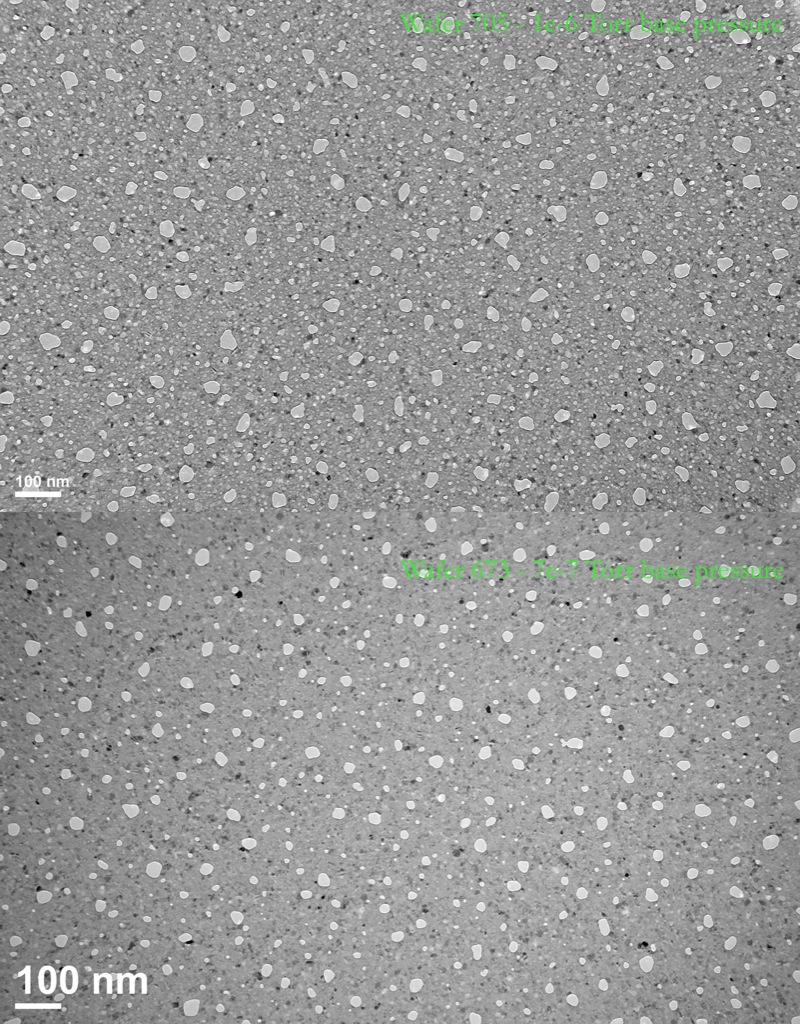
I propose a study to explore the effects of several deposition base pressures (i.e. different impurity content) on discoloration rate. Our standard 40/15/40 stack will be deposited using the two sputtering systems and then RTPed at 1000 C. We can then break the wafer into pieces and perform several post-oxide-strip treatments (RTP, Ozone, RTP+Ozone).
- Wafer 1: CVC system, base 1e-6 Torr
- Wafer 2: CVC system, base 7e-7 Torr
- Wafer 3: AJA system, base 2e-7 Torr
I will coordinate with Jess and Barrett (and whoever else has interest) to test the different wafers & treatments for discoloration under the various chemical solutions.
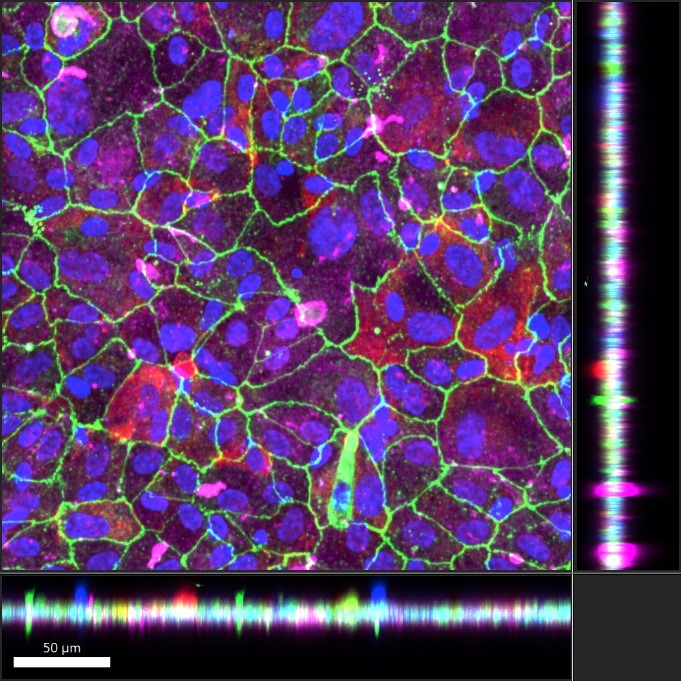
To add to the list of noticed differences, Tom mentioned that the material he worked with recently was more hydrophobic than any he has seen before. Contact angle images might be an interesting part of this study.
Wow – this is pretty dramatic. Given how small the amount of contamination was in the chamber, this is fairly amazing. It just shows how reactive oxygen and water can be in a vacuum, and how little material we are really putting down.
Everything is starting to make sense, and I think we have learned more about our material in the last couple weeks than we had in the previous 2 years. Score that a win, but now we need to deal with the other issues that are going to trickle down from this purity improvement.
I’m not keen on re-contaminating the films, but as a stopgap measure to get a paper out – OK. The best thing would be a controlled flow of O2 during the process, but we have no way to flow such a tiny (contaminant-level) amount of gas. The base pressure suggestion is reasonable, but to clarify, this is just the base pressure before the Si dep? You would probably clean the target, turn off the plasma, flow, say 100 SCCM O2, then pump to the “test” base pressure, re-strike the plasma and immediately start depositing? I guess this is worth a try.
It also makes sense that these are more hydrophobic – smooth and pure Si. Does ozone help?
Regarding hydrophobicity – remember Jess’ first set of contact angle measurements? Does the current material match or is it worse? I thought she had some luck with plasma treatment, but it only lasted a day or something. Can’t remember if ozone was tried.
I think Tom did UV/ozone as part of the study he completed for the manuscript, although I doubt that he measured the angle. Only now I’m back to being confused because I thought the material Tom used was w705 which according to Dave’s post and time-table was created before the rebuild. Since we’ve been doing the rebuild in steps, we may have an array of material properties. I’ll ask Tom to comment when I see him.
Yes, my recent permeability work was on w705. I did not perform contact angle tests. Jim, I don’t recall my specific comments about hydrophobicity – at this time I am going to say that it wasn’t anything really different.