SepCon EQ Format Separation
We finally achieved a separation using the EQ format. 4 SepCons from wafer 319 were loaded with 500 uL of .93 mg/mL clarified brain extract. They were run at 1000 rpm (which we roughly figured to be 3.3 psi initially) for 2 hours. After 2 hours, I judged the flow through the membrane to be too little to test for protein in the filtrate. I decided to run these samples overnight for about 23 hours all together. One tube had broken during the run, and the remaining three passed from 40 – 80 ul. I concentrated the filtrate using a 10kD Millipore MicroCon device (14000 g, 15 min) to about 100 ul. I then ran the retentates and concentrated filtrates of all three samples on the following gel.
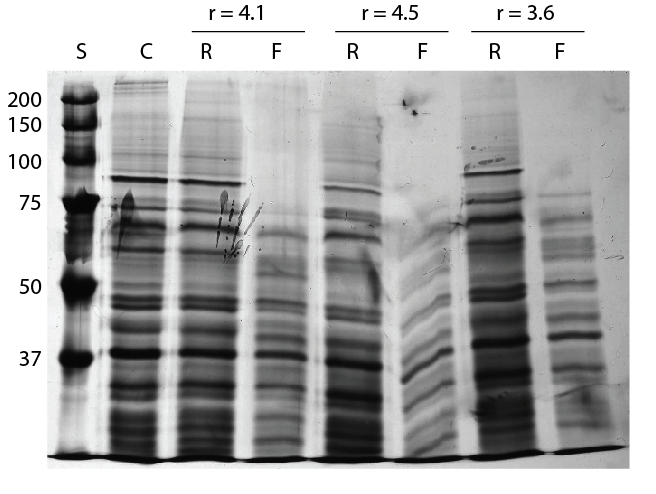 We can see that in all three cases, the filtrate shows a distinct cutoff around 75 kD. We can’t observe depletion of the lower molecular weights in the retenate since so little of the starting volume passed the membrane. I will be following up this result with some diffusion experiments. One issue though is that w319 had many pinholes, and it may be difficult to find more usable samples.
Woohoo! This is excellent news!
Thanks for sticking with the plan until it worked. The porosity of the outer membranes for 319 are ~4% and the pores in this membrane are around ~30 nm. I think the protein is clearly redefining the the pore sizes in these experiments to create a low permeability and low MW cut-off. The cut-off looks sharp to me. We need to do a densitometry scan on these lanes.
We also don’t see much enhancement of the small molecular weight species relative to the large molecular weight species in the filtrate. I think this is expected with convection.
I predict that the diffusion experiments will allow everything to go through and that small MW will be clearly enhanced over large MW. I can’t wait to see them.
We should revisit your work imaging proteins stuck to the membranes as part of this. Lets redo the quantification with diffusion vs. forced flow and do the TEM imaging in both cases.
What was the cut-off of the microcon you used for concentration?
This looks very good! Did we ever answer those questions that keep coming up about what the real sizes of these proteins are in the extract before denaturing them? I doubt the cutoff is really 75 kD, since all TEMs of wafer 319 show pores approaching 50nm. That famous dark band that keeps being held back must really be quite large, correct? It is a nice looking cutoff, no matter the size.
Anyway, we’ll continue trying to get you viable membranes fro these separations…
Dave has histograms up for inner and outer membranes from w319 (post from Dec. 19).
For (0,0) mean pore size: 29, Porosity: 1.2, cut-off: 44
For (0,5) mean pore size: 25, 3.5%, cut-off: 47
I’ve seen this before. The gradient doesn’t seem to be as strong in the pore sizes as it is in the porosity. Thats gotta be a clue to pore generating mechanism.
The gels looks pretty clean above 80 kD so I think we must have much smaller pores in practice. My guess is that huge proteins from the extract – say 15 nm or so – are coating the walls of the large pores making tunnels that are 10 nm or so.
We could take these gels to Alan Friedman in the Proteomics Center and ask him to identify that famous dark band for us. Since it is right at the cut-off (and possibly helping to create the cut-off) this could be very illuminating.