Incorporating Debye Length into EO Theory
During my previous derivations of electroosmotic theory, I described the electroosmotic velocity using the classical Helmholtz-Smoluchowski equation:
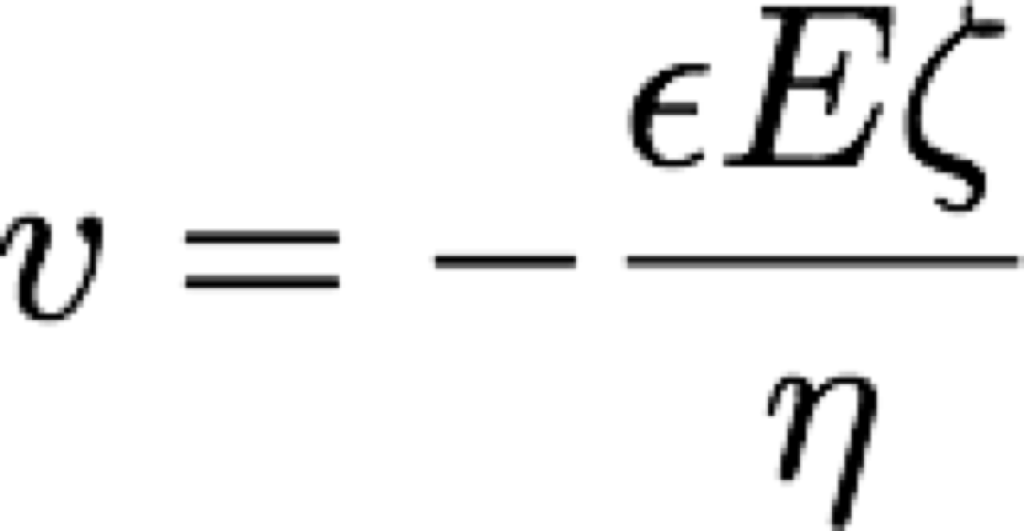
where ε is the permittivity, E the electric field, ζ the zeta potential, and η the viscosity. This equations basically says the velocity of electroosmosis is dependent on the electric field across the material and the zeta potential. An important point about this equation is that the electroosmotic velocity is the velocity at the edge of the diffuse layer; because of a no slip condition, this velocity decreases as you get closer to the pore wall. Thus this equation can only be used to describe the velocity of all the fluid in a pore only if the Debye length is much smaller than the pore radius.
In my electroosmosis experiments, the Debye length is ~1nm in a 100 mM KCl solution. This Debye length is not quite small enough to completely disregard. There is an analytic solution of the Poisson Equation that makes use of the Debye Huckle approximation that enables the determination of the velocity over an entire capillary with non-negligable Debye lengths. The one caveat is that the zeta potential of the material must be low enough (-50 to 50 mV) to satisfy the Debye Huckle approximation. Streaming potential and electroosmosis measurements puts our material at -10 to -20 mV, so it seems that this approximation will work.
The analytic solution by Rice and Whitehead (1965) states that the velocity is described as follows:
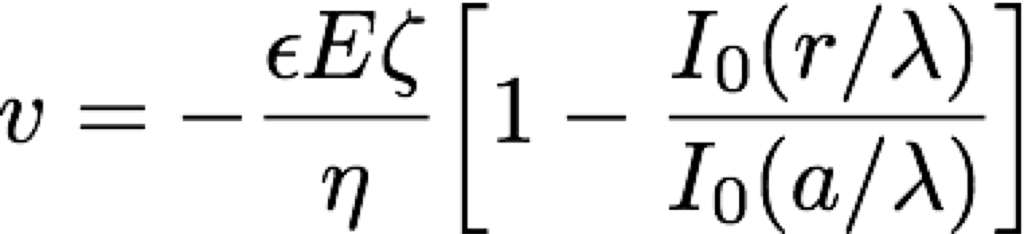
where I0 is a zeroth order modified Bessel function of the first kind, r is the radial position within the pore, and a is the pore radius. This equation simplifies to classical Helmholtz-Smoluchowski if the a/λ >> 1.
The following figure shows a comparison of Rice and Whitehead theory and Helmholtz-Smoluchowski:
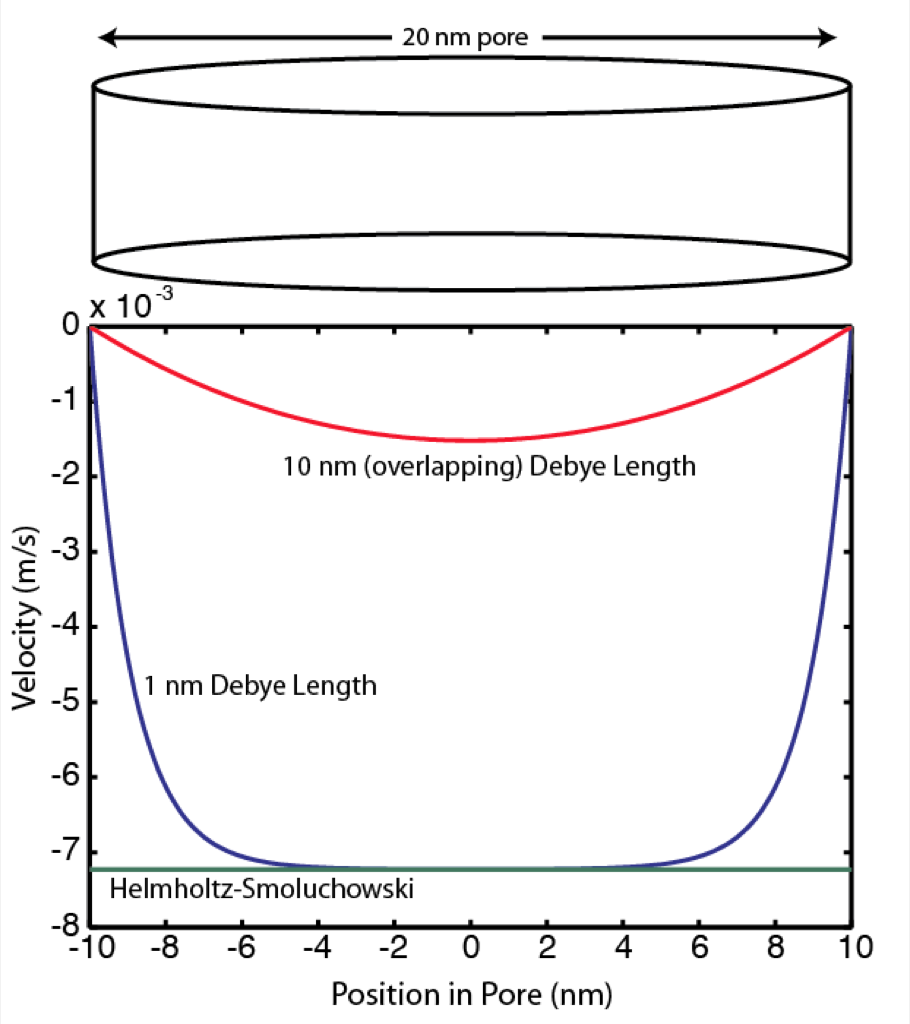
The Helmholtz-Smoluchowski equation (green line) predicts the maximum velocity, but as you can see, the Rice/Whitehead equation with a 1 nm Debye length (blue line) shows a deviation from the maximum velocity near the pore walls. This means the volumetric flow rate will be lower than the optimal Helmholtz-Smoluchowski case. As a comparison, I have also plotted the Rice/Whitehead analysis for a 10 nm Debye length (red line), which is overlapping in a 20 nm pore. This profile is very similar to a Hagan Pouiseulle profile and never reaches maximum velocity.
Now that I understand all of the theory a bit better, I thought that I’d try to make a comparison to experimental results. In the following figure I plot Helmholtz-Smoluchowski and Rice/Whitehead theory along with the experimental results for flow rates. In order to calculate the theory, zeta potentials from streaming potential measurements were used, the electric field was approximated using the current within the pores, and the theory is summed over all pores in the distribution of the actual wafer.
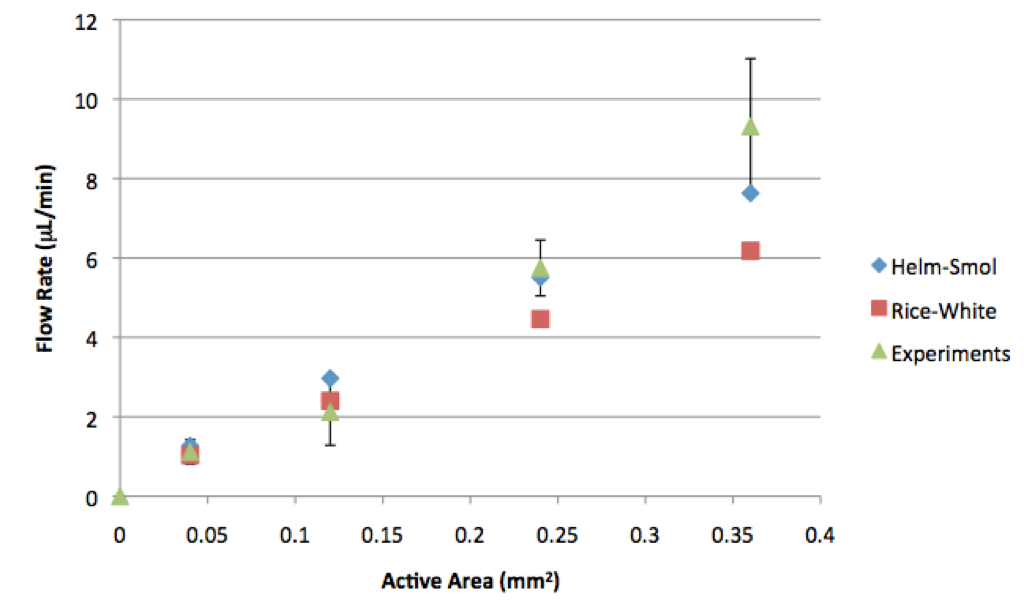
Here’s what I notice when looking at this figure: 1. There isn’t that big of a difference between the two theories and that difference is within the experimental uncertainty. So you lose a bit of optimal velocity near the edges of the pores, but with the size of the pores in the distribution this apparently isn’t that big of a loss. 2. Experimental flow rates seem to be a bit faster than theory for the larger active areas. This may be due to measuring errors (bubbles, pipetting, etc), or perhaps we’re not estimating field or zeta potential well. In fact the changing pH in electroosmosis may contribute to a different zeta potential than the one we measured by streaming potential.
I don’t recall that we’ve ever compared volumetric flow rates to theory before. In fact, I’ve been running around saying that there is no appropriate theory because all theories are based on infinitely long pores. Perhaps by integrating these profiles to calculate the volumetric flow rate for the first time, and by discovering this mismatch, you’ve provided our first real evidence that a new theory is needed.