Streaming potential in narrow pores
In narrow pores that have a significant Debye length, we need to use the same corrections on surface potential in streaming potential theory that we used in electroosmosis theory (click on link above for EO theory). In essence, the equation for streaming potential (E) becomes:
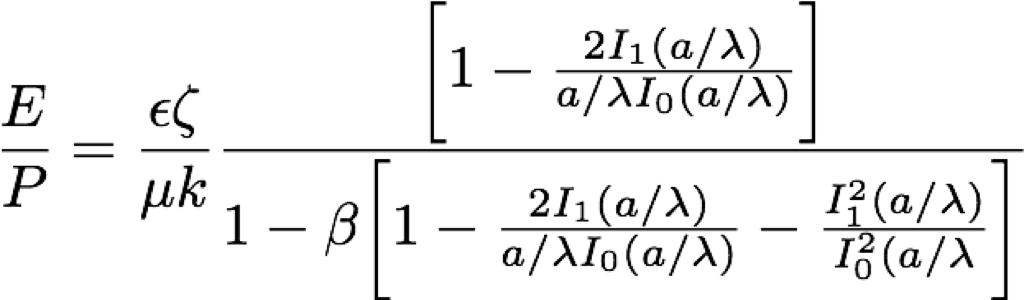
where
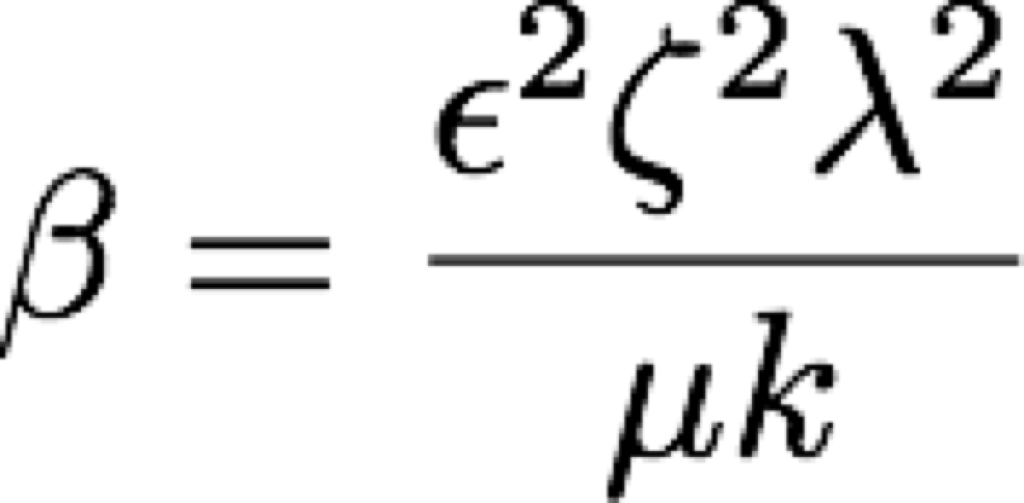 ,
,
P is the applied pressure, ε the permittivity, ζ the zeta potential, μ the viscosity, k is the conductivity, a the pore radius, and λ the Debye length. I0 and I1 are modified Bessel functions. In our situation, β tends to 0, which sets the denominator in Eq. 1 at 1 and leaves us with an equation very similar to the electroosmosis equation.
I have used this formulation to calculate zeta potential, and used the adjusted zeta potentials in the recalculation of electroosmosis theory. This leaves me with the following figure:

This seems to leave us with a better fit between experiments and theory, although there are a number of error sources in the theory (ex. pore distribution, porosity, conductivity, current).
Does this mean that there is no need to develop EO theory that applies to thin materials?
Any material with these pore characteristics, no matter how thick would achieve the same flow rates?
The theory was developed for long pores, so yes this should hold for any material with these pore characteristics as long as it is under the same electric field.
Because we’re thin, our electric field is very high and we only need a tiny voltage drop. The theory would predict thicker membranes to have lower fields for the same voltage drop and thus much lower flow rates.