Absorbance Problems with Colored Centrifuge Tubes
This is a follow up to Josh’s post, “Continued Au Separations with SiN-NP wafer #’s 1029 and 1030”, and seems to explain why we initially got an S value greater than one during our gold separations.
We conducted tests to see if the colored centrifuge tubes were at fault for our seemingly large filtrate absorbance values, thus causing S to be too high. All filtrates, retentates, and stock solutions were kept in green, red, and clear centrifuge tubes respectively. To test the suspected absorbance increase due to each color, we first measured the absorbance of the stock solutions for 10nm, 20nm, 40nm, 50nm, 60nm,80nm, and 100nm gold nano particles, using the Tecan. Then, 100uL of the 20nm and 60nm stock solutions were pipetted into green, red, and clear centrifuge tubes. The other solutions were only pipetted into green centrifuge tubes.

The tubes sat for about 5-10 minutes, were vortexed, and the absorbance values were measured. The results are shown below. The labels are, “solution, white cuvette, tube color, time in centrifuge tube”.
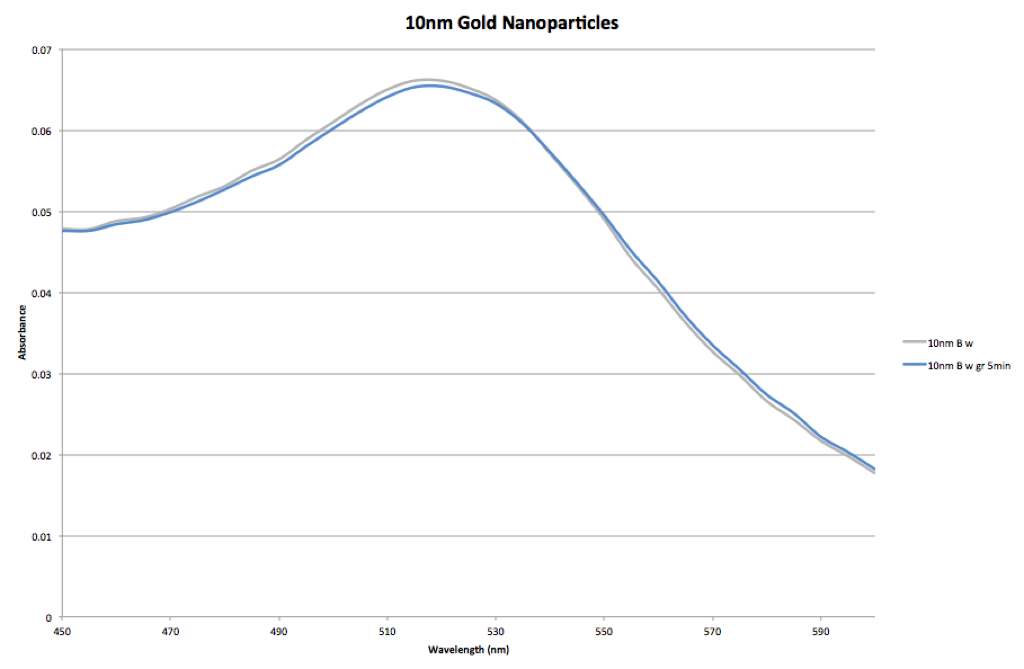
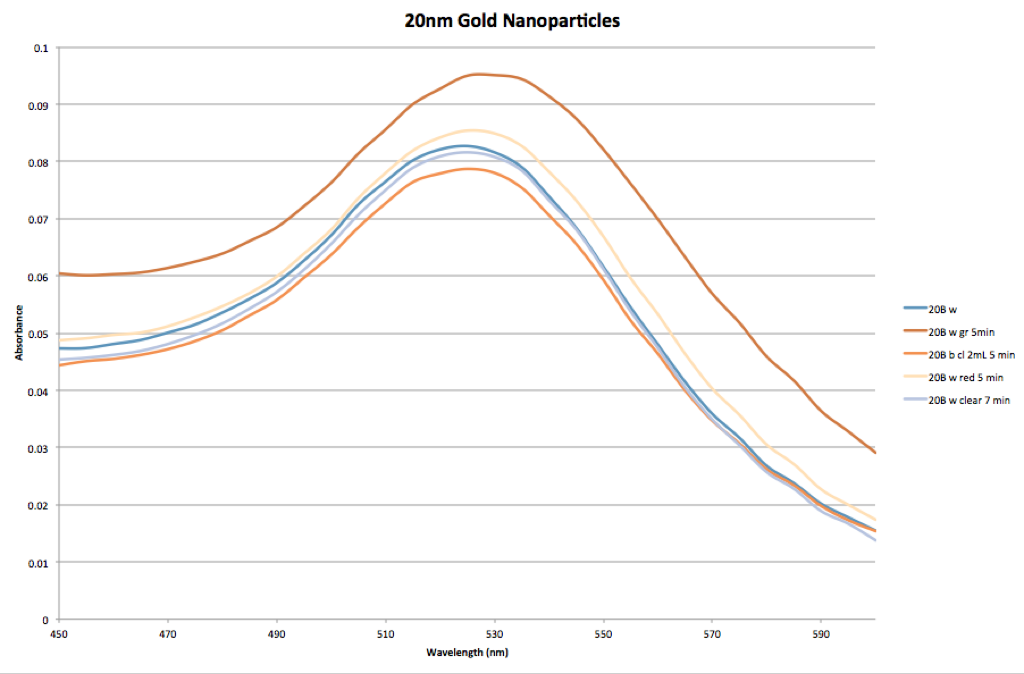


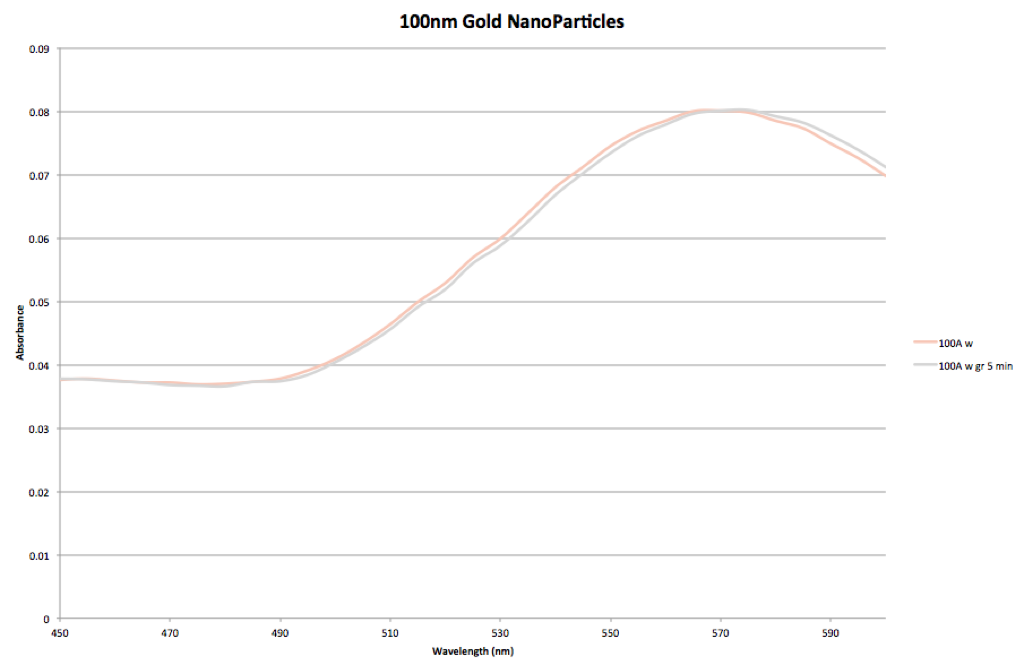
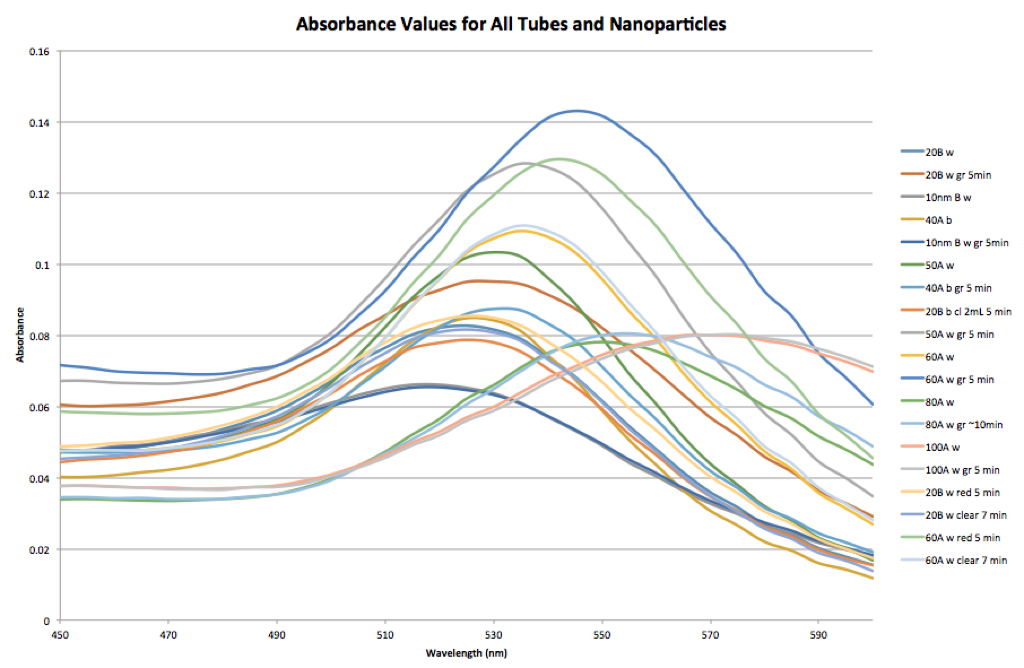
The colored centrifuge tubes are clearly problematic. The behavior looks erratic, and we are not sure why. We did run a test with the green tubes using only water, and the absorbance level did not change. This leads us to believe that the gold must be reacting with the tubes in some way. We do not know how this is possible, and will not be investigating this further. As far as the gold, BBI Solutions says, “they are suspended in water, no preservatives, residual chemical left from manufacturer.” Colored centrifuge tubes should not be used in future gold nanoparticle experiments.
Were all these tubes purchased at the same time from the same manufacturer or were they just laying around the lab? It seems unlikely that color would have an effect like this, especially the absorbance increase. I assume the increase absorbance is due to water loss? You said that you checked to make sure there was nothing leaching out of the tubes, correct?
Sometimes strange things happen, but it would be nice to understand why, or at least have a working theory tat can guide thinking in the future. Thanks!
I’m not sure when they were purchased, but Sarah has found a lot of centrifuge tubes purchased in 2009-2010.
A lot of people have suggested water loss, but Sarah measured the mass of a tube before and after they were subjected to water and saw no difference.
I agree that the color of the tube seems an unlikely cause for changes in absorption of the media inside, and that’s why we’ve been using them, but the results in the plots are pretty obvious. We’ve been thinking a lot about this and we haven’t come up with any realistic theories as of yet.
There’s no reason to continue using these tubes, or indeed any color tube ever again, so rather than spend any more time in the lab on this particular problem that is totally removed from the membranes themselves, we’ve decided to move on.
That said, if anyone has a specific suggestion for a test they’d like us to try, we’d be more than happy to try it.
Great detective work Josh and Sarah. This is highly believable as I’ve seen the dye used to make fluorescent particles leach out into solutions. The manufacturers don’t seem to worry these potential complications.
This represents dogged determination not to cut any corners even though corner cutting was formally approved. Applause. Applause.
So it was found to be leaching of the color? This points to fairly low quality manufacturing, probably from some corner-cutting off-shore supplier. I guess colors can be pretty, but if they start interfering with the science, it’s time to abandon the bling….
I’ll stop using the colored tubes, but there’s no way I’m giving up my chains.