Flow demo (T cell interaction with human in vitro BBB model under flow)
I attached a link to a short presentation regarding the flow movie setups. The figures and videos will be explained in detail during the meeting on Friday.
I attached a link to a short presentation regarding the flow movie setups. The figures and videos will be explained in detail during the meeting on Friday.
Introduction We are differentiating and validating EECM-BMEC (Extended Endothelial Cell Culture Method-Brain Microvascular Endothelial Cell)-like cells in µSiM devices. See this post and this post for method details and validation in traditional cell culturing platforms. Methods Attempt 1 – Overstimulated cells IMR90-4 iPSC EECM-BMEC P3 frozen vial was thawed. At P4 cells were seeded and cultured 2…
Introduction In a previous post, an initial version of the flow module and its sealing components were described. In order to improve the initial version based on collaborators’ feedback, several modifications have been made to simplify the device assembly for the end-user (Fig. 1) and address concerns about: 1) Local regions of high shear stress…
Introduction Pages regarding our in situ permeability assay development can be found in these links: Theoretical Underpinnings of Small Molecule Permeability Measurements in the µSiM (Part 1: Approach) Theoretical Underpinnings of Small Molecule Permeability Measurements in the µSiM (Part 2: Experimental Validation) Theoretical Underpinnings of Small Molecule Permeability Measurements in the µSiM (Part 3: Application to Cell…
Introduction Alzheimer’s disease (AD) is a neurodegenerative disorder that is characterized by accumulation of amyloid beta (Aβ) peptides and neurofibrillary tangles (NFTs) made of aggregates of the protein tau (1,2). It results in the destruction of neurons and their connections due to this accumulation of amyloid beta and tau (3). Tau is a microtubule associated…
Introduction Tissue barriers separate different compartments of body organs. These barriers regulate the absorption of nutrients, maintain homeostasis, and prevent toxins from entering. In vitro models of tissue barriers have been developed to understand human diseases and investigate drug toxicity and effectiveness. In order to investigate cell-cell junctions and barrier maturity created on these models,…
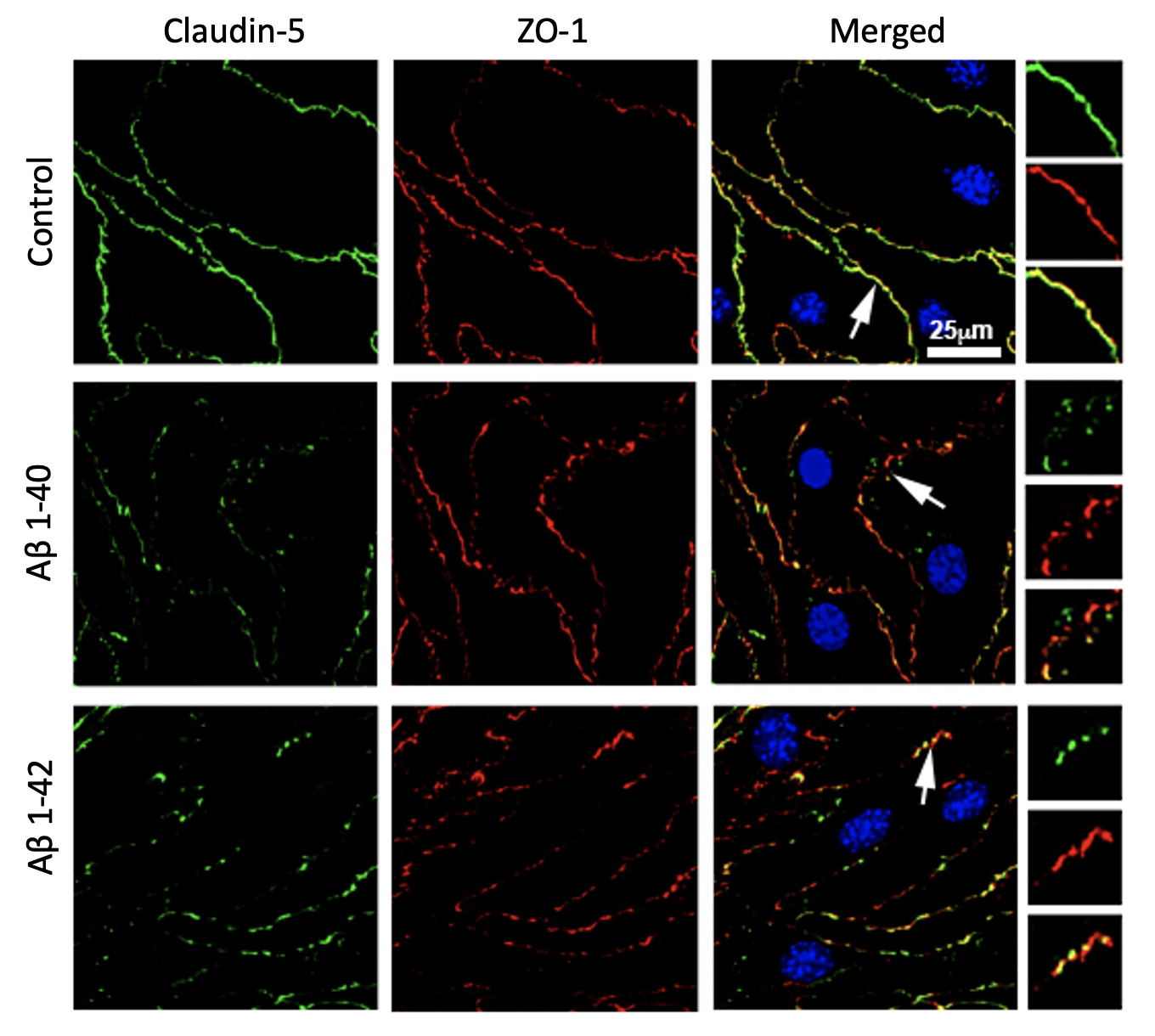
Introduction Vascular hyperpermeability and hemorrhagic stroke are hallmark symptoms of Cerebral Amyloid Angiopathy (CAA), a cerebrovascular disease characterized by amyloid-β deposition around the brain microvasculature. In CAA pathogenesis, vascular Aβ accumulation contributes to structural alterations and loss of integrity in the neurovascular unit/blood-brain barrier (NVU/BBB) resulting in “leakier” blood vessels, intracerebral hemorrhages, increased risk of…
Comments are closed.
Micro three-way valve http://www.theleeco.com
#LFYA1226032H 12volts 0.054inch ports(push on tubing)& deadspace=22uL
You do need to make an electronic box- I had one made by our department’s electronics guy.
Thanks for showing us your system- Always interested in seeing the clever ways people do this stuff!
Coisne, C., R. Lyck, and B. Engelhardt, Live cell imaging techniques to study T cell trafficking across the blood-brain barrier in vitro and in vivo. Fluids Barriers CNS, 2013. 10(1): p. 7.
I upload pdf file of this paper and recorded zoom meeting in media.