Pressurized Gold Separations
Motiviation and Background: Nakul and I have been performing a lot of DNA filtration and attempted DNA shearing experiments. We found that large DNA fragments (>1000 and >2000 bp) pass through ~30-40 nm max pore size membranes when pressurized to 10 psi (even in low salts). This is in contrast to the Bernhard data where the cut off was ~10 bp (low salts) and ~100 bp (high salts) in diffusion. This led to me consider whether pressurized flow would allow gold particles to pass even though Jess has had difficulty in diffusion.
Experiment Series 1
My first experiment was to see if 5 nm gold would pass through Wafer 199 which has been showing good wet/dry permeability (TEM images). I used a 1:1 dilution of 5nm gold particles (BBI, Batch 12066) with DI water. I pressurized the SepCon to 10 psi and collected 42 uL of filtrate after 10 minutes. The color was a similar pink to the stock solution I started with. To test the theory that had been thrown out in NRG last week that micro-tears might be causing wet/dry properties, I rinsed and washed the membrane with DI water and repeated with 40 nm gold (BBI, batch 12050). I collected 45 uL of clear filtrate after 10 mins at 10 psi. I rinsed and repeated with 5 nm gold to ensure that the membrane was not “clogged” – 32 uL of pink 5 nm gold passed in 10 mins at 10 psi. To be overly thorough and rinsed/washed with DI water again and ran a 1:1 solution of 30 nm gold (BBI, batch 11990). I collected 45 uL of clear filtrate in 10 mins at 10 psi. (Abs is the peak between 515-530 nm from 400-700nm traces performed on 3 uL samples in the TECAN)

Conclusions: 5 nm passes in DI water; 30 and 40 nm particles do not pass; no microtears; no clogging; simple rinsing with water is sufficient; flow rate doesn’t reduce dramatically with repeated use. (note: membrane did appear pink after later “washings”)
Experiments Series 2
I selected a new wafer 199 SepCon to close in on the size cut-off at 10 psi. I again used stock solutions of 1:1 gold to DI water, except when I mixed 10 and 15 nm gold which was 1:1 of each size (no addition of water). Like 5nm, the 10 nm gold particles easily passed. The Abs dropped only slightly from the stock solution (0.056 to 0.047), suggesting both the 5 and 10 nm particles are passing almost as freely as water through the membrane. Neither 15 or 20 nm samples had any visible pink in the filtrate solution and Abs measurements did not have a noticeable peak between 515-530 nm. All samples were run on the same SepCon membrane with DI water rinsing between runs. After the 20 nm run, I rinsed then mixed 1:1 15 nm gold with 10 nm gold meaning the concentrations of the 10 and 15 nm gold populations were the same as individual experiments but the total concentration was 2x. The filtrate was pink suggesting that the 10 nm particles again passed even in the presence of the 15 nm particles that were held back. The retentate Abs increased to 0.792 (~50 uL of the starting 100 uL passed). Increasing pressure to 15 psi did not result in passage of 15 or 20 nm particles.

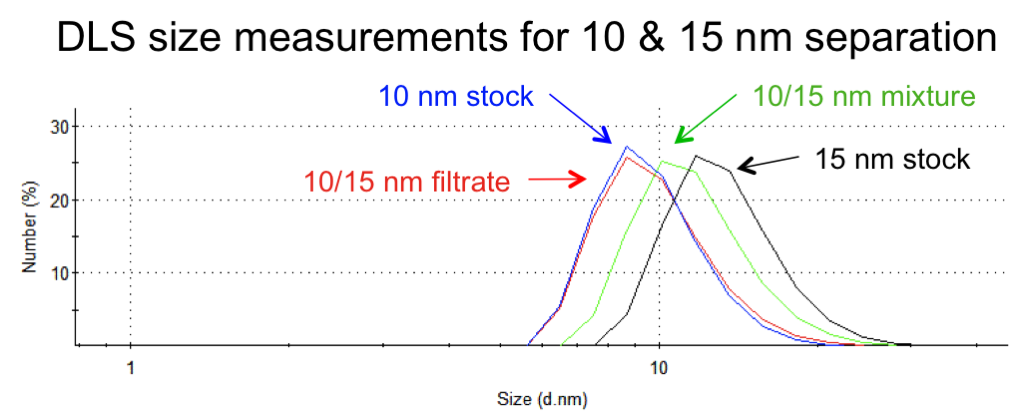
Size data for the 10 & 15 nm experiment (Malvern – DLS)
| 10 nm stock | 9.4 nm |
| 15 nm stock | 13.2 nm |
| 10/15 nm stock | 11.8 nm |
| 10/15 nm filtrate | 10.2 nm |
| 10/15 nm retentate | 12.0 nm |
As Jess has described before, the size data is more heavily weighted by the larger species, explaining why the 10/15 nm stock is closer in size to the 15 nm stock. Since the 10/15-F still significantly decreased, this suggests there are probably very few larger particles in the solution (solutions are probably not monodisperse anyway). About 1/2 of the starting solution passed through the membrane, so even in the best case the retentate would have 1/3 10 nm and 2/3 15 nm. I think it is significant that the rentate particle size increased since loss of the small species should not significantly impact the size measurement. For fun, I will probably prepare a few solutions of varying ratios to empirically determine the concentrations (this would unfortunately have to assume monodisperse populations).
Conclusions: At 10 psi, the cut-off is somewhere between 10 and 15 nm for gold particles. A slight increase in pressure to 15 psi did not seem to shift the cut-off above 15 nm. Flow was generally ~50 uL over 10 mins at 10 psi regardless of particle size and whether or not particles were retained (Format: (2) 100×2000 um slots). Future experiments will investigate lower pressures to see if we can control size and charge based separations based on pressure.