Effects of Allyl Alcohol on Gold flow in Centrifuge
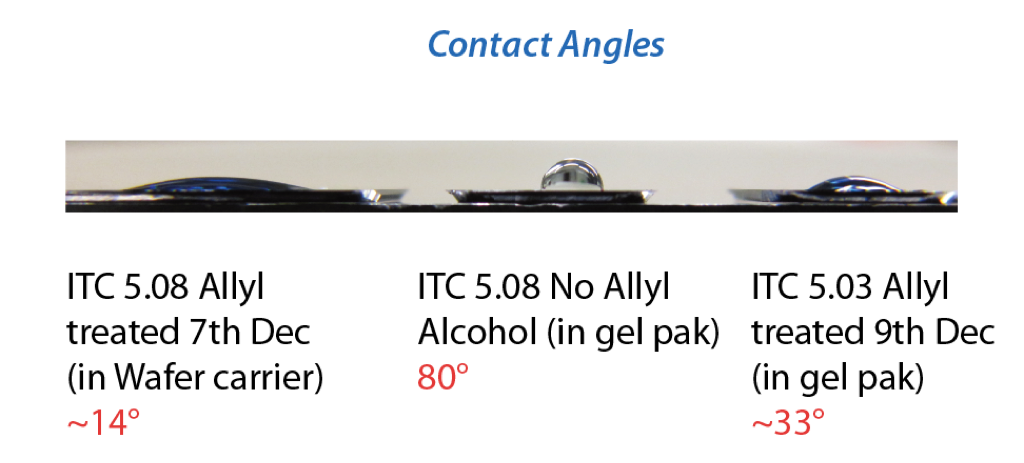
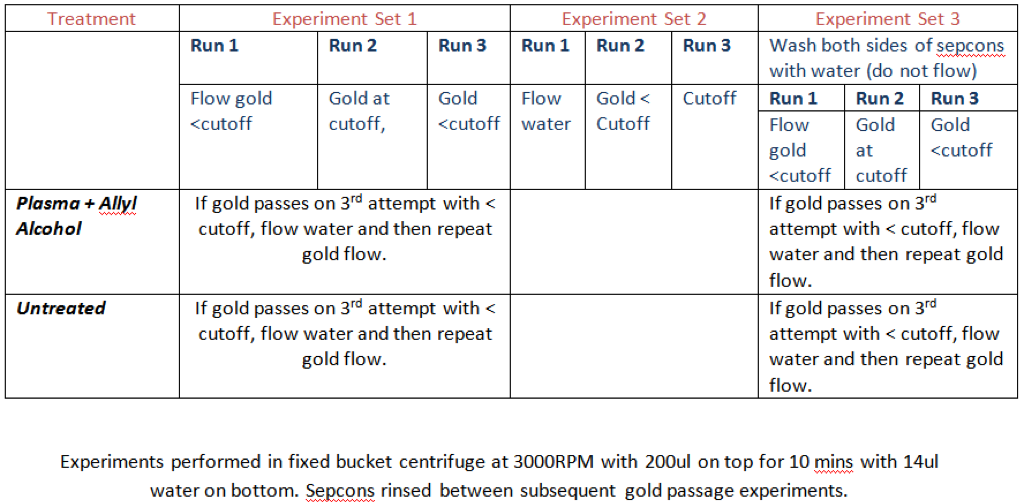
Experimental setup: All sepcons were run in the fixed bucket centrifuge with the new sepcon design which needs 14ul of water in the bottom bucket to keep the membranes wet on both sides. Gold nanoparticles were bought from BBI labs (UK) and diluted 1:1 with nanopure water. Absorbance was measured on the TECAN (wavelength 514nm). Results were plotted as sieving co-effiecient (C/Co) where C is conc measured in filterate and Co is original stock concentration. A C/Co of 1 would mean gold is passing at the same rate as water. C/Co of 0 would mean no gold is passing through. Since all filterate concentrations get diluted into the bottom bucket volume of 14ul, the final concentration readings have been compensated for the 14ul dilution based on total volume passed.


- 753 & 755 No allyl treatment

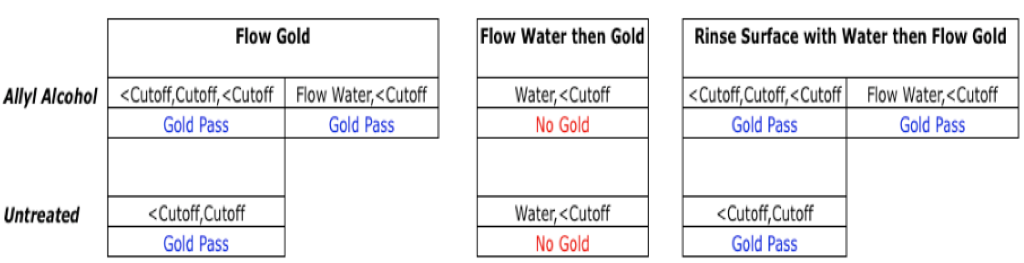

In order to elaborate on this set of experiments, 749 which was allyl alcohol treated was subjected to water passage and gold flow. 749 had a cutoff of 30nm, so all experiments previous to this would involve testing at 20nm (known passage). To check if the cutoff was reducing, but gold was still passing at a lower cutoff, 15nm gold was tested rather than 20nm.

- 749 Allyl Alcohol

One of the scenarios suggested to account for this was the possible contamination of water. So more control experiments were tested. This included passing ultra-pure RNase free bottled water (courtesy Benoit lab), passing salt to test if affecting the membranes will lead to similar effect and leaving water in the sepcon for 15 mins without flowing. The last condition would be to test if leaving water in the sepcon for the amount of time needed to conduct my experiments would mimic flowing water through it (if it was related to impurities in the water or surface being modified by water).

It appears that salt passage still seems to retard gold flow. The ultra pure water results suggests that contamination in the water may not be a possible cause.
The same set of experiments (ultra pure water, salt passage) have to be repeated with Untreated chips to see if this phenomenon is inherent to the chips or if it is an effect of allyl alcohol. Tom also has suggested that we try passing nanoparticles of different charges to narrow down our explanation to it being a charge effect.
I think a lot of ideas was thrown around and it would be good for us to summarize what was discussed. So what I got out of this discussion is that we need to explain the following problem : flowing water first changes separations which happens regardless of Allyl Alcohol treatment. I am worried that something from either the SepCon vial or silicone gasket plus water is significantly effecting the membrane.
The first thing to try is flowing Citrate buffer (the solution gold nanoparticle is in). If pore cut off changes, gold itself is significant in protecting the pore cut off. If pore cut off remains, Citrate buffer is a workable solution that could be protecting the charge or pore of the membrane.
The second thing I would like to see is to get a used (flowed with gold nanoparticle) sepcon vial and gasket and then use a new membrane and then flowed with new water. I think we should try this because whenever the vial, gasket and membrane see gold nanoparticles first, all subsequent separations are not changed even with new DI water. No change in separations could mean that the vial or gasket has been fixed with the nanoparticle gold or citrate. If there is a change in separations, it’s the effect of new membrane and new water flowing through the membrane.