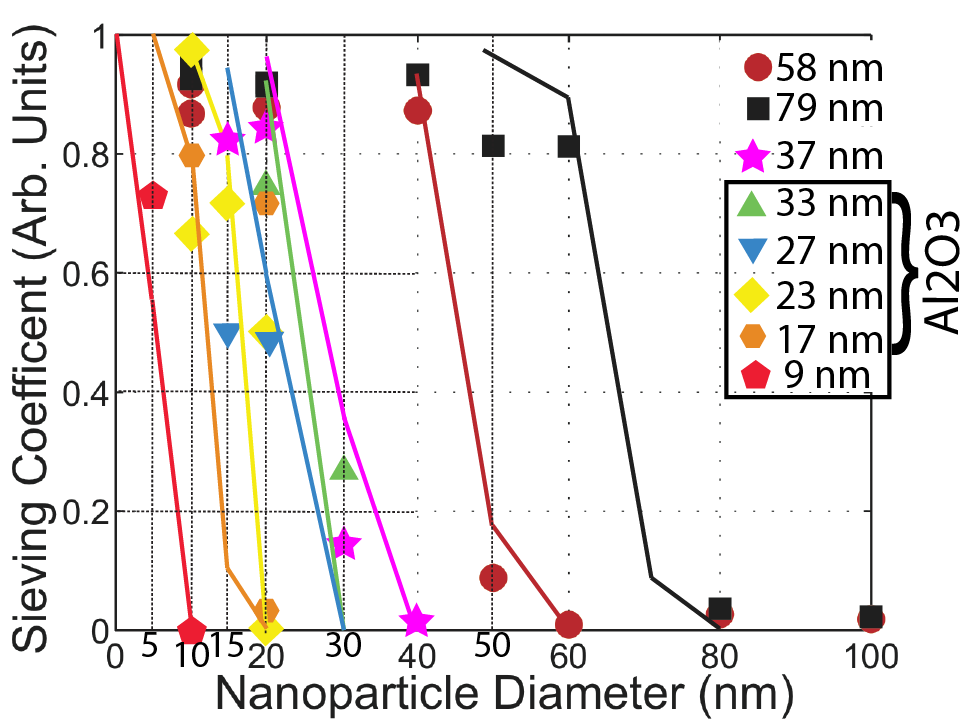
Gold sieving graph with all my data and model lines
Poor English Paper used as a starting point: Silicon Nitride Etch Rate paper This is a continuation of the work I’ve done, attempting to make freestanding MgF2 nanomembranes (theory and deposition) using a Silicon Nitride nanoporous substrate. I originally wanted to use hot phosphoric acid to remove the Si3N4, but since we do not have that…
I’ve been working hard on my model paper for a few months now. My first attempt at doing separations with Track Etched (TE) membranes, which are all 6um thick and come in pore sizes of either 30 nm or 50 nm, resulted in data that was all over the place: Note that the gold concentrations are…
In an attempt to help wet the pores prior to permeability experiments, I’ve started soaking assembled SepCons in a %50 ethanol solution. Each SepCon is inserted into an eppendorf so that the membrane side is fully submerged. I realized that in my last post, I was soaking multiple samples in a beaker which did not…
We finally achieved a separation using the EQ format. 4 SepCons from wafer 319 were loaded with 500 uL of .93 mg/mL clarified brain extract. They were run at 1000 rpm (which we roughly figured to be 3.3 psi initially) for 2 hours. After 2 hours, I judged the flow through the membrane to be…
Maryna’s presentation
We are happy to be back this summer. Anthony has been working on setting up a system that mimics Kilean’s dialysis devices. Our approach is different in two important ways. First, we are using PETLs, instead of PDMS/glass. For those who are not familiar with PETLs, here is a short summary: Commercial laminating pouches made…