BSA does not pass through Peg-lyated or EA treated Sepcons with cutoffs of either 10 or 15nm
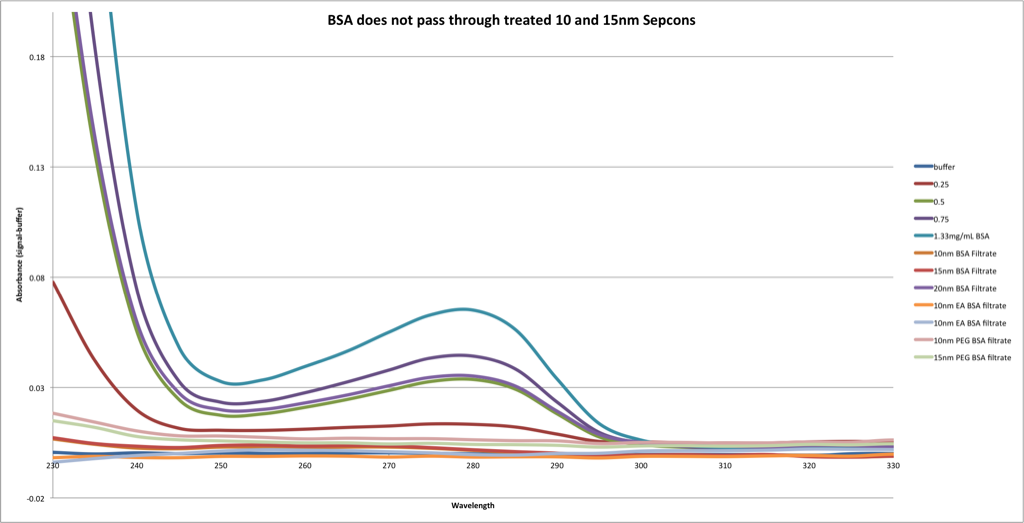
On Wednesday we ran several separations using both the EA and PEG treated membranes. The treatment process had damaged many of the chips. Of the 10 treated 10nm PEG chips, 2 survived. Of the 10 treated 15nm PEG chips, 2 survived. Of the 10 treated 10nm EA chips 8 survived. Of the 10 treated 15nm EA chips 4 survived. Unfortunately several of the intact chips broke during Sepcon assembly, but we were able to recover enough to run one separation each for 10nm EA, 10nm PEG, 15nm EA and 15nm PEG.We used a concentration of 1.33mg/mL BSA in PBS and spun the chips in the centrifuge at 2000rpm for 5 minutes. Yield was low – both EA chips had a filtrate volume of ~5uL, and both PEG chips had a filtrate volume of ~10uL.
Do you normally break chips during assembly or is it your impression that these were weaker?
Seems that we really wanted to do 20 nm anyway. Since you showed before that cytochrome C doesn’t pass through these. Are those experiments underway?
What volume was loaded in each sepcon? Did you pre-wet the membranes or apply protein to a dry surface? Is the flow continuous or did it just plug? Did you spin any CytC solution? Do you want to pas BSA or retain it?
Seems like increasing the permeability should be a very high priority, so you can do more realistic experiments. Are you looking at wetting properties to make sure there are no bubbles plugging the pores? Can you do air flow experiments to measure any porosity difference between the treated and untreated samples? Can we make larger area SepCons (with scaffolds) that will help with permeability? Have you tried any of the nanoporous SiN that JP has been working on?
I really think that getting Sepcon to work at these moderate protein concentrations should be a high priority, as this would make our materials useful to other researchers in the near term.
Thanks!
Initially, the Sepcons were wetted with 12uL water on the backside and loaded with 400uL of water. They were then spun at 2000rpm for 5 minutes to be sure that the membranes were intact. If between 20-200uL of water passed into the filtrate, we considered them intact. Next, they were loaded with 400uL of 1.33mg/mL BSA and again spun at 2000rpm for 5 minutes. The filtrate was then put in the TECAN to generate the curves in the post. We hope that BSA was retained but cytochrome C can pass through, and BSA is certainly retained. I just passed cytochrome C through 10nm cutoff EA-treated membranes (the only ones I had left after the BSA tests), and though I don’t yet have the number for how much cytochrome C got through (check back in a few hours) I know some did (which is good).
As for whether the flow was plugged or continuous, I know that my cytochrome C continued to pass when it was spun for a second time. The Sepcons I used for the BSA experiments have been sitting out, wet, for a little less than a week, so take this with a grain of salt, but re-spinning the tubes from the original post gave me a small volume of filtrate for the PEG-lyated 10 and 15nm sepcons, and no filtrate at all for the EA. This could mean that PEG allows more continuous flow and EA blocks them, but with old chips we can’t be sure.
We have not looked at the wetting properties (and I’ll be reading the paper you posted later tonight, so thanks for the heads up). As of right now we can’t do air flow experiments because we don’t have any more intact PEG or EA membranes. I have not yet worked with JP’s SiN. I’ll talk to Josh about larger area Sepcons.
Hope that answers everything. Great comment!