Nanomembrane Vapor Transfer Stability Mechanism Brainstorming
We have previously observed some interesting transfer characteristics of our nanomembranes, using water vapor (breath) to delaminate and adhere them to glass and silicon nitride surfaces. Some membrane transfers do not appear to be stable (fragments or floats away when submerged and exposed to shear stress), while others can withstand shear stress at high rates (Nanomembranes under Shear).
Good Stable Transfer:
Unstable Transfer:
What makes a nanomembrane vapor transfer (NVT) stable? I hypothesize that the physical proximity of water vapor bonding the nanomembrane and the substrate together is the key factor for stability. If the hydrated area that anchors the nanomembrane evaporates, it should weaken and flake off (or maybe change to an electrostatic attraction?)
I would expect as the contact area of the nanomembranes increase, the stability of the overall structure should increase. However we will have to use more specialized tools to quantify the layers of water in the bond and the amount of contact area that entails (our rainbow pattern fringe interferences tend to disappear when we go below 50 nm of water).
What maximum thickness of the bonding layer water contributes to the stability of the nanomembrane?
How does physical stress in the nanomembrane impact the overall stability?
Would membranes under tension transfer effectively?
I am guessing at this point that the stable bonded nanomembrane has assumed a relaxed (low stress, low potential energy) state, whereas the unstable nanomembrane is not relaxed and can adopt many more configurations that could lead to delamination. Stiffer materials may not be able to configure theirselves to a low energy state.
Physical Characteristics
- Membrane Thickness
- Membrane Material
- Membrane Porosity (Aerial Image)
- Membrane Pore Size (Aerial Image)
- Membrane Roughness
- Substrate Roughness
- Substrate Material
Tucker and I have done some work that suggests that the thickness of the nanomembrane is important to having a stable transfer, and not so much the membrane pore size or porosity (Microporous Membrane Transfer).
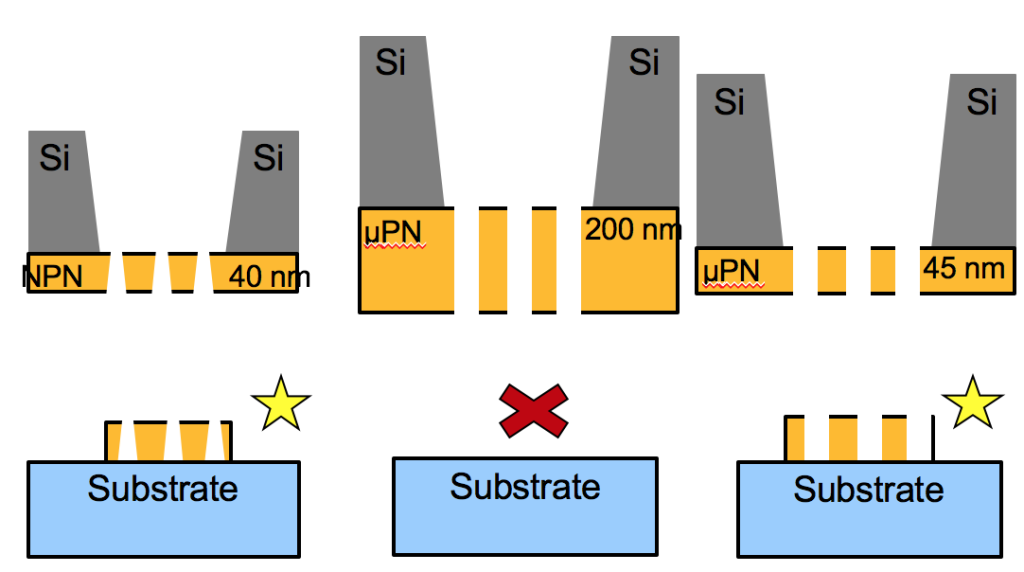
So, there should be a critical thickness for materials of a certain flexibility that will allow the membrane to bond stably.
We will have to create a model that can make predictions given
- Membrane Thickness (nonlinear bending resistance)
- Membrane Material (Elastic modulus)
- Membrane Structure (porosity, roughness, pore shape, aerial image)
- Substrate Roughness
- Substrate Material
- Hydration
Creating predictions of
- Bonding Strength Map
- Membrane Stress Map
Which can be used to make predictions of stability.
From our observations, it seems the thinner materials are more stable than the thicker ones. The simple experiment to do is to figure out the critical thickness for bonding stability with uPN. By partially etching the nanomembranes at 5 s intervals, we can determine a bonding stability threshold by creating nanomembranes with the same aerial image material properties but different thicknesses. (I suggest 30 nm – 120 nm)
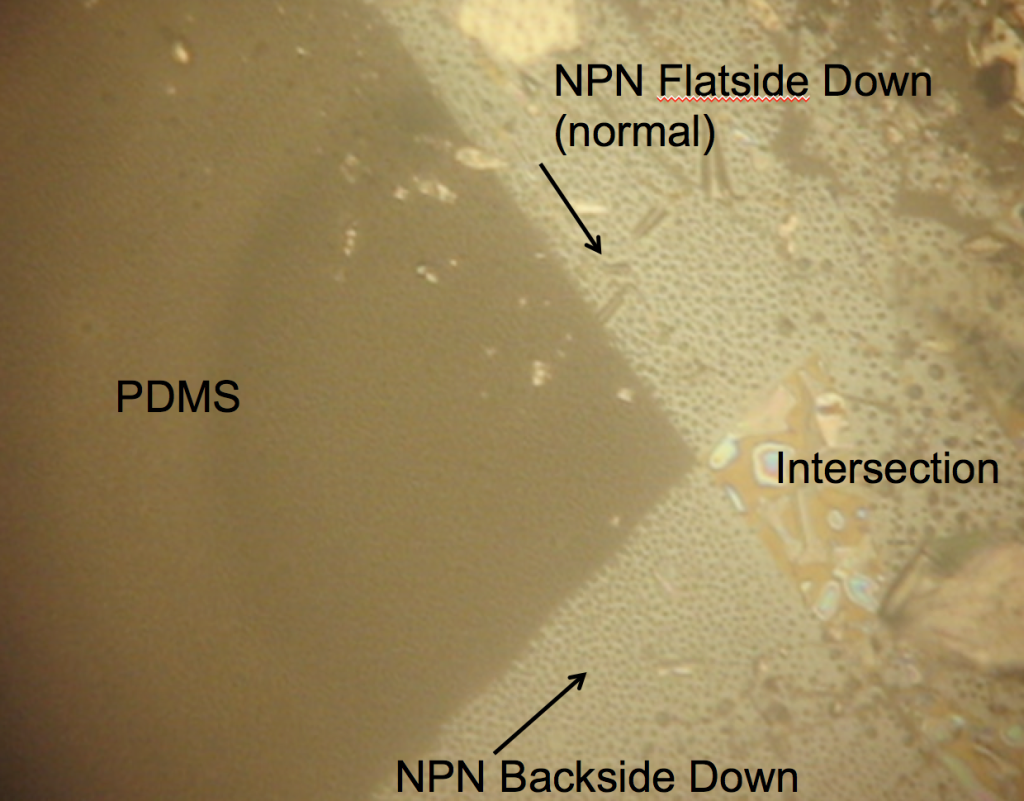
Relating to the Journal Club discussion (Unimpeded Permeation of Water through helium leak tight graphene oxide membranes), we have already previously delaminated NPN membranes on top of each other, resulting in a much more hydrated film stack (see intersection below). The two pieces were delaminated at right angles to each other, and it’s not a great transfer, but you can clearly see bits of intersecting nanomembranes, resting flat, with some hydrated interference fringes. I think it should be possible to do this process over and over again to get an appreciable stack of membrane. Take a smaller window (ie 0.2 um x 0.2 um) as the base substrate and continually vapor transfer larger windows on top of it (ie 0.7 um x 0.7 um) until you’ve reached whatever thickness you like (20x 50 nm nanomembranes should produce about 1 um thickness).