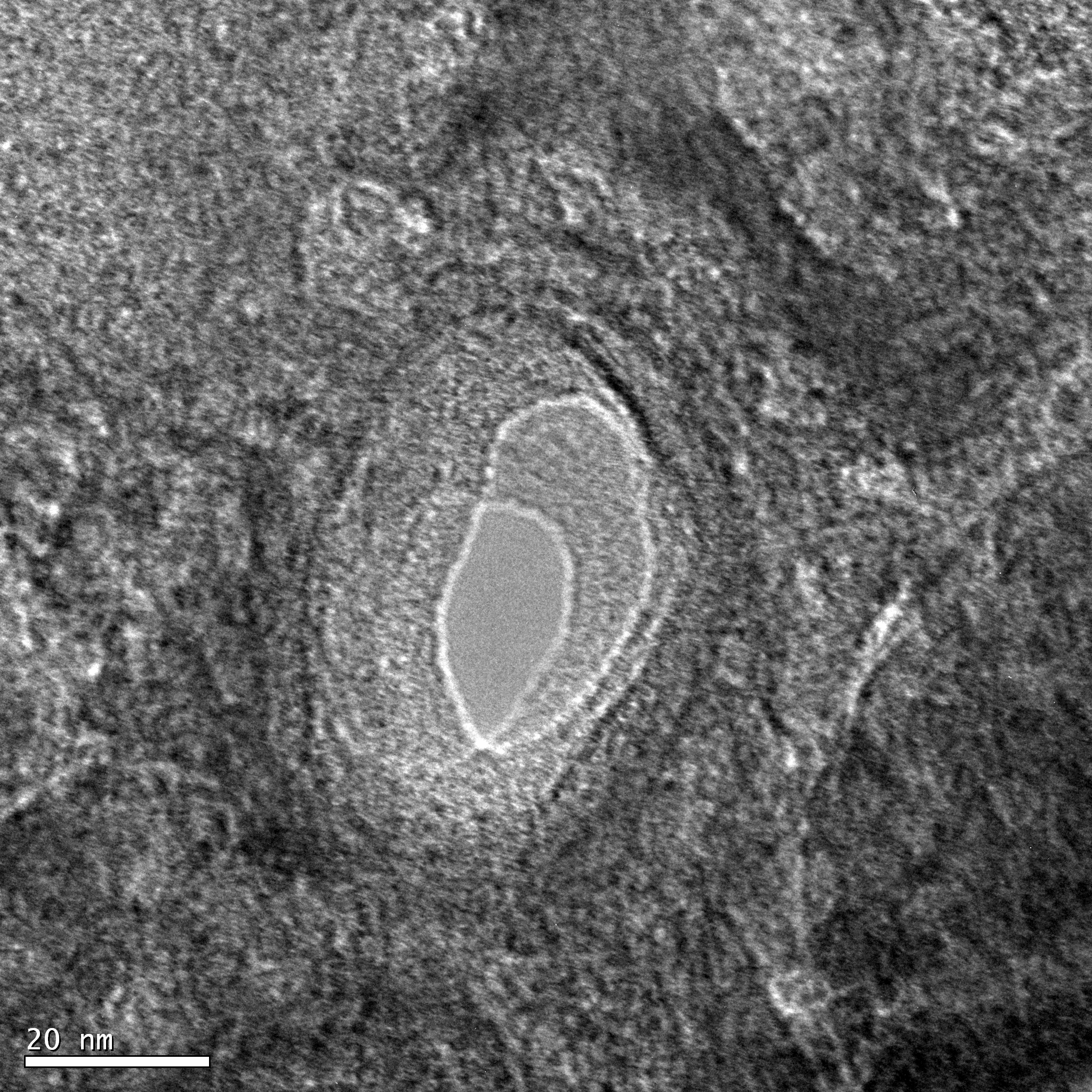
Annealed MgF2 produces smoother features than Unannealed MgF2
Thanks to Kilean for the TEMs.
One of the properties that influences strong SERS behavior is surface roughness; rougher metals produce a better SERS effect. People have electrochemically roughened surfaces before to make better SERS sensors. The following quote is from a review paper (SERS Materials Review Paper, 5 years old now)
After decades of debate, it is now generally agreed that the dominant contributor to most SERS processes is the electromagnetic enhancement mechanism10. The enhancement results from the amplification of the light by the excitation of localized surface plasmon resonances (LSPRs). This light concentration occurs preferentially in the gaps, crevices, or sharp features of plasmonic materials, which are traditionally noble and coinage metals (e.g., silver, gold, and copper) with nanoscale features. Reproducible and robust structures that strongly enhance the electromagnetic field are most desirable for SERS, and will be discussed below.
Depending on the structure of the supporting plasmonic material, electromagnetic enhancement for SERS is theoretically calculated to reach factors of ~ 10^10 – 10^11. In most circumstances the enhancement factor can be well approximated by the magnitude of the localized electromagnetic field to the fourth power.
The other mechanism involved in signal enhancement is chemical enhancement, which primarily involves charge transfer mechanisms, where the excitation wavelength is resonant with the metal-molecule charge transfer electronic states. Theoretically, chemical enhancement factors up to 103 were calculated using time dependent density functional theory for para- and meta-substituted pyridine interacting with a silver cluster. The authors found that the magnitudes of enhancement through charge transfer transitions are highly molecule specific…
Presently, we have experimentally obtained chemical enhancement factors of only ~ 5 – 10.14 The total SERS enhancement factor is the product of the electromagnetic and chemical enhancement mechanisms. For highly optimized surfaces, it may approach ~ 10^10 – 10^11. In addition, resonance Raman effects have traditionally played a large role in SERS experiments, as dye molecules with extremely large resonance Raman cross sections are often used in SERS. Development of SERS substrates with high enhancement factors remains an active area of SERS research.
In our case, we rely on the surface topography of the substrate to provide a surface roughness that ultimately the gold layer passivates and imitates. From this principle, excluding all else I would expect NPN to have worse SERS performance than the MgF2, as we see that NPN is smooth and uniform compared to the rougher MgF2. Among MgF2 nanomembranes, we can influence the surface roughness by changing the method of production. By annealing the MgF2 at a high temperature, I believe we have been smoothing out the film, which would decrease the SERS performance of the membranes.