Morphology evolution in pnc-Si membrane(2)
In the last post, we have discussed the intermediate state of the membranes which shows the irregular shape pores and silicon nanocrystals after annealed at 700C. Last week I did a quick test on the same nitride membrane with a different annealing process to verify this intermediate state. I run two different heat treatments. The first one was to anneal the sample SiN(30)-Si(25)-SiN(30) to 700C for 1 minute, cool down, then heat to 800C for 1minute and cool down. The second heat treatment was to ramp the temperature to 700C, hold for 1 minute, then ramp to 800C and hold for another 1 minute. The followings are the TEM images.
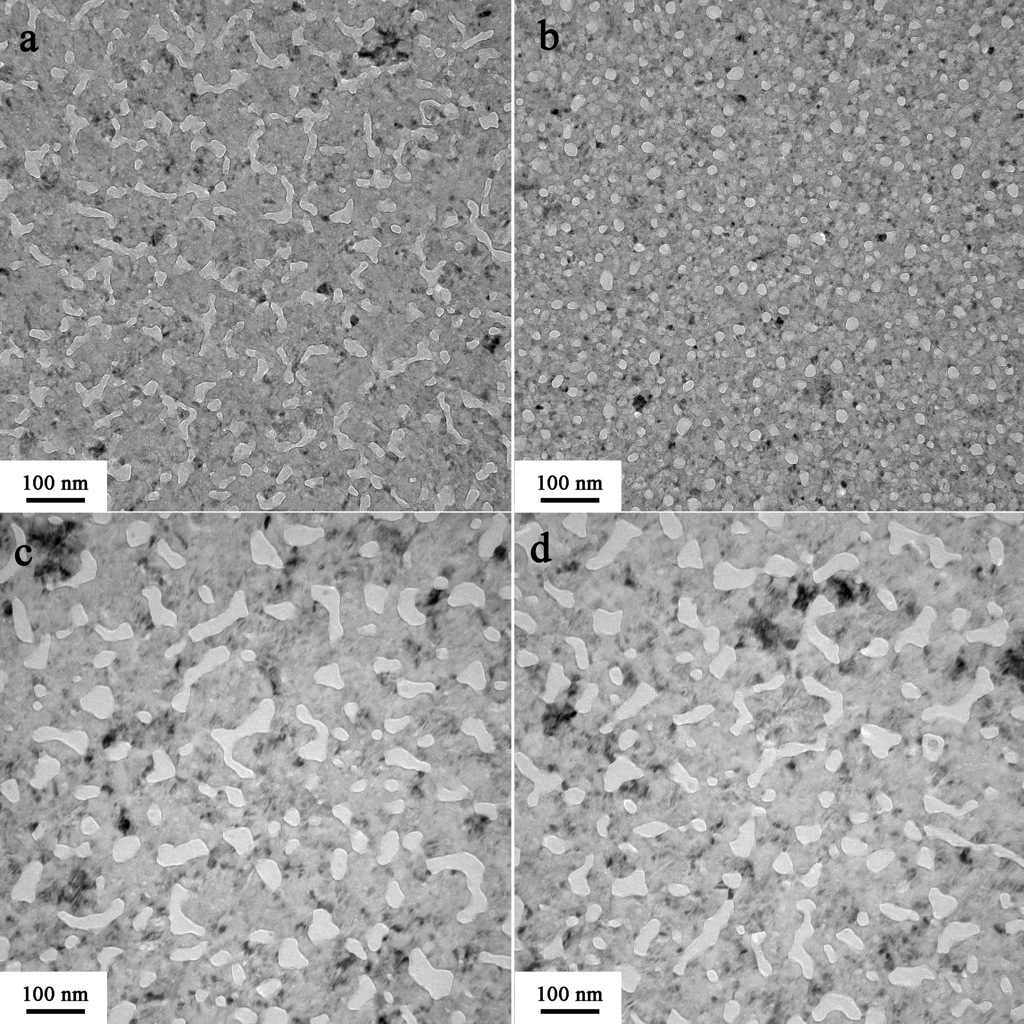
Image (a) and (b) are control samples which are annealed at 700C and 800C for 1 minute respectively. Image (c) is the sample annealed follow the first process and (d) is corresponding to the second heat treatment. The morphology of the membrane under these two heat treatment is quite similar, which also looks like the sample (a) annealed at 700C for 1 minute. The only difference is the size of those irregular pores that they becomes wider and larger after experienced a higher annealing temperature. However those elongated irregular pores are very different from the sample which was annealed at 800C for 1 minute without intermediate annealing.
This result proves that membranes annealed at 700C show us an intermediate morphology in the pnc-Si membrane. It also proves that pores are fixed by the adjacent Si crystals and once they are fixed, they are less likely to be affected by higher temperature annealing.
Make sense. This relates to ramp rate and how conditions with the same steady state but different ramp rate effects pore morphology.