Skip to content

Nanomembrane Research Group

  • Home
  • Publications
  • MembranesExpand
    • Common Chip Formats
    • Common Membranes
    • Microslit Membranes
  • DevicesExpand
    • µSiMExpand
      • Geometry
      • µSiM CAD Files
      • AssemblyExpand
        • Protocols.io (µSiM Assembly)
        • Instructions
        • Common Issues and Troubleshooting Tips
      • Cell Culture ProtocolsExpand
        • Top Well: hCMEC/D3
        • Top Well: HUVEC
        • Bottom Channel Culturing
        • Immunocytochemistry Protocol
        • Impact of Chip Orientation on Fluorescence Imaging
        • Permeability: In Situ Method
        • Permeability: Sampling Method
        • Cell Culture Common Issues and Troubleshooting Tips
    • SepCon®Expand
      • Sepcon Assembly
      • Sepcon Video Protocol: Assembly
      • SepCon Gasket Silhouette File
      • SepCon Video Protocol: Wetting the membrane
      • SepCon Video Protocol: Disassembly
    • µSiM-DXExpand
      • µSIM Video Protocol: Capture of Nanoparticles
  • ImpactExpand
    • TraCe-bMPS
    • HCIC
    • LOMP
    • SiMPore
Nanomembrane Research Group
  • NRG

    ICOM 2017

    ByJim July 31, 2017August 2, 2017

    Grand Ballroom A Chair: Baoxia Mi & Zhiping Lai 09:00-09:25 [O8.01] Synthesis of graphene oxide membranes and their behavior in water and isopropanol A. Aher*1, Y. Cai1, M. Majumder2, D. Bhattacharyya1 1University of Kentucky, USA, 2Monash University, Austria 09:25-09:50 [O8.02] Carbon nanotube hollow fiber membranes R. McGinnis*1, K. Reimund2, B. Freeman2, L. Xia3, J. McCutcheon3 1Angstrom…
    Read More ICOM 2017Continue

  • NRG

    Folding Suppression Experiments

    ByKyle Briggs July 31, 2017August 1, 2017

    A quick recap: of the pores using the old NPN batch, 2 of them showed folding suppression. The first one I was able to collect events for 1000 and 2000 bp dsDNA, bnoth of which showed almost no folding, but had an unusually low event rate. The second suppressed folding for the first half of…

    Read More Folding Suppression ExperimentsContinue

  • NRG

    Residue on SiO2 membranes is dependent on wafer lot, but not storage location

    ByStephanie Casillo July 25, 2017

    Last meeting, we discussed the possibility of the storage gel-boxes outgassing a residue onto the porous SiO2 membranes, as evidenced by cells not adhering to the membranes and difficulty in acquiring SEM images. Possible Gel-Box Outgassing on Porous SiO2 Membranes Several cleaning methods were utilized in attempt to clean the membranes, such as O2 plasma,…

    Read More Residue on SiO2 membranes is dependent on wafer lot, but not storage locationContinue

  • NRG

    Neutrophil Transmigration through Collagen Gels

    ByEmma Luke July 25, 2017

    Intro For the past couple months, I have been working with Tejas to recreate his previous experiments using a more complex system. The goal of the research is to study the transmigration of neutrophils and represent how they behave during chronic inflammation in vitro. To do so, we planned to use a setup that included…

    Read More Neutrophil Transmigration through Collagen GelsContinue

  • Immunogold Labeling of Exosomes
    NRG

    Immunogold Labeling of Exosomes

    ByKilean July 25, 2017July 25, 2017

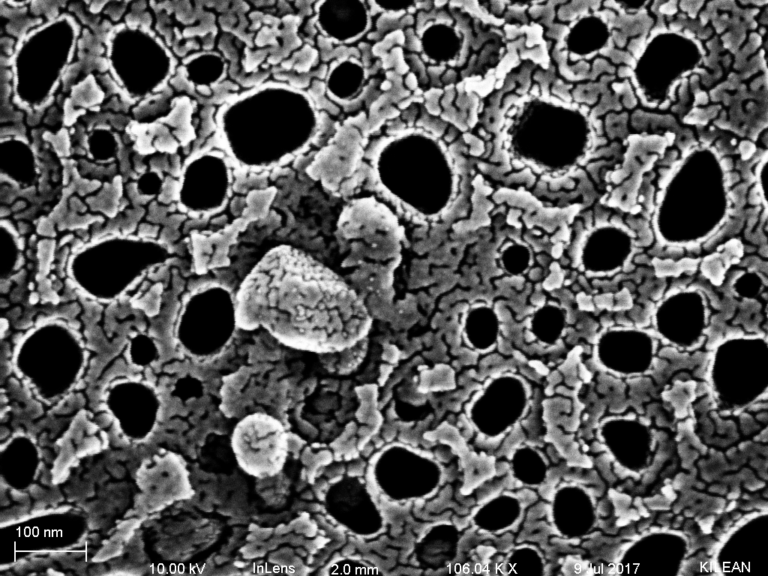
    So, this is the data that we have all been waiting for. Without all the fancy introductions and stuff, I present you with labeled exosomes. They were isolated in tangential flow from my human plasma samples using the SOP that I have been following along with a labeling protocol that Henry and I developed. It…

    Read More Immunogold Labeling of ExosomesContinue

  • NRG

    Scale Up Experiments

    ByAslan July 25, 2017July 25, 2017

    Hello Everyone, So as you probably remember, we were able to show the capturing and releasing successfully.   In addition, we have a Matlab Code now which helps us for intensity change, so as you can see in the next figure which is the analyzed data for videos at the top, it shows capturing gradually…

    Read More Scale Up ExperimentsContinue

  • NRG

    NIH 3T3 and Human Dermal Fibroblast wound healing

    BySean Bellefeuille July 25, 2017

    For the past few weeks, Henry and I have been working with human dermal fibroblast cells and 3T3 mice fibroblast cells. We have been working to quantify wound recovery in hopes to be able to incorporate exosomes from different cell lines to see the effects on wound healing. The NIH 3T3 cells are small cells…

    Read More NIH 3T3 and Human Dermal Fibroblast wound healingContinue

  • NRG

    Fabrication update and functionalization plans

    ByMarcela Mireles July 25, 2017July 25, 2017

    Thanks to UR cleanroom and Jim Mitchell, we finally have a better way to deposit the ZnO film that our fabrication process uses as sacrificial layer. Below is a quick comparison of the previous ZnO deposited by sol-gel and the new ZnO deposited by sputtering at UR. Hopefully, if you look close enough (or far…

    Read More Fabrication update and functionalization plansContinue

  • NRG

    MgF2 grain size as a function of temperature

    ByGreg Madejski July 25, 2017

    Summary Surface roughness is believed to impact the SERS effect. Rougher surfaces tend to produce more SERS activity. We can manipulate the npMgF2 surface by changing the deposition temperature, in the form of changing the grain nucleation, shifting the overall grain size and roughness. I performed TEM tomography and segmentation to pull out distributions of…

    Read More MgF2 grain size as a function of temperatureContinue

  • NRG

    Exosome Scale Experiments

    ByAslan July 25, 2017August 23, 2017

    Hello Everyone, This is another quick update over our experiments. Exosome Scale Experiments:  In all of our experiments, beads are 100nm and pores are 80nm. As you probably remember, in my last post, i talked about hos the membranes are resisstive and they don’t stand these flow rates, so the flow finds another source in…

    Read More Exosome Scale ExperimentsContinue

Page navigation

Previous PagePrevious 1 … 51 52 53 54 55 … 231 Next PageNext

© 2026 Nanomembrane Research Group - WordPress Theme by Kadence WP

0
    0
    Your Cart
    Your cart is emptyReturn to Shop
    Continue Shopping
    • Home
    • Publications
    • Membranes
      • Common Chip Formats
      • Common Membranes
      • Microslit Membranes
    • Devices
      • µSiM
        • Geometry
        • µSiM CAD Files
        • Assembly
          • Protocols.io (µSiM Assembly)
          • Instructions
          • Common Issues and Troubleshooting Tips
        • Cell Culture Protocols
          • Top Well: hCMEC/D3
          • Top Well: HUVEC
          • Bottom Channel Culturing
          • Immunocytochemistry Protocol
          • Impact of Chip Orientation on Fluorescence Imaging
          • Permeability: In Situ Method
          • Permeability: Sampling Method
          • Cell Culture Common Issues and Troubleshooting Tips
      • SepCon®
        • Sepcon Assembly
        • Sepcon Video Protocol: Assembly
        • SepCon Gasket Silhouette File
        • SepCon Video Protocol: Wetting the membrane
        • SepCon Video Protocol: Disassembly
      • µSiM-DX
        • µSIM Video Protocol: Capture of Nanoparticles
    • Impact
      • TraCe-bMPS
      • HCIC
      • LOMP
      • SiMPore