Committee Meeting presentation
[17-01-13] Committee Meeting
[17-01-13] Committee Meeting
This post is a brief update on the previous post of HUVEC migration on 0.5 μm porous substrates. Brief Recap We compared cell migration on nonporous (np), 0.5 μm low porosity, and 0.5 μm high porosity SiO2 membranes. Low and high porosity refer to a center-to-center distance of two or three pore diameters, respectively. For…
Here are the first experiments I have performed with the SepCon slots, under the guidance of Jamie and Kilean. The goal of these experiments is to prove that goat anti-human beads (6.8 um diameter) can be combined with a low concentration of Human IgG (1 mg/mL) which will cause aggregation, and therefore accumulate on the…
As a follow up to my previous post, I would like to present some preliminary data on the subject of endothelial cell alignment under shear stress with variable substrate stiffness. The flow set-up (Figure 1) allows for steady flow across the membrane on which the HUVECs are cultured. No Gel HUVEC Alignment Alignment of HUVECs…
I’ve been culturing RPE cells over here in Rochester for my MgF2 fabrication paper, in which the goal is to make a permeable Raman compatible cell substrate. My previous work had shown polarization of RPE cells (via-ZO-1 staining) on nanoporous MgF2 nanomembranes, but in the meantime, I have reworked my MgF2 substrates to be thicker…
As you may already know, we are writing a review article for the Electrophoresis journal on nanofabrication methods. This post is to request your feedback on the figures included in the manuscript. The main objective of figure 1 is to compare top-down and bottom-up processes to justify the use of the methods reviewed in the…
I would like to share a collection of high resolution SEM images of nanopores of polycarbonate track-etch (PCTE) membrane. These nanopores have very high pore length-to-diameter aspect ratio of 6000 nm / 25 nm. I hope you find them useful. Cross-section of PCTE membrane Cross-sectional view of long and straight nanopores with a close-up at…
This work is a continuation of my last post, Partial Etch RIE Blows out NPN Pores, where I take the process a step further and deposit MgF2 onto the newly opened substrates. I used the same etch recipe to blow out the pores (0, 10, 20, 30, 40s) and then evaporated MgF2 onto these new substrates…
SLAS – Society for Laboratory Automation and Screening https://www.slas.org Annual Conference February 6-8, 2017 in Washington DC Attended by Tom Gaborski for informative purposes. Collaborators/colleagues in attendance: Vinay Abhankar (UT-Arlington), Andrea Mazzocchi (alum @ Wake Forest), August Allen (alum @ Recursion Pharmaceuticals) My goal in attending this conference was to learn more about high content…
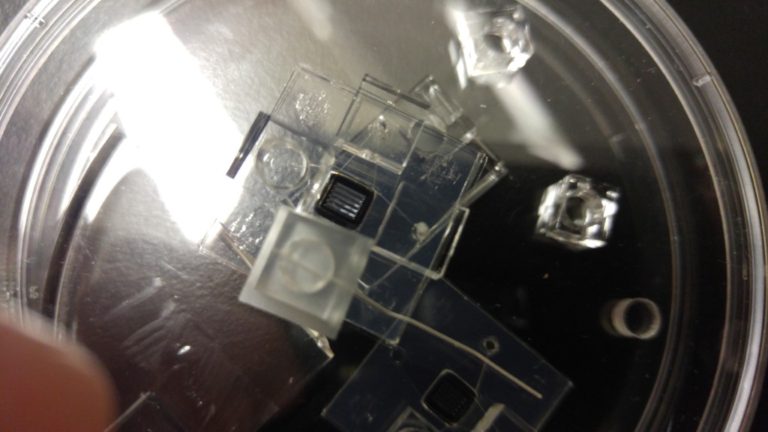
This blog post details how to assemble a variant of Jirachai’s microfluidic device (which looks like this): From its constituent parts (mostly this, two separate devices shown): Cutting the Gaskets You can find the template used to cut the 6 layers in Jirachai’s folder on the desktop mac in the computing alcove downstairs. The file…